
Domestic pepper prices
As of 11:30 AM today (August 4th), domestic pepper prices continued to be flat, listed at 139,000 VND/kg. Currently, key areas are trading in the range of 138,000 - 141,000 VND/kg.
Domestic pepper prices remain unchanged compared to the closing session yesterday in all regions. Currently, provinces and cities list prices as follows:
Gia Lai, Dong Nai and City. Ho Chi Minh simultaneously listed it at 138,000 VND/kg.
Similarly, Dak Lak and Lam Dong respectively offered for sale at the highest purchase price in the whole region of 141,000 VND/kg and 140,000 VND/kg.
World pepper price
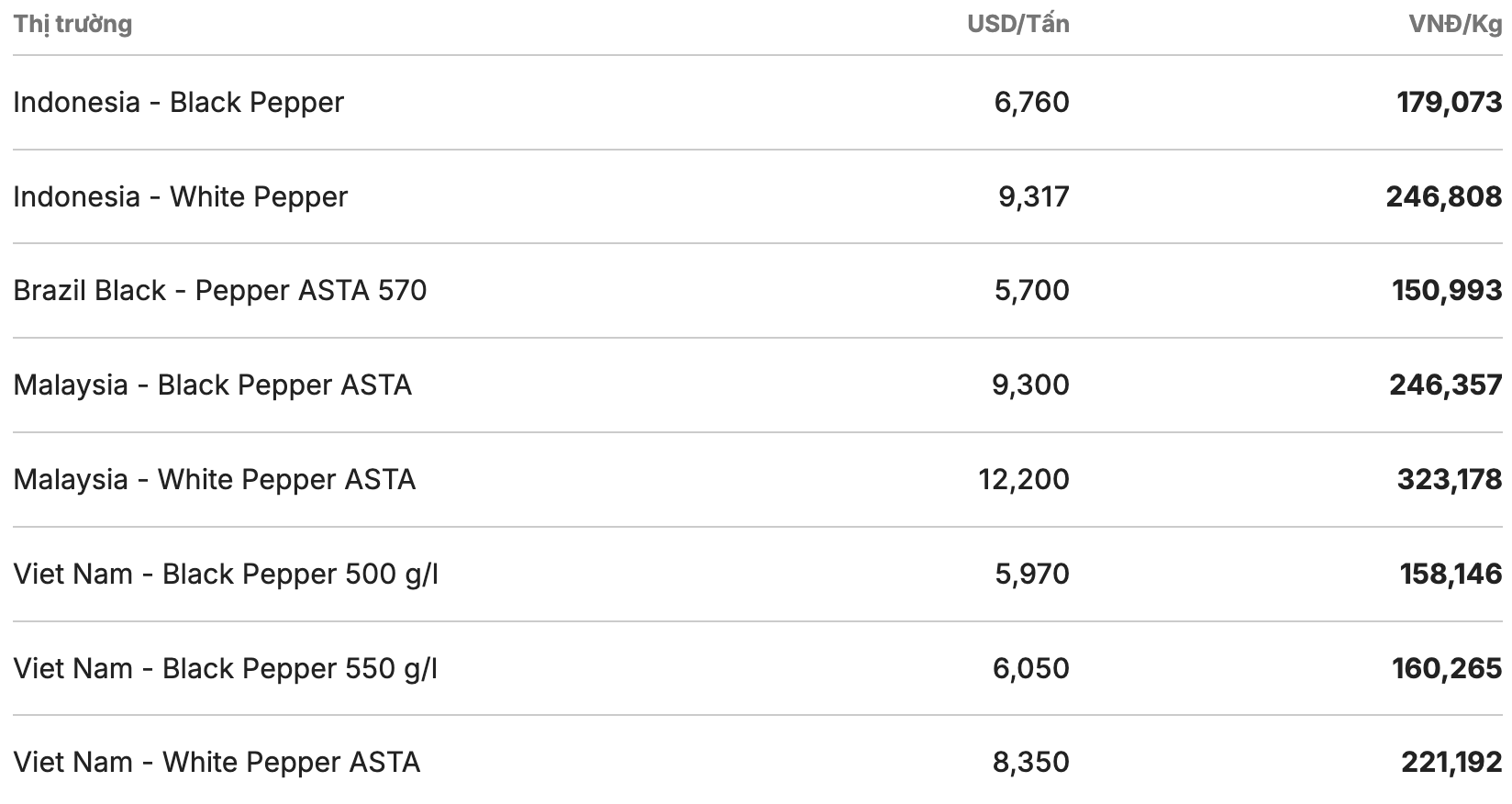
In the world market, pepper prices are stable in all countries. Indonesia's black and white peppers are no exception, trading in the range of 6,760 - 9,317 USD/ton (equivalent to 179,073 VND/kg - 246,808 VND/kg).
Meanwhile, the price of black pepper in Brazil sold to the market is 5,700 USD/ton (about 150,993 VND/kg). Notably, black and white pepper in Malaysia are still trading at high prices, respectively 12,200 USD/ton and 9,300 USD/ton.
In Vietnam's pepper export market, the price of black pepper of 500 g/l and 550 g/l remains unchanged at 5,970 - 6,050 USD/ton. ASTA white pepper is offered for sale at 8,350 USD/ton (equivalent to 221,192 VND/kg).
Assessments and forecasts
According to data from the Customs Department, in the second quarter of 2026, Vietnam's pepper export volume reached nearly 80,000 tons, an increase of 20.8% compared to the first quarter and an increase of 5.1% compared to the same period last year. In general, in the first 6 months of the year, Vietnam exported 146,003 tons of pepper, earning 950.2 million USD, an increase of 18.5% in volume and 12.1% in turnover compared to the same period in 2025.
Due to the impact of the conflict in the Middle East, pepper prices in the Vietnamese domestic market in the second quarter decreased by 4.6-5.4% (equivalent to 7,000-8,000 VND/kg) compared to the first quarter and the same period last year, down to an average of 138,500-141,000 VND/kg.
It is forecasted that in the short term, the global pepper market will continue to fluctuate due to intertwined impacts between limited supply and slow import recovery.


