
On the morning of August 24, the 16th National Assembly voted to pass the Law on Urban Development.
Exchanging about the meaning of the Law on Urban Development, Politburo Member, Secretary of the Ho Chi Minh City Party Committee Tran Luu Quang said that the city has participated in building the law early.
From March 2026, the Standing Committee of the Ho Chi Minh City Party Committee established a Steering Committee for research and development of the Special Urban Law, to summarize the implementation of Resolution 31 of the Politburo and form a stable and long-term legal framework to replace pilot mechanisms.
By July 2026, the Politburo will unanimously rename it to the Urban Development Law.
According to Mr. Tran Luu Quang, this change shows that the law not only meets the development requirements of Ho Chi Minh City but also aims to create a legal framework to guide the urban system and growth poles across the country.
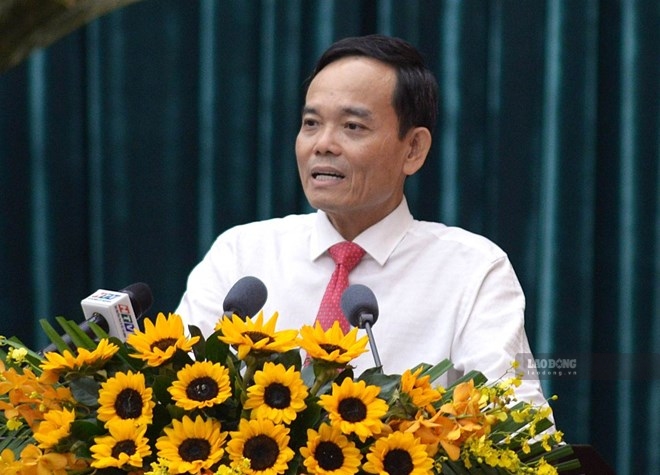
For Ho Chi Minh City, this can be seen as a'launchpad' for the city to more strongly exploit its potential and advantages, create momentum for rapid and sustainable growth, and at the same time better promote its leading role, leading the region and contributing more to the country" - Ho Chi Minh City Party Secretary said.
Greater rights must come with greater responsibilities
An important spirit of the Law on Urban Development is to strengthen decentralization, delegation of power, and granting greater initiative to Ho Chi Minh City.
According to Mr. Tran Luu Quang, the Urban Development Law provides about 240 contents for the People's Council, People's Committee and Chairman of the Ho Chi Minh City People's Committee to detail and expand the space for the city to proactively decide and organize the implementation of development issues.
The consistent spirit is "locality decides, locality does, locality takes responsibility". However, greater authority must go hand in hand with greater responsibility, with a "with valve, with lock" mechanism: pre-inspection by impact assessment, post-inspection by supervision, publicity and accountability, especially of the head.
Ho Chi Minh City also builds indicators to evaluate the effectiveness of governance and decentralization, towards periodic public disclosure to strengthen supervision.
The ultimate goal of decentralization and delegation of power is not for localities to have more power, but to make decisions faster, more practical and create better results" - Mr. Tran Luu Quang emphasized.
People must see fewer procedures, faster work
According to Secretary of the Ho Chi Minh City Party Committee Tran Luu Quang, the value of a law must be measured by the results that people and businesses "feel, see, grasp and are recognized".
For the people, it is a spacious city, convenient transportation, houses along rivers, canals, ditches and old apartments are renovated, construction order and fire prevention are guaranteed, and legitimate rights are better protected.
For businesses, it is to reduce time and costs; increase investment opportunities; streamline procedures; accelerate the appraisal of strategic projects, and at the same time create a transparent and predictable investment environment.
A good law is not just for people and businesses to read and understand. The important thing is that when the law comes into life, they must see more opportunities, fewer procedures, faster work and more and more solid trust" - Mr. Tran Luu Quang said.
These requirements are even more urgent as Ho Chi Minh City sets a double-digit growth target in 2026. In the first six months of the year, GRDP increased by 8.55%, the highest in the past 10 years. To complete the target for the whole year, the city needs to increase by about 11% in the third quarter and 11.8% in the fourth quarter.
According to Mr. Tran Luu Quang, Ho Chi Minh City cannot continue the old way of doing things but needs new thinking, new ways of doing things and substantive breakthroughs, especially in developing TOD, exploiting underground space, low-lying space, mobilizing social resources for infrastructure, developing international financial centers, free trade zones, logistics and new public-private partnership models.
The core thinking is to turn resources into development drivers, rationally exploit the added value of infrastructure for reinvestment, instead of just relying on the budget.
Ready to put new mechanisms into practice
Secretary of the Ho Chi Minh City Party Committee Tran Luu Quang said that the city determines not to wait for the law to take effect before starting preparations. Ho Chi Minh City has established a steering committee for implementation, mobilizing departments, branches and experts to review and prepare documents under its authority.
The implemented policies are divided into 4 groups: planning, resources, urban areas, environment and regional linkage; economy, finance, investment and science - technology; culture - society, social security; public service, apparatus, administrative procedures and human resource development.
According to Mr. Tran Luu Quang, when given more development space, Ho Chi Minh City has 3 commitments: Fast but sustainable growth, striving for double-digit growth; authority to what extent, responsibility and accountability to that extent; new policies must quickly go into life, creating substantial and measurable results.
Being given greater power also means being assigned greater responsibility. Ho Chi Minh City will not measure success by how much authority it is given, but what is important is what specific results it will produce with that authority and responsibility" - Mr. Tran Luu Quang emphasized.


