
Due to the impact of industrialization, digital transformation and the explosion of high-tech industries such as AI, data centers..., by 2030, energy demand in Vietnam will increase sharply. However, the energy industry is facing many challenges, when traditional supply decreases, projects are behind schedule, the legal system is not synchronized and there is a lack of financial mechanisms for large-scale projects...
4 bottlenecks hindering energy development
At the "Forum to Improve Policies to Create Competitive Advantages to Promote Energy Development", organized by Vietnam Economics Magazine/VnEconomy on August 11 and accompanied by Vietnam National Petroleum Group (Petrovietnam), Dr. Nguyen Hung Dung, Vice Chairman cum General Secretary of the Vietnam Oil and Gas Association, raised the reality that Vietnam's energy industry is increasingly large in scale, leading to rapid development pressure.
Among them, there are up to 4 policy bottlenecks hindering the development of the energy industry. First of all, the policy system is not synchronized, when a current energy project may simultaneously be subject to the adjustment of many laws: Electricity Law, Oil and Gas Law, Investment Law, Land Law, Law on Environmental Protection, Law on Marine Resources and many other guiding Decrees.
The second bottleneck is that the energy market is not fully developed, the competitive electricity market is only at a certain level. Electricity prices do not fully reflect market signals, price adjustments are slow. The output consumption mechanism and electricity purchase and sale contracts are not complete. Meanwhile, the gas and LNG markets have almost not been formed and lack a transparent legal framework, mechanisms to ensure capacity mobilization and long-term contracts, causing difficulties for attracting investment in LNG infrastructure.
The third bottleneck is that the development of power sources is not synchronized with the transmission infrastructure. The revised VIll power plan has set the goal of strongly developing the transmission, storage and smart grid system, but the mechanism to mobilize the private sector to participate in grid investment is still limited.
The fourth bottleneck according to Dr. Nguyen Hung Dung is the lack of policies for new energy industries. While many countries have issued national strategies on Hydrogen, CCUS, Sustainable Aviation Fuels (SAF), energy storage or carbon credits, in Vietnam, many fields still do not have technical standards, investment incentive mechanisms, pricing mechanisms or consumption markets.
Reviewing and completing policies is an urgent task
To make the energy sector truly become a driving force for national development in the new period, according to Dr. Nguyen Hung Dung, it is necessary to focus on three main groups of solutions. That is to improve institutions in a synchronous, stable and highly predictable direction. It is necessary to review all regulations related to energy investment, ensure consistency between the Electricity Law, the Oil and Gas Law, the Investment Law, the Land Law and specialized laws; and at the same time simplify investment procedures, shorten project preparation time.
It is necessary to fully build a competitive energy market according to the market mechanism with state regulation. Soon complete the electricity price mechanism, gas and LNG market, long-term electricity purchase and sale contracts, risk sharing mechanism, carbon credits and green financial instruments to attract private and international capital.
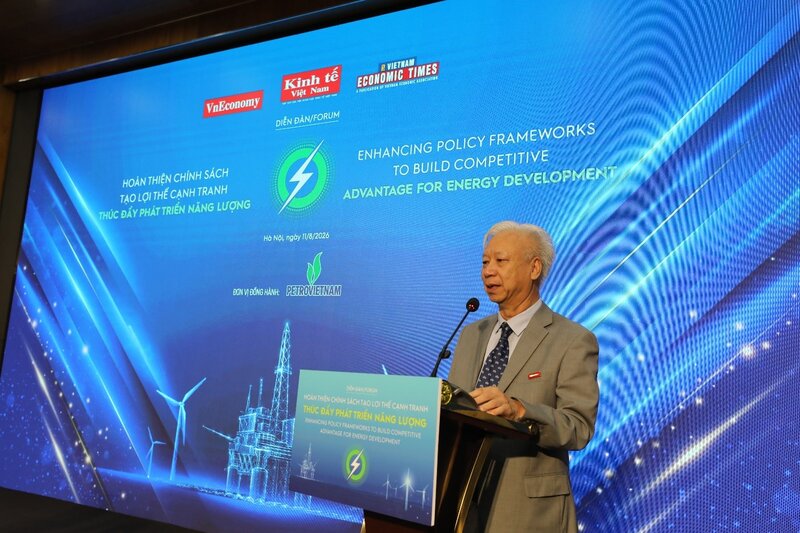
At the forum, Mr. Dao Quang Binh, General Secretary of the Vietnam Economic Science Association; Vice Chairman of the Editorial Council of Vietnam Economics Magazine/VnEconomy, the completion of policies to improve the competitiveness of the energy sector is not only to solve immediate requirements, but also to prepare for a new development cycle of the economy; for rapid, green and prosperous growth of the country.
Opinions at the forum unanimously agreed that reviewing and perfecting policies and removing institutional bottlenecks is an urgent task. Building a transparent, stable and highly competitive investment environment is a prerequisite for unlocking resources and ensuring national energy security. This is also an important foundation to promote Vietnam's energy industry to develop in a modern, green and sustainable direction in the future.


