
The program is accompanied by Vietnam National Petroleum Group (Petrovietnam).
Energy is the "blood vessel" of the economy, must go one step ahead to meet the requirements of rapid and sustainable growth. However, practice shows that the energy industry is still facing many bottlenecks in institutions and investment environment, requiring continued completion of synchronous, transparent, and stable policies, creating a foundation to promote sustainable development of the energy industry.
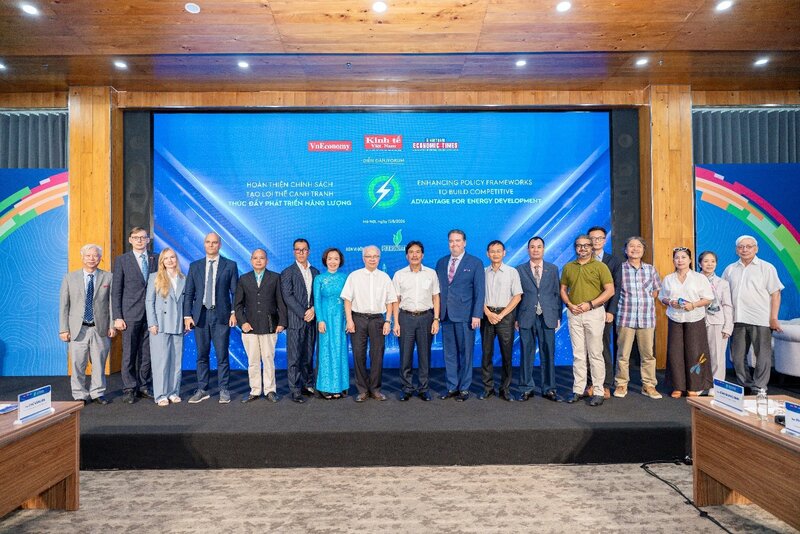
At the Forum, Mr. Dao Quang Binh - General Secretary of the Vietnam Economic Science Association - said that the world is entering a profound transition phase, leading to fundamental changes in the consumption structure and energy market. The development of artificial intelligence (AI), data centers, cloud computing, semiconductors and high-tech industries are increasing energy demand; while the commitment to net zero emissions, the requirement to ensure energy security and geopolitical fluctuations are promoting the process of restructuring the energy market at a faster pace.
To realize that goal, energy must go one step ahead, because without a safe, stable, diverse and sufficiently capable energy system to meet the needs of the economy, it is difficult to create a foundation for rapid and sustainable growth" - Mr. Binh emphasized.
Sharing the same view, Dr. Nguyen Hung Dung - Vice President cum General Secretary of the Vietnam Oil and Gas Association - said that energy is always considered the "blood vessel" of the economy. In the context of Vietnam setting a double-digit economic growth target, the requirement for the energy industry is not only to ensure sufficient electricity and fuel for production and life, but also to build a modern, competitive energy market, capable of adapting to the global energy transition and meeting greenhouse gas emission reduction commitments. This is both an opportunity to restructure the energy industry and a test for policy planning and implementation capacity.
Notably, according to the adjusted Power Plan VIII, by 2030, commercial electricity is expected to reach about 500.4 - 557.8 billion kWh; electricity production and import output will reach 560.4 - 624.6 billion kWh; the maximum capacity of the system is about 89,655 - 99,934 MW, nearly double the current capacity.
Similarly, offshore wind power is assessed to have a potential of about 600 GW, but so far no commercial projects have been implemented. Green hydrogen, green ammonia or carbon capture and storage technology are also only at the research and investment preparation level.
Analyzing specifically the barriers hindering the development of the energy sector, delegates said that the first bottleneck is the unsynchronized policy system. An energy project may simultaneously be subject to the adjustment of many laws such as the Electricity Law, the Oil and Gas Law, the Investment Law, the Land Law, the Law on Environmental Protection, the Law on Marine and Island Resources and Environment, and many guiding documents. Intersection or inconsistent regulations may prolong the preparation time for investment.
The second bottleneck is that the energy market is not fully developed. The competitive electricity market has only stopped at certain levels, while the gas and LNG markets have almost not formed. Electricity prices do not fully reflect market signals, and the price adjustment mechanism is still slow, making it difficult for investors to build long-term financial plans.
The next barrier lies in the lack of synchronization between power source development and transmission infrastructure. In the period when solar and wind power are strongly developed, many projects have been completed but cannot generate full capacity due to overload of the power grid. This situation not only causes damage to investors but also reduces the efficiency of using social resources. Meanwhile, the mechanism to mobilize the private sector to participate in grid investment is still limited.
Another gap is policy for new energy industries. Hydrogen, carbon capture and storage technology, sustainable aviation fuel, energy storage or carbon credits are being promoted by many countries, but in Vietnam, many fields still do not have sufficient technical standards, investment incentive mechanisms, pricing mechanisms or consumption markets. This makes it difficult for businesses to boldly invest, while financial institutions also lack a basis to evaluate project efficiency.


