
World gold prices fluctuated after the US released the latest economic data, in which Q2/2026 growth was significantly lower than expected. Although this information may strengthen the ability of the US Federal Reserve (Fed) to maintain interest rates, the precious metal has not yet formed a clear upward momentum.
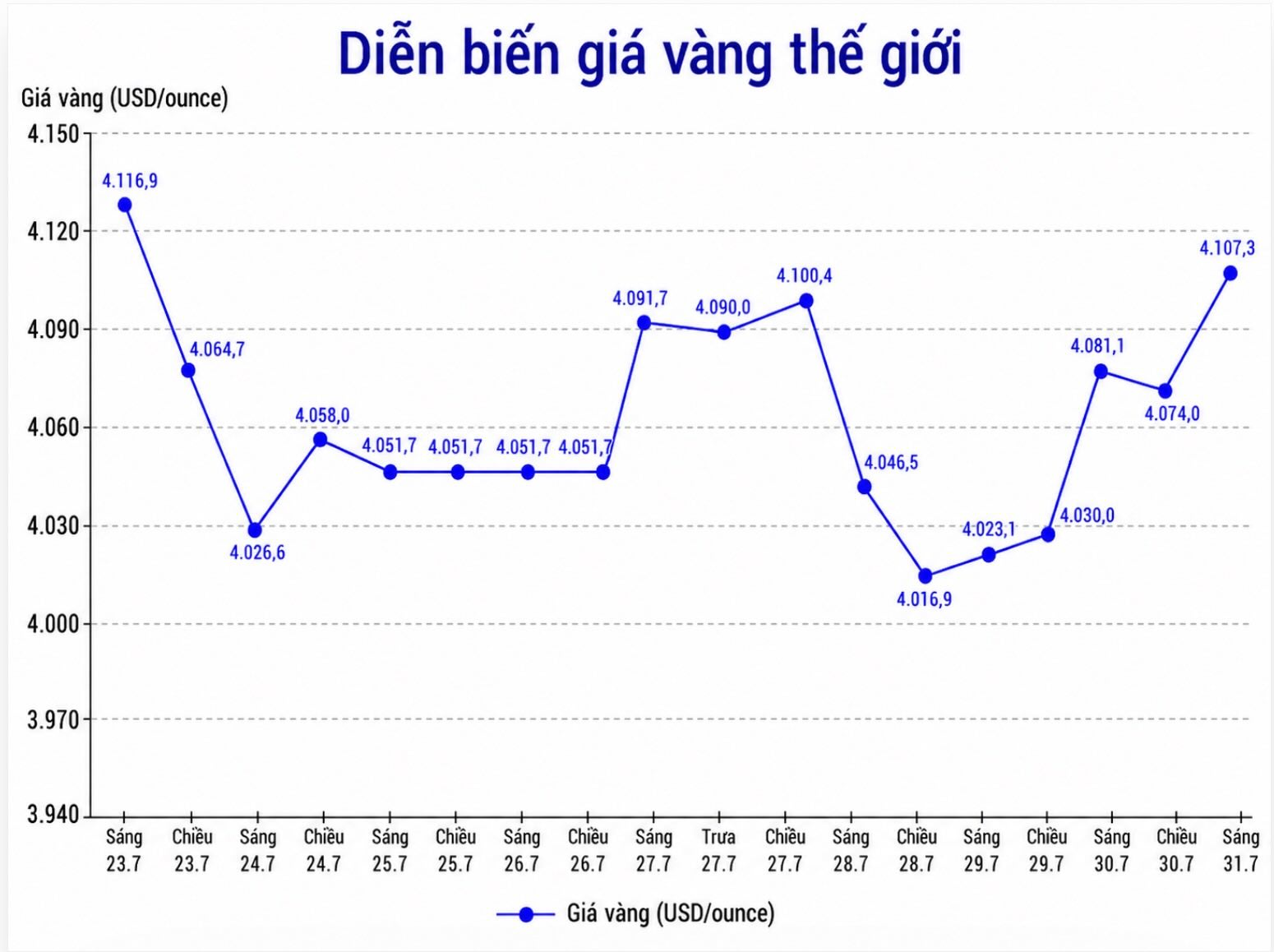
Before the opening of the North American market on July 30, spot gold prices were traded around 4,067 USD/ounce. After the data on growth, inflation and labor markets were announced, gold prices edged up to the range of 4,074-4,077 USD/ounce, equivalent to an increase of about 0.2-0.3% during the day.
The relatively cautious reaction of gold prices shows that US economic data is creating mixed signals for monetary policy prospects.
According to preliminary data from the US Bureau of Economic Analysis, the gross domestic product (GDP) of the world's largest economy increased by 1.5% in the second quarter of 2026, at an annual rate. This increase is significantly lower than the 2.1% of the first quarter, and does not meet the 2.1% forecast of economists.
The slowdown of the US economy mainly reflects the weakening of government spending, investment and exports. Personal consumption increased faster but only partially compensated for the negative impact from other components. Imports also increased more strongly than in the first quarter of the year.
Usually, lower-than-expected growth may support gold prices due to increased expectations that the Fed will maintain or ease monetary policy. However, this report also shows that price pressure is still high.
The GDP pricing index in the second quarter increased by 6.3%, much higher than the 3.6% increase in the first quarter and market forecasts. This raises concerns that inflation may still become a barrier to any policy changes by the Fed.
The June Personal Consumption Expenditure (PCE) price index data again brings a more positive signal. Core PCE, a measure of excluding food and energy prices, increased by 0.1% compared to the previous month, lower than the increase of 0.3% in May and the forecast of 0.2%.
Year-on-year, PCE inflation decreased from 4.1% to 3.7%, while core PCE slightly decreased from 3.4% to 3.3%. Personal income increased by 0.2%, and consumer spending increased by 0.3%.
Although inflation shows signs of cooling down, these indicators are still higher than the Fed's long-term target. Along with that, the yield of 10-year US Treasury bonds remained around 4.7%, increasing the opportunity cost of holding gold - an unprofitable asset.
Meanwhile, the US labor market also continues to show relatively good resilience. The number of initial jobless claims in the week ending July 25 increased by 9,000, to 197,000 claims. However, this figure is still lower than the forecast of 201,000 claims.
A stable job market is considered an important pillar for US consumption and the US economy. However, for gold, this is a factor that limits the upward momentum because the Fed has more room to focus on controlling inflation without having to worry excessively about recession or unemployment.
Previously, the Fed decided to keep interest rates unchanged. However, three members of this agency voted in favor of raising interest rates by another 0.25 percentage points. The above developments show that the Fed still maintains a tightening trend and is not ready to declare the anti-inflation war over.
In addition to monetary policy, gold prices are also affected by US-Iran tensions and transportation disruption risks in the Strait of Hormuz and the Red Sea. These factors support safe-haven demand, but at the same time push oil prices and inflation expectations up.
Technically, gold prices are fluctuating in the range of 4,028.4 - 4,101.1 USD/ounce. If it sustainably surpasses the 4,101.1 USD mark, the precious metal may head towards the thresholds of 4,114 USD and 4,166 USD/ounce. Conversely, if it falls below 4,028.4 USD, the support zone of 3,995.2 USD/ounce may be retested.
In the short term, gold price movements are likely to continue to depend on changes in interest rate expectations, bond yields and new signals related to US inflation.


