
Gold and silver prices are fluctuating sharply, buyers are flocking to trade. But besides direct buying and selling, a phenomenon is also appearing in some places: people spend money to buy gold and silver but do not receive assets immediately, but only hold a promissory note and wait for delivery later. Some people wait a few weeks, some have to wait a few months. Many people consider this normal, like "booking in advance to keep the price", or a form of "buying gold, paying first and receiving later".
But if you look closely, the biggest risk in "paper" gold and silver transactions does not lie in whether the price goes up or down, but lies in a much simpler question: what is the buyer actually holding?
In common thinking, spending money to buy gold is naturally "already having gold". But legally, that is not entirely true. When the buyer only holds the appointment slip but has not received the asset, in many cases they do not have the right to own gold, but only have the right to request the seller to deliver the gold in the future. In principle, asset ownership usually only arises when the asset has been delivered or established according to a specific agreement, not just because money has been paid.
This difference is easily overlooked when everything goes smoothly. Buyers trust, sellers deliver on time, and the transaction ends. But when there are problems, such as delivery delays, no delivery, or sellers encounter financial problems, the boundary between "already have assets" and "only have the right to request" immediately becomes very large.
At that time, buyers cannot simply "get back gold and silver", because in reality they have never held gold and silver. They can only ask the seller to fulfill their obligations, or if not, they must dispute. And civil disputes are often prolonged, costly, and the result is not always as certain as initially expected.
Not all transactions of this type have problems. But risks will arise if buyers do not clearly understand the legal nature of the transaction. This is the core risk point of buying gold "on paper": the risk is not in the price, but in the legal structure of the transaction.
When the asset has not been handed over, all rights of the buyer depend on whether the seller fulfills the obligation or not. Without guarantee mechanisms such as margin, guarantee or an intermediary standing out to control the transaction, most of the risk will fall on the buyer. The appointment slip at this time is only evidence of an obligation to be fulfilled, not necessarily evidence of a secured asset.
Looking deeper, many such transactions are actually no longer purely buying and selling, but have the appearance of a credit relationship hidden under the form of buying and selling: the buyer hands over the money first, and the handover of assets depends entirely on the seller's ability to fulfill obligations in the future.
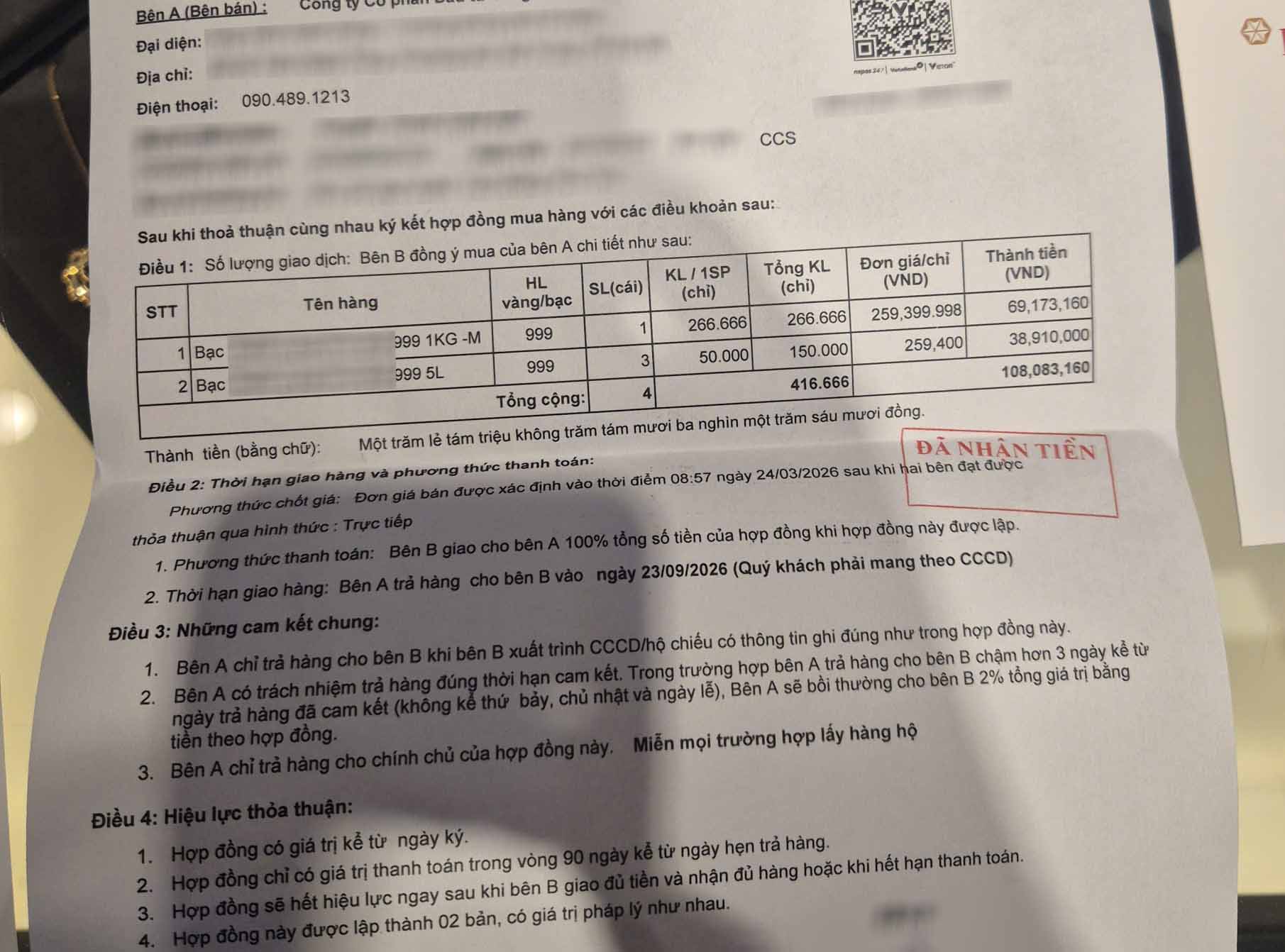
Another misconception that is also emerging is that many people think these transactions are like "term transactions". Listening to it seems reasonable, because both are paying first and receiving goods later. But in reality, these two types are very different.
A true term market is not simply a post-contract. It must have a complete system attached: Standard contracts, margin mechanisms, clearing and settlement, risk management and supervision by regulators. These factors create safety for participants.
Meanwhile, most of the gold and silver transactions "on paper" today are just civil agreements between buyers and sellers. There is no common control mechanism, no independent intermediary organization, no risk diversification system. Therefore, if this is considered a "term transaction", it is easy to create a feeling of security that is not true to reality.
The biggest difference between these two types of transactions does not lie in gold or silver, but in the way risks are handled. In an organized market, risks are controlled by a system. In "paper" transactions, risks often focus on the relationship between the two parties, and buyers are often the disadvantaged party if an incident occurs.
Looking broader, the phenomenon of buying gold but not receiving gold shows a familiar thing: the market always goes faster than the law. That does not mean that all new transactions are wrong, but when transactions go ahead of the ability to adjust by the law, participants need to understand its nature even more clearly.
Before spending money, the important question is not only whether gold prices will increase or decrease, but what power you are actually holding, whether that power is certain, and if disputes occur, what mechanism will protect you.
In "paper" gold transactions, the most dangerous thing is not the volatile market, but the fact that buyers do not know exactly whether they have assets, or are only holding a claim.
The biggest risk does not lie in gold prices, but in the fact that buyers do not know they are holding assets - or just holding a promise.


