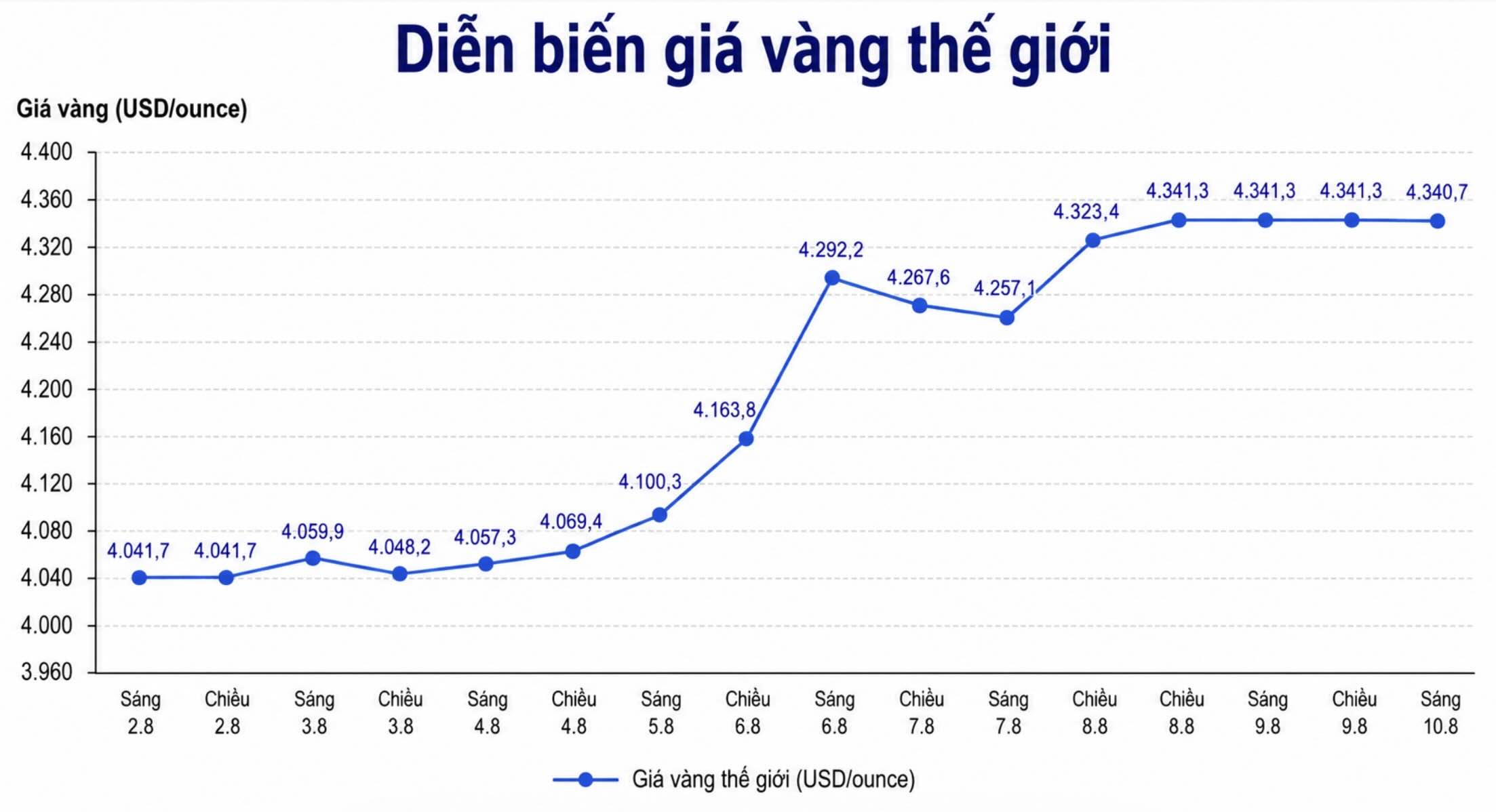
After a week of strong increases to nearly 300 USD/ounce, the gold market is facing a new test when this week's economic calendar is packed with reports that could change expectations about the monetary policy of the US Federal Reserve (Fed).
The biggest focus is still on US inflation, in the context that the market has just received a significant weakening signal from the labor market. The report released on August 7 showed that the number of non-farm jobs in the US decreased by 23,000 in July, while the unemployment rate was 4.1%. Notably, the number of jobs in May and June was also adjusted down a total of 103,000 compared to previous estimates.
Weak labor data reduces pressure for the Fed to continue to tighten its grip, thereby creating a more favorable environment for gold. However, the ability of precious metal prices to maintain their upward momentum will depend significantly on the answer from inflation in the coming days.
CPI becomes the biggest "gateway" for gold
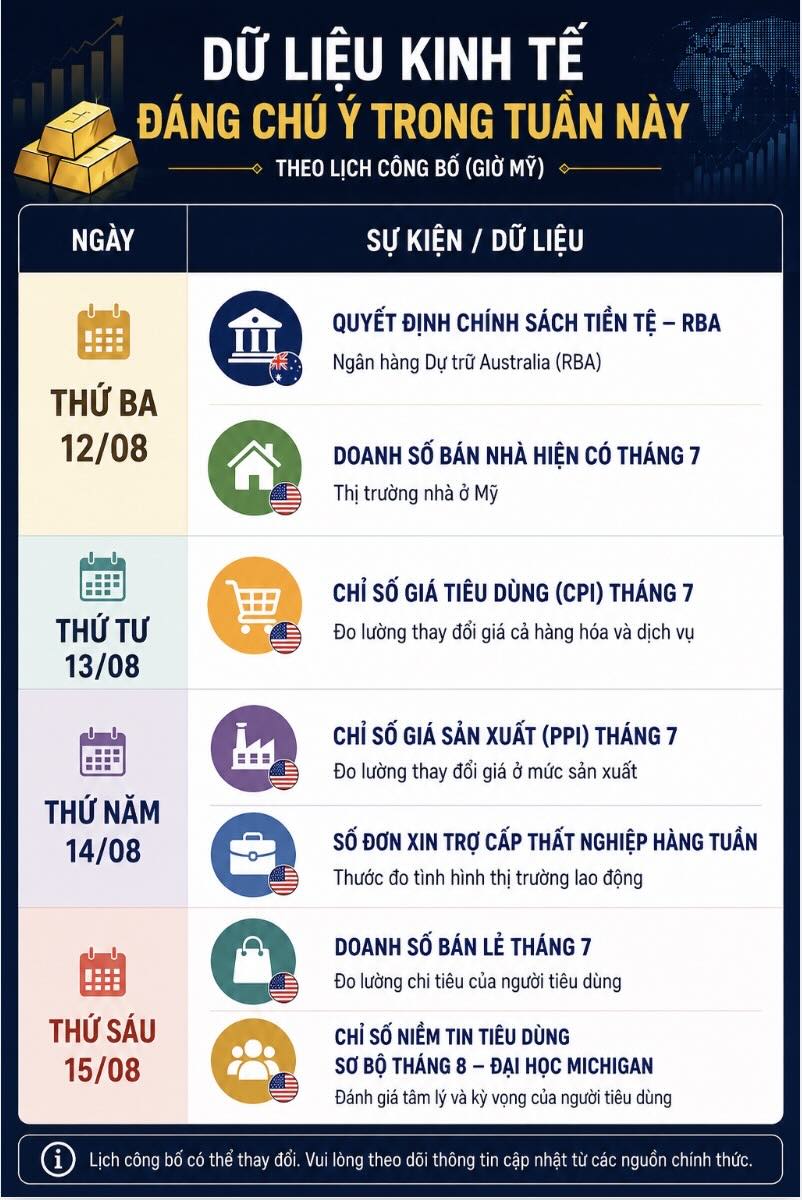
On August 11, the market will first follow the monetary policy decision of the Reserve Bank of Australia (RBA). The policy meeting takes place on August 10-11. 8 and the decision is announced on August 11. 8.
On the same day, the US announced existing home sales in July. This is not the data that usually causes the biggest fluctuations for gold, but it may provide more signals about the health of the economy and the impact of high interest rates on demand. The US National Association of Realtors confirmed the report was released on August 11.
Attention will increase sharply on August 12, when the US releases the Consumer Price Index (CPI) for July. According to the schedule of the US Bureau of Labor Statistics, the report was released at 8:30 AM in the Eastern United States.
This may be the most important data for gold this week.
If the CPI continues to show persistent price pressure, the market may rebound to expectations of the Fed raising interest rates. Bond yields and the USD are then likely to be supported, putting pressure on gold - an asset that does not bring yields.
Conversely, a lower-than-expected inflation report will reinforce the view that the Fed may continue to stand aside. This scenario could open up more room for gold to challenge the 4,400 USD/ounce zone and further the 4,500 USD/ounce zone.
Previously, at the meeting on July 29, the Fed kept the target interest rate at 3.5-3.75%, but still emphasized inflation higher than the target of 2%. Notably, 3 members voted in favor of raising interest rates by another 0.25 percentage points.
Series of consecutive data may cause gold prices to fluctuate sharply
Pressure on the market has not ended after the CPI. On August 13, the US continued to announce the Producer Price Index (PPI) for July along with weekly jobless claims. The official US schedule confirming the PPI was announced on the morning of August 13 local time.
PPI will help investors assess price pressure in the production stage. If both CPI and PPI are higher than expected, concerns about prolonged inflation may return quickly, increasing the risk of profit-taking in the gold market after the recent strong increase.
By August 14, the focus shifted to US retail sales and the preliminary consumer confidence index of the University of Michigan. The US Bureau of Statistics scheduled to release retail sales for July on this day, while the University of Michigan also released a preliminary consumer confidence survey for August.
Strong retail sales may show that US consumers are still strong enough to withstand high interest rates, thereby giving more room for the Fed to maintain a tough stance. Conversely, weakening consumption and cooling inflation will strengthen the story of economic slowdown, a factor that may continue to support gold.
After last week's rapid increase, the 4,400-4,500 USD/ounce area is becoming a noteworthy test zone. The upward momentum may be maintained if data reinforcing the Fed's outlook does not continue to raise interest rates. However, higher-than-expected CPI or PPI may also trigger strong profit-taking activity.
Thus, instead of a clear trend from the beginning of the week, gold may experience many fluctuations when each data is released one by one. Among them, CPI on August 12 is likely to play the most important "shot" role for the next direction of the precious metal.
The article only reflects market developments, not investment recommendations.