
Gold prices surge as the USD weakens
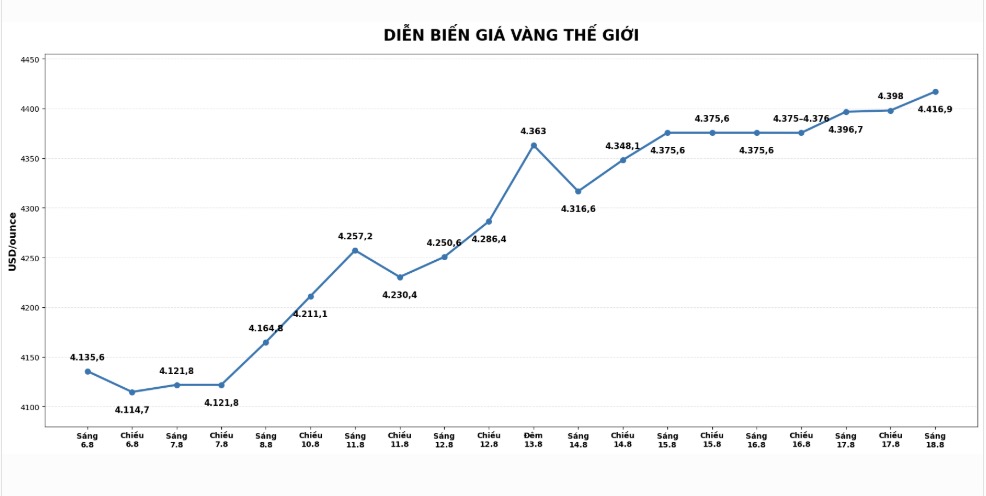
Last night, world gold prices simultaneously increased. At the time recorded (6:20 AM on August 18 - Vietnam time), world gold prices were listed around the threshold of 4,416.9 USD/ounce.
The upward momentum of precious metals is mainly supported by the weakening of the USD and the market's downward expectations that the Fed will continue to raise interest rates at the September meeting.
Previously, at the beginning of the trading session in the US, gold prices fluctuated around 439.7 USD/ounce, up 0.44%. Thus, buying power continued to increase in the following hours, helping gold significantly expand its increase.
US economic data released last week generally made investors more cautious about the possibility of the Fed raising interest rates. July retail sales were lower than forecast, the consumer price index (CPI) cooled down, the overall producer price index (PPI) moved sideways, and consumer sentiment weakened.
These signals contribute to reducing the market's ability to bet on a new interest rate hike in September. According to Kitco, the market currently only values about 30-31% of the Fed's ability to raise interest rates in September.
However, the latest data from the US manufacturing sector is sending a more positive signal.
The Empire State Survey by the New York Fed showed that the general business performance index in August increased 5 points to 20.6, the highest level in more than 4 years.
The new order index reached 17.3; the delivery index reached 11.7. Notably, the input price index increased by 6 points to 58.6, showing that cost pressure has not completely disappeared.
This makes the monetary policy outlook for the Fed continue to be unpredictable.
Rising oil prices put pressure on the market
Another factor that is significantly impacting gold prices is the strong developments of the oil market.
WTI crude oil prices on the Nymex exchange rose to around 84.58 USD/barrel, while Brent oil traded nearly 90.87 USD/barrel.
The upward momentum of oil prices raises concerns that inflationary pressure may return, thereby pushing US government bond yields up.
The yield of 10-year US government bonds at one point approached 4.73% and continued to fluctuate around the 4.7% range.
This is an unfavorable factor for gold because precious metals do not yield yields. When bond yields are high, the opportunity cost of holding gold increases.
Therefore, the gold market is being affected in opposite directions. The weakening USD and expectations of the Fed raising interest rates falling down support gold prices, while high bond yields limit the possibility of breakthrough.
The Strait of Hormuz continues to be the focus
Tensions related to the Strait of Hormuz continue to be one of the important geopolitical factors affecting oil prices, inflation expectations and safe-haven asset demand.
The peace negotiation process between the US and Iran has not made much progress, while oil transportation through the Strait of Hormuz sharply decreased at the end of the week.
For gold, this development creates a two-way impact.
Risks to transportation and geopolitical instability boost defense demand, thereby supporting gold. Conversely, high oil prices increase the risk of inflation, making it difficult for bond yields to fall sharply and becoming a drag on precious metals.

Investors await Fed meeting minutes
The next focus of the market is the minutes of the Fed's July meeting, scheduled to be released at 2 pm on August 19 US Eastern time.
The market will closely monitor the content of the minutes to find more clues about the views of Fed officials on inflation, growth and interest rate orientation in the coming months.
After that, data on the housing market and the preliminary PMI index of the US released at the end of the week may also create more fluctuations for the USD, bond yields and gold prices.
Technically, gold buyers are aiming to bring prices above the resistance zone of 4,447.66 USD/ounce. If maintained above this threshold, the next targets are at 4,533.68 USD/ounce and 4,571.83 USD/ounce respectively.
In the opposite direction, the near support zone is defined at 4,326.22 USD/ounce. If this threshold is broken, gold prices may head towards 4,275.62 USD/ounce and deeper to 4,189.60 USD/ounce.
The article updates market developments, not investment recommendations. Investors need to carefully consider risk factors before making a decision.


