
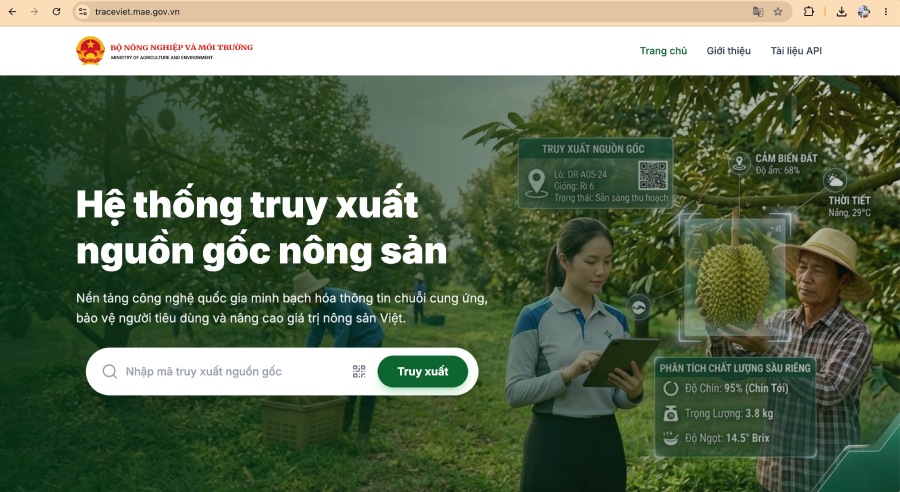
On July 1, 2026, the Ministry of Agriculture and Environment officially put into operation the Common Agricultural Product Traceability System nationwide. This shows the determination of the Ministry of Agriculture and Environment to take data as a foundation to serve quality management, ensure food safety, market development and enhance the reputation and value of Vietnamese agricultural products.
This is considered an important step in the digital transformation process, contributing to making the value chain of Vietnamese agricultural products transparent.
After nearly 2 months of operation, the agricultural origin traceability system has received many positive reviews from businesses and farmers. Talking to Lao Dong Newspaper, Mr. Dao Van Toan - Deputy Director of Hao Dat Tea Cooperative (Thai Nguyen) - said that after about 2 months of implementation, Hao Dat Tea Cooperative assessed that the origin traceability system is necessary and meaningful in transparentizing the production process, from raw material areas, care, harvesting, processing to product packaging.
The system helps businesses manage production data better, and also creates more trust for customers when they can check the origin of products," Mr. Toan shared.
Also according to Mr. Toan, in the initial stage, the system still needs time for businesses and employees to get used to data entry, information standardization and maintain full and accurate data.
According to Assoc. Prof. Dr. Nguyen Dinh Tho - Deputy Director of the Institute of Agricultural Policy Strategy and Policy (Ministry of Agriculture and Environment), traceability has become a mandatory requirement for agricultural product import markets, especially the European Union and China - 2 major markets for Vietnamese agricultural products. Therefore, building a common traceability system has helped reduce implementation costs for farmers and businesses.
Besides the significance of the common agricultural origin traceability system nationwide, some businesses also share the biggest difficulty today is the relatively large data entry, while production activities take place regularly and have many stages.
Businesses also proposed that in the coming time, the system should continue to simplify data entry operations, have specific instructions, be easy to use on the phone and have the ability to interlink with production and sales management software that businesses are using. At the same time, they hope that there will be more direct training sessions and regular technical support, then businesses will be more convenient in the implementation process.
The agricultural origin traceability system built by the Ministry of Agriculture and Environment includes 3 main components, including: Component for people to look up information; management component serving management agencies, businesses and chain participants; application installed on mobile phones and smart devices.
Developed in a modern, service-oriented architecture and with flexible expansion capabilities, the agricultural origin traceability system ensures continuous operation, meeting the requirements of a national common platform in the agricultural sector.
An important new point of the system is the ability to authenticate, be transparent and ensure data integrity through electronic digital signatures, blockchain technology; product identification according to GS1 international standards, QR code according to GS1 Digital Link; data exchange according to unified standards, creating conditions for many solution units to participate, regardless of a single technology provider.


