
World gold prices are receiving many positive signals after a period of strong fluctuations. Some experts believe that although the market is still interspersedly affected by geopolitics, the USD, interest rate expectations and US economic data, the technical outlook for gold has not deteriorated. Conversely, if it surpasses important resistance zones, this precious metal may open a new wave of increase.
Mr. Marc Chandler - Managing Director of Bannockburn Global Forex - said that gold has recovered along with risky assets in the context of the market expecting a ceasefire in the Middle East to be extended.
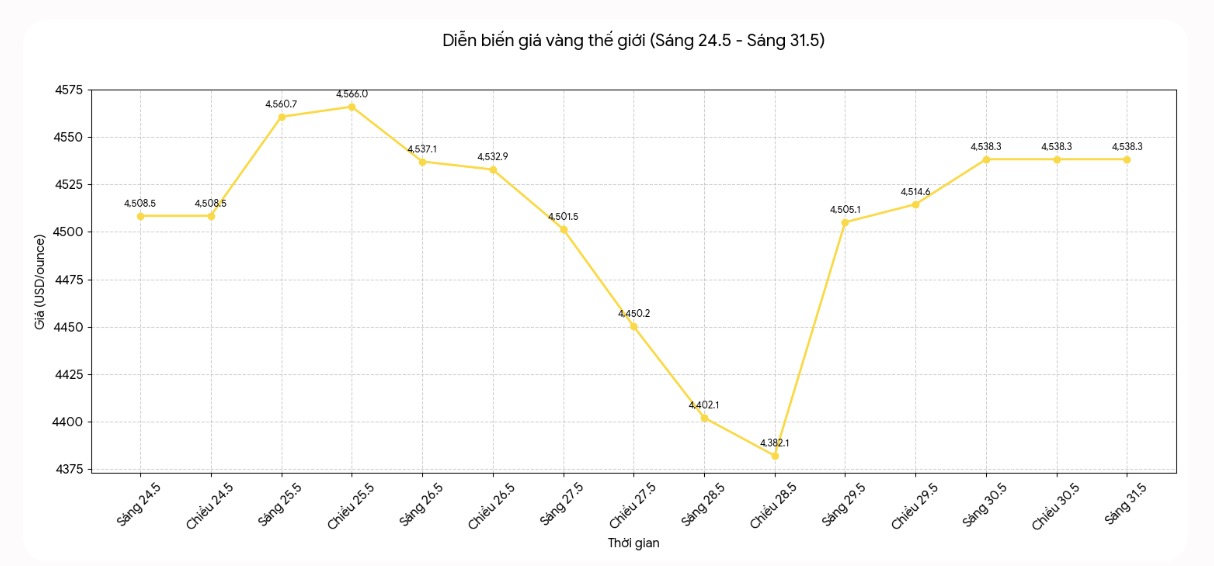
According to him, gold was once sold below the 200-day moving average in the session, for the first time in 2 years, but then quickly recovered and increased to a 3-day high, slightly higher than 4,543 USD/ounce.
This development shows that buying power still appears in low price zones. Mr. Chandler believes that extending the ceasefire can be understood as a positive factor for gold, because this helps eliminate a potential source of liquidation pressure in the market. According to this expert, if gold prices exceed the 4.585 USD/ounce zone, the technical signal of the precious metal will be improved more clearly.
This assessment has similarities with the viewpoint of Mr. Lukman Otunuga - Senior Director in charge of market analysis at FXTM.
He believes that although the temporary extension of the Iran-US ceasefire helps the global market feel somewhat relieved, gold continues to rise along with stocks. This shows that gold is currently not only reacting to geopolitical factors but also heavily influenced by the USD and interest rate expectations.
According to Mr. Otunuga, Brent oil prices are heading towards the strongest monthly drop since 2020, which may ease inflation concerns. If this development weakens the USD, gold may receive more momentum next week.
FXTM experts noted that the US May jobs report will be important data, because a weak report could increase expectations that the US Federal Reserve (Fed) will be less tough on interest rates.
Technically, Mr. Otunuga said that gold is rising on the daily chart after rebounding from the 4,450 USD/ounce range. If it rises above the 21-day moving average, the price may head towards the 50-day moving average around 4,625 USD/ounce. Conversely, if weakened below 4,450 USD/ounce, gold may retreat to the 4,400 USD/ounce range - equivalent to the 200-day moving average.
Meanwhile, Jonathan Da Silva from Kitco Media also gave a positive perspective on gold. He believes that gold is still likely to return to the 5,000 USD/ounce zone if it breaks out of the parallel channel. Although this scenario has not yet taken place, he still has a certain confidence in the possibility that gold prices may increase again.
According to Jonathan Da Silva, gold prices are currently being compressed between the 200-day moving average and the resistance line above the price channel. A session closing above 4, 510 USD/ounce will help the upward scenario continue to be maintained. Conversely, if the price closes below 4, 500 USD/ounce, the probability of gold increasing in the short term will need to be reconsidered.
Notably, this expert believes that the weekly chart of gold is quite positive. The stochastic indicator on the weekly frame is in an oversold state, while the price is supported at the 50-week moving average line. The weekly candlestick is also forming a "hammer" pattern, which may become a higher bottom than the 4th-zone test of $100/ounce at the end of March.
The common point in the above assessments is that gold is still facing an important decisive zone. Experts have not confirmed that the upward trend has been fully confirmed, but all believe that technical support is still there and the levels of 4, 510 USD/ounce, 4,585 USD/ounce, 4,625 USD/ounce or further, 5,000 USD/ounce will be areas that need to be monitored.
In the short term, gold prices may continue to fluctuate strongly as the market waits for more US economic data, especially indicators on labor and inflation. A series of weak data may increase expectations that the Fed will shift to a more moderate stance, thereby supporting gold. Conversely, if economic data is positive, the USD and US Treasury bond yields may increase, putting pressure back on the precious metal.


