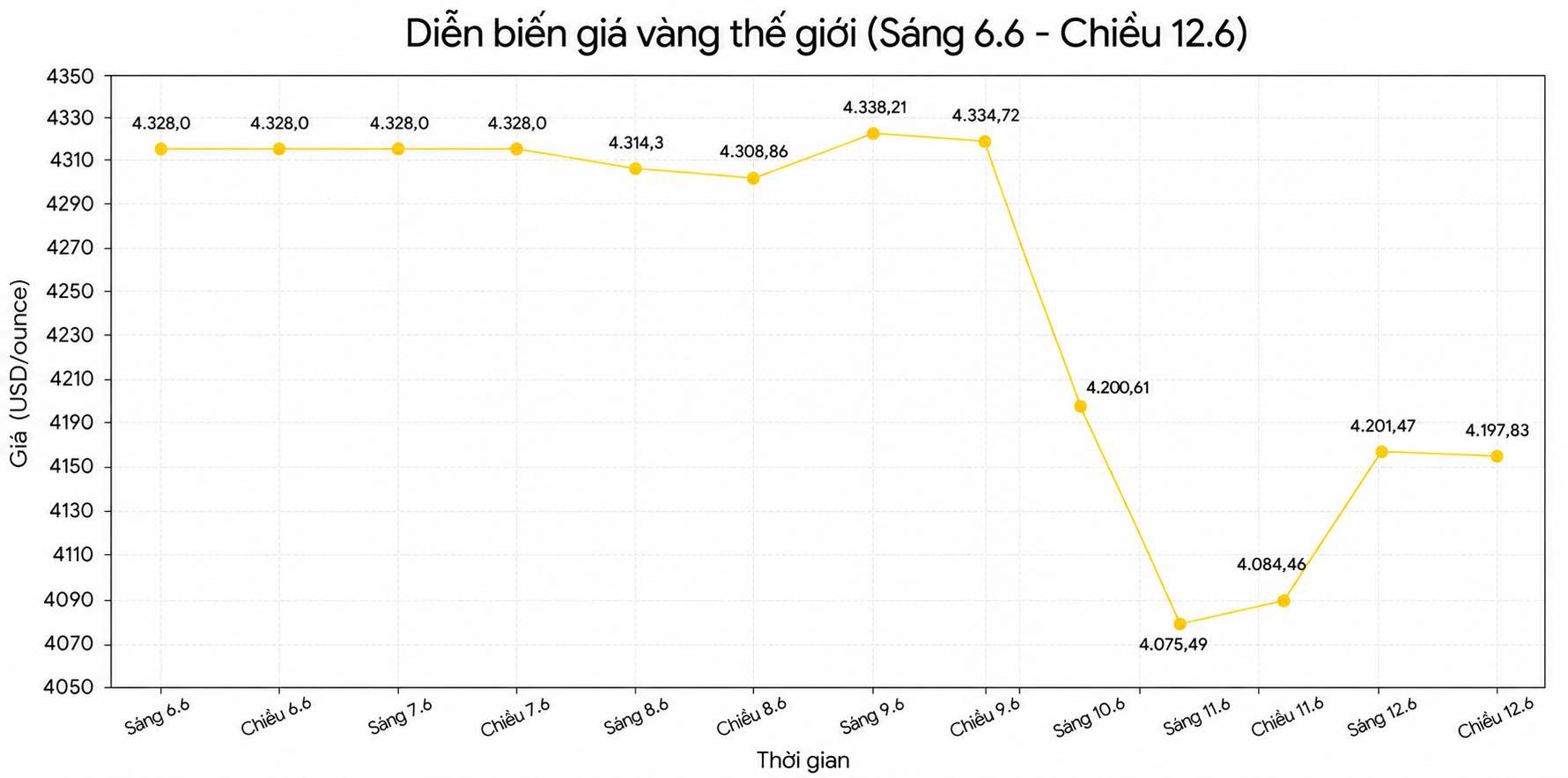
Gold prices fell slightly in the last session of the week and are heading towards their second consecutive week of decline as investors continue to be cautious in the face of inflationary pressure and global interest rate outlook.
The precious metal at one point decreased by 1%, to nearly 4,170 USD/ounce in the June 13 session, thereby extending the weakening momentum despite a slight recovery in the previous session. Overall for the week, gold prices are on a downward trend of about 3.5%.
Mr. Ole Hansen - Head of Commodity Strategy at Saxo Bank said that the market is becoming more cautious in the face of short-term information and focusing more on factors directly affecting inflation and monetary policy.
Before the market can return to focusing on long-term supporting factors, investors need to see a clear signal that inflationary pressure is being controlled. Until then, gold price movements are likely to still be greatly affected by short-term trading sentiment," he said.
One of the factors putting pressure on gold is the expectation that interest rates will continue to remain high. The European Central Bank (ECB) has just raised interest rates for the first time in nearly three years, while many other major central banks still maintain a cautious stance in the face of inflation risks.
High interest rates increase the opportunity cost of holding gold - an asset that does not yield yields - thereby reducing the attractiveness of the precious metal to investors.
From the end of February to now, gold prices have decreased by about 20%. The decline was further accelerated after gold broke through the 200-day moving average - a long-term technical threshold closely monitored by investors. In the session of June 12, gold prices once retreated close to the 4,000 USD/ounce mark before recovering again.
Mr. Carsten Menke – Head of New Generation Research at Julius Baer said that most of the recent selling pressure stems from changes in market technical trends.
We believe that the current selling pressure mainly comes from the reversal of technical trends," he said.
Julius Baer has now lowered its gold price forecast for the next 3-12 months to the 4,250-4,500 USD/ounce range.
In the opposite direction, analysts believe that investment demand for gold has not completely disappeared. The Chicago Mercantile Exchange (CME) recently announced a plan to deploy 1-ounce gold futures contract trading continuously 24 hours a day and 7 days a week from July 26.
This move reflects the increasing demand of investors for the gold market and related derivatives.
In other precious metals markets, silver prices fell 0.9% to 66.71 USD/ounce, while platinum and palladium both increased in price. The Bloomberg Dollar Spot Index increased 0.2%, continuing to put pressure on gold.