
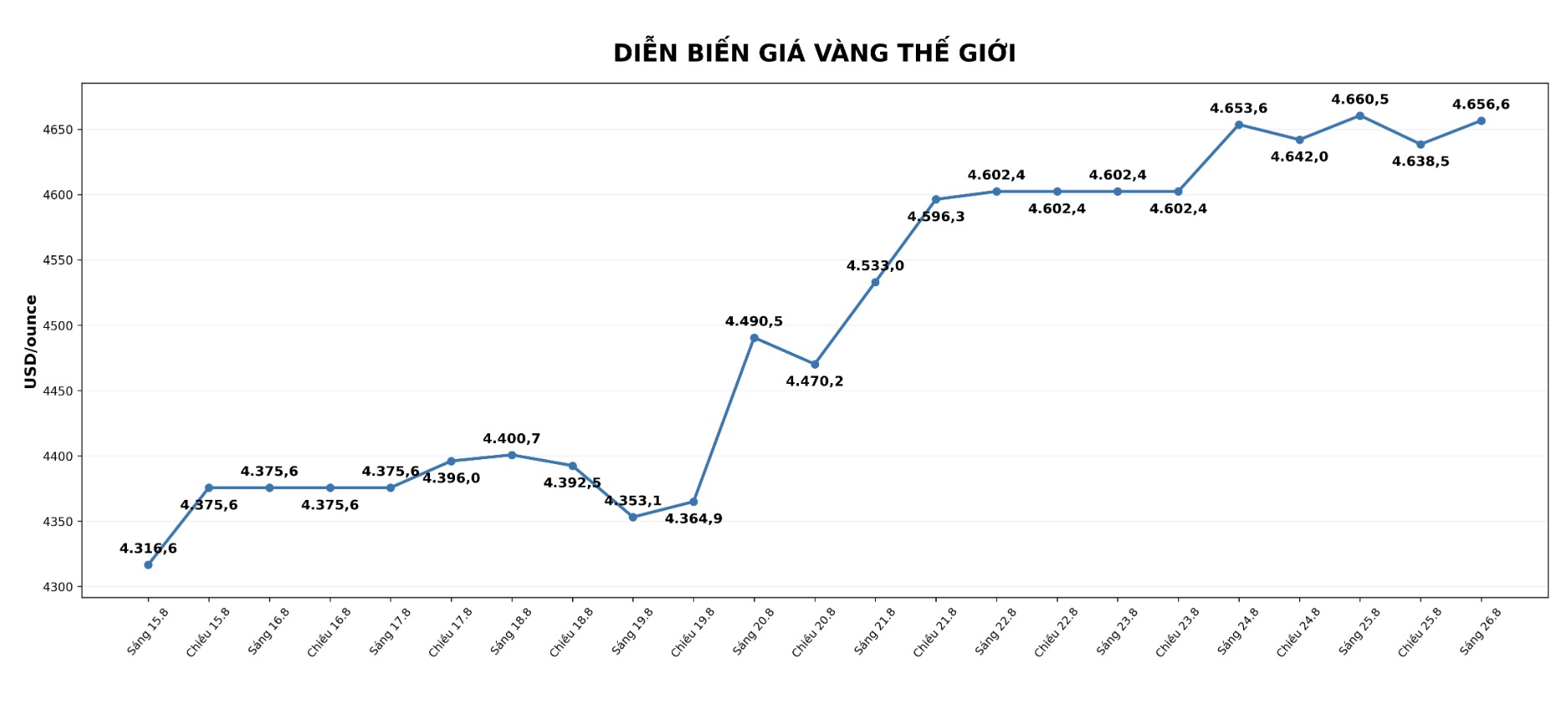
World gold prices are maintaining an upward trend. Although the upward momentum is showing signs of slowing down as the market is waiting for new monetary policy signals from the US Federal Reserve (Fed), the price is still fluctuating around the threshold of 4,650 USD/ounce.
In the most recent trading session, December gold futures contracts recorded a seventh consecutive session creating a new peak on the daily price chart. Although the closing price was almost unchanged compared to the previous session, gold futures still stood firm above the important technical support zone around 4.692 USD/ounce.
This is the level corresponding to the Fibonacci retreat threshold of 38.2% - a tool used by many investors to determine the support and resistance areas of the market. Maintaining above this price range shows that buying power is still present, although the upward momentum has somewhat weakened.
Another notable factor is the 200-day moving average of gold prices currently at around 4,635 USD/ounce. Previously, this average used to play a role as a resistance zone that made it difficult for prices to overcome, but recently it has turned into a support zone.
The fact that gold prices simultaneously stand on two important technical foundations, including the Fibonacci threshold and the 200-day moving average, helps the market have more support, limiting the risk of a deep decline in the short term.
Bragging signal appears
The latest trading session created a Doji candlestick on the gold price chart - a candlestick that usually appears when buyers and sellers are in a balanced state.
In technical analysis, the Doji candlestick shows market hesitation when the opening and closing prices are almost equivalent. The appearance of this candlestick after a strong rally shows that investors are more cautious and have not clearly defined the next direction.
However, the appearance of the Doji candle is not enough to confirm that gold prices will reverse downwards. This is just a sign that the market is lacking consensus when buyers and sellers temporarily balance. If a sharp decline appears in the next trading sessions, erasing most of the increase of the previous session, gold prices may form a "sao hom" pattern - a technical signal often seen as a warning that the upward trend is weakening and the possibility of prices entering a correction phase may appear.
However, the possibility of gold having large fluctuations immediately is assessed as not high, as investors are turning their attention to the Jackson Hole Symposium taking place this week.
Silver prices recover strongly
While gold is temporarily stagnant, silver prices are showing signs of recovery after recent declines.
At the time of writing the article (9:00 AM on August 26 - Vietnam time), spot silver prices increased by about 0.92% to 69.16 USD/ounce. The diễn biến of silver is closely monitored by the market because the difference in strength between gold and silver at important times may provide a signal about the next trend of the precious metal group.
If silver continues to maintain its recovery momentum, this could be a psychological support factor for the entire precious metal market.
Market awaits Fed Chairman's speech
The focus of attention now lies in the Fed Chairman's speech at the Jackson Hole Conference. Although the next Fed monetary policy meeting is about a month away, investors still expect this event to provide more clues about the interest rate orientation in the near future.
According to CME Group's FedWatch interest rate tracking tool, the market currently assesses the possibility of the Fed raising interest rates in the September meeting at 40%. Any signal from the Fed Chairman that changes this expectation could strongly impact the USD and USD-valued assets, including gold and silver.
Currently, the gold market is in a waiting state. Technical signals show that the upward trend is still maintained, but investor caution is increasing in the face of important information about US monetary policy.
The article only updates market developments, not investment recommendations. Investors need to carefully consider risk factors before making a decision.


