
World gold prices are being affected by two opposing factors. On the one hand, US interest rates remaining at a high level along with inflation signals put pressure on gold. On the other hand, concerns related to budget deficits and the risk of weakening the value of the USD still help the precious metal maintain its attractiveness.
In the last three trading sessions, gold prices have continuously reversed direction, strongly struggling above the threshold of 4,600 USD/ounce. It can be seen that the upward momentum of gold is not really sustainable as the market is still re-evaluating the prospects of US monetary policy. Inflation in the US, although cooled down compared to the previous period, is still maintained higher than the US Federal Reserve (Fed) target of 2%.
Newly released data shows that the July Personal Consumption Price Index (PCE) continues to show that price pressure has not completely disappeared. This increases the possibility that the Fed may maintain a cautious monetary policy, even considering raising interest rates if inflation does not continue to fall.
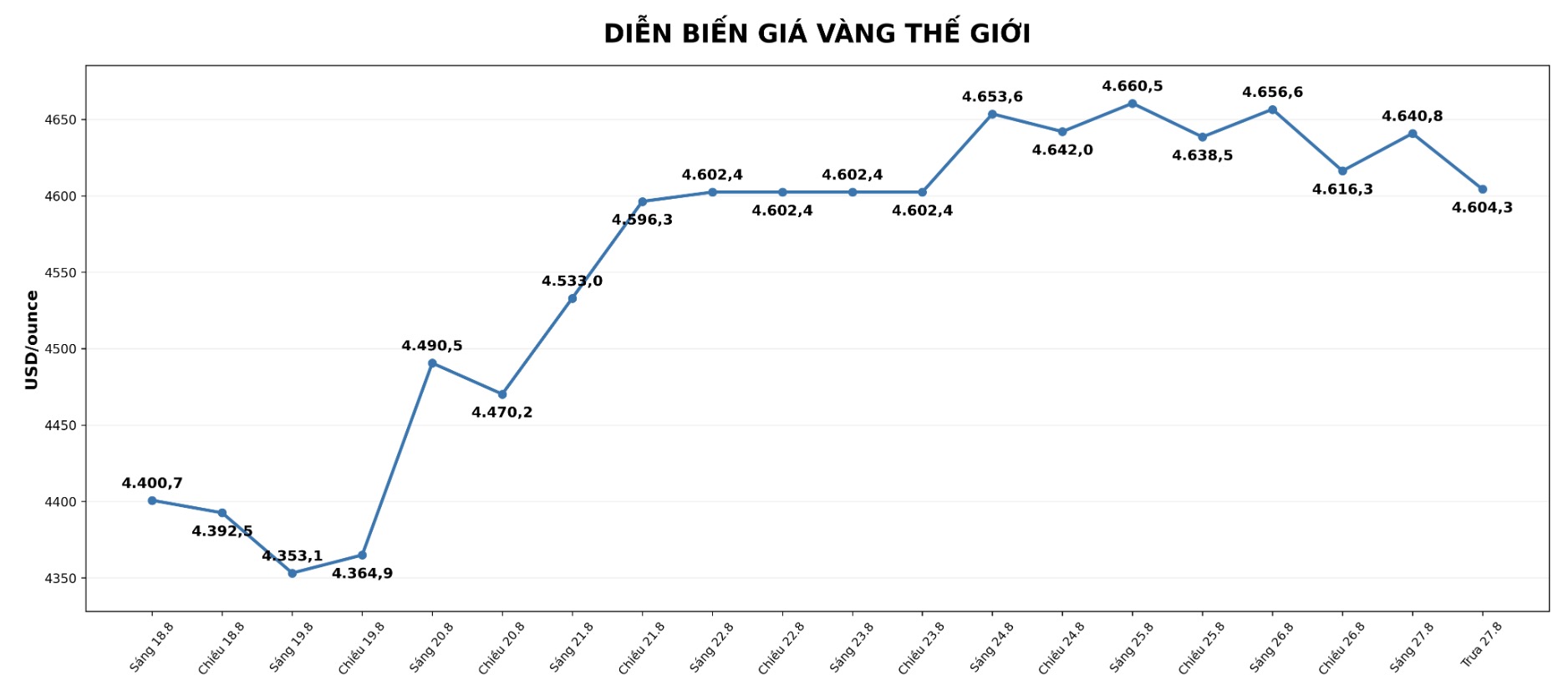
High interest rates are often detrimental to gold because this precious metal does not generate yields. When US government bond yields increase, investors tend to consider shifting part of their cash flow to profitable assets, thereby putting pressure on gold prices.
Besides the interest rate factor, the USD has also become an important variable for the gold market. Concerns about the US budget deficit and the possibility of a decline in purchasing power of the greenback are driving a part of investors to turn to gold as a tool to preserve value.
Previously, the US Treasury Department's expansion of the long-term government bond repurchase program increased concerns about the USD outlook. This is one of the factors that helped gold prices increase sharply by more than 5% last week.
However, the market has not yet formed a clear trend as supporting and pressuring factors are coexisting. The USD has stabilized again, US bond yields remain high, while expectations for Fed policy are still unclear.
The focus of investors' attention is currently the speech of Fed Chairman Kevin Warsh at the Jackson Hole conference on August 28. The market expects new information from the Fed to help determine the direction of interest rates in the coming time.
Technically, the 4,700 USD/ounce zone is being considered an important resistance level for gold prices in the short term. If it passes this zone, the market may open up new room for increase. Conversely, if it loses the support zone around 4,573 USD/ounce, adjustment pressure may increase, with the next support zones at 4,545 USD/ounce and 4,500 USD/ounce.
In the current context, gold prices are likely to continue to be affected by the balance between US interest rate expectations and concerns about the health of the USD. The market needs more clear signals from monetary policy to determine the next trend.
The information in the article reflects market developments at the time of update, not an investment recommendation.


