
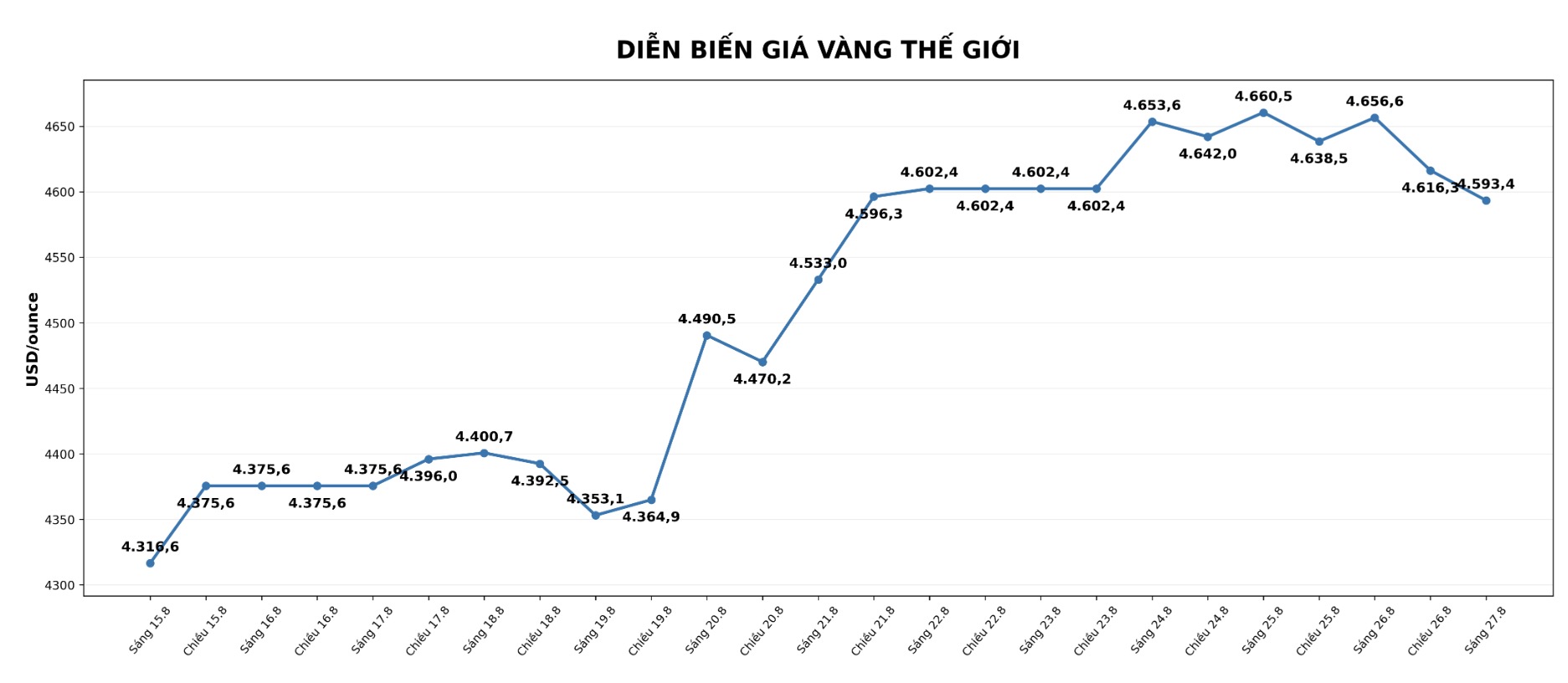
World gold prices fell in the trading session as a series of US economic data showed that inflationary pressure is still present, reducing expectations of the Fed's ability to soon ease monetary policy. However, geopolitical risk factors and prolonged inflation concerns are still creating support for the precious metal.
In the latest trading session, spot gold prices fell below 4,600 USD/ounce, after being pressured by important US economic reports.
The focus of the market is the July Personal Consumption Price Index (PCE) - an inflation measure of particular interest to the Fed. Data shows that the overall PCE index increased by 0.2% in July and increased by 3.7% compared to the same period last year, higher than market forecasts.
Meanwhile, the core PCE - the index excluding the volatile food and energy group - increased by 0.2% in the month and increased by 3.3% over the same period. Although the increase did not create a big surprise, this result shows that inflation is still significantly higher than the Fed's target of 2%.
After the data was released, US government bond yields increased again, the USD was supported, putting pressure on gold prices. Because gold is an asset that does not generate yields, maintaining high interest rates for a long time may reduce the attractiveness of the precious metal.
In addition, US economic growth data also shows a contrasting picture. US GDP in the second quarter grew by 1.5%, lower than the growth rate of the previous quarter. While the economy shows signs of slowing down, price pressure has not cooled down as the GDP pricing index in the second quarter increased by 6.4%.
This development increases concerns about the risk of stagnant inflation - a scenario where the economy grows weakly but prices still rise. This is a factor that makes it difficult for the Fed to balance between the goal of controlling inflation and supporting growth.
Despite bearing downward pressure in the short term, the long-term trend of gold still receives support from many factors. Geopolitical risks, especially instability related to the Middle East region and energy transportation through the Strait of Hormuz, continue to boost demand for safe-haven asset searches.
Concerns about the rebound in energy costs may also create additional pressure on inflation in the future. This both makes monetary policy difficult and maintains the defensive role of gold in the investment portfolio.
Technically, gold prices are still in the accumulation zone after the previous strong increase. The threshold of 4,661 USD/ounce is an important resistance zone. If this level is surpassed, gold prices may head towards higher targets around 4,729 USD/ounce and 4,794 USD/ounce.
In the opposite direction, the 4,567 USD/ounce zone is considered a support level to be monitored. If this zone is lost, adjustment pressure may cause gold prices to fall deeper into lower support zones.
Investors are focusing on Fed Chairman Kevin Warsh's speech at the Jackson Hole conference to look for new signals on interest rate orientation. Messages related to inflation prospects and monetary policy could become decisive factors in the next trend of gold prices.
The article only updates gold price developments and factors affecting the market, not investment recommendations.


