
Gold prices fluctuated around the 4,000 USD/ounce mark as investors simultaneously monitored progress in negotiations between the US and Iran as well as assessed a series of new US economic data to forecast the next steps of the US Federal Reserve (Fed).
As of the trading session at 9:53 am Vietnam time, spot gold price decreased by 1.06%, to 3,981.23 USD/ounce. Spot silver price decreased by 1.46%, to 57.72 USD/ounce. At the same time, the Bloomberg Dollar Spot Index increased by 0.1%, showing that the USD continues to maintain its strength in the international market.
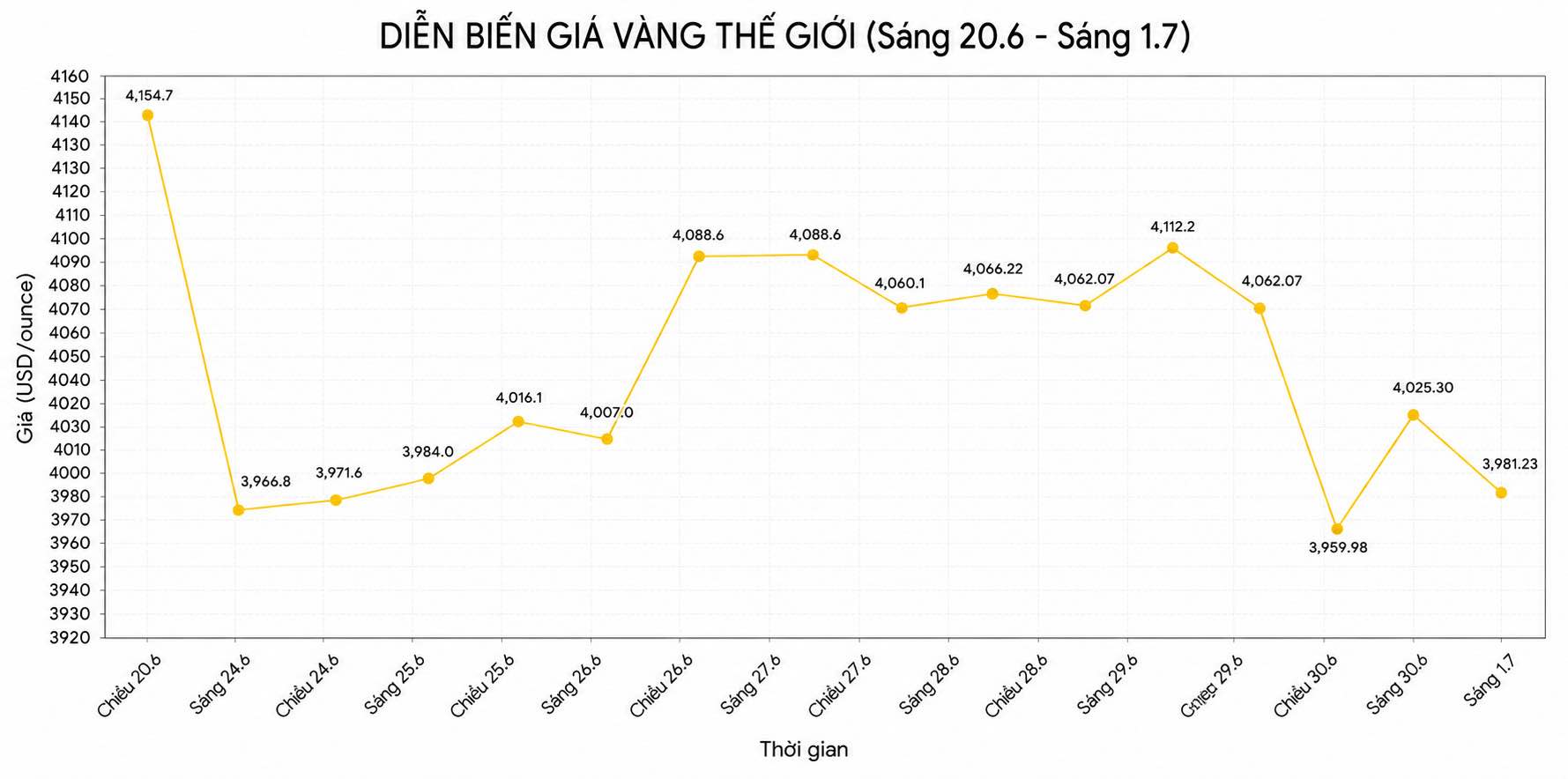
The price has not yet surpassed important resistance zones to confirm the recovery trend. Conversely, silver prices traded in the 56.53 – 60.55 USD/ounce range, supported by a decrease in the gold/silver ratio and technical buying power.
The focus of the market continues to be the negotiations between the US and Iran in Doha. Two special envoys of US President Donald Trump have arrived in Qatar to participate in the new round of negotiations, but Qatar - the intermediary country - said it does not expect to achieve a significant breakthrough and US and Iranian officials have no plans to meet directly.
Meanwhile, Iran continues to affirm that it will maintain control of maritime activities through the Strait of Hormuz - a transport route that once accounted for about 20% of the world's oil and liquefied natural gas before the conflict broke out. Although the volume of oil tankers through this area has almost returned to pre-war levels, geopolitical risks still exist and can quickly impact the energy market.
Since the US-Iran conflict broke out at the end of February, gold prices have fallen by about 24%, while breaking many important technical support levels, including the 200-day moving average.
Although oil prices have cooled down significantly compared to the peak period of the conflict, investors continue to raise expectations that the Fed will have to maintain high interest rates, and may even continue to raise interest rates this year to control inflation. This is still the biggest factor putting pressure on gold – a non-rotating asset.
This prospect is further strengthened after the Fed kept interest rates unchanged at the meeting on June 17, but at the same time raised its 2026 interest rate forecast from 3.4% to 3.8% and raised its PCE inflation forecast from 2.7% to 3.6%, sending a signal that monetary policy may be maintained in a longer-term tightening direction.
In addition, the latest JOLTS report shows that the number of jobs being recruited in the US in May reached 7.594 million, higher than the forecast of 7.3 million and almost unchanged compared to the previous month. This shows that labor demand remains stable, creating more room for the Fed to continue monitoring inflation developments before making a decision to adjust interest rates.
Immediately after the report, the yield of 10-year US Treasury bonds increased to about 4.47%, while the USD Index remained around 101.17 points. A strong USD along with rising bond yields continued to reduce the attractiveness of gold.
On the energy market, WTI oil traded around 70.03 USD/barrel, while Brent oil was at 73.45 USD/barrel. Although oil prices have fallen much lower than the peak in June, any unexpected developments in the Strait of Hormuz could cause inflation to rise again, thereby directly affecting the Fed's policy expectations and the gold market.
In terms of technical analysis, the 4.063 – 4.096 USD/ounce area is considered an important resistance level for gold. If successfully surpassing this area, the price may head towards the 4,107 USD/ounce and 4,201 USD/ounce levels.
In the opposite direction, if it loses the mark of 3,959 USD/ounce, the gold price may continue to retreat to 3,927 USD/ounce, further to 3,886 USD/ounce.
For silver, the 61 – 62 USD/ounce zone is the nearest resistance level. If successfully breaking through, the price may head to 65 USD/ounce then 66 USD/ounce. In a negative scenario, if it breaks through the support zone of 56 – 57 USD/ounce, the silver price may fall to 55 USD/ounce, even 54 USD/ounce.


