
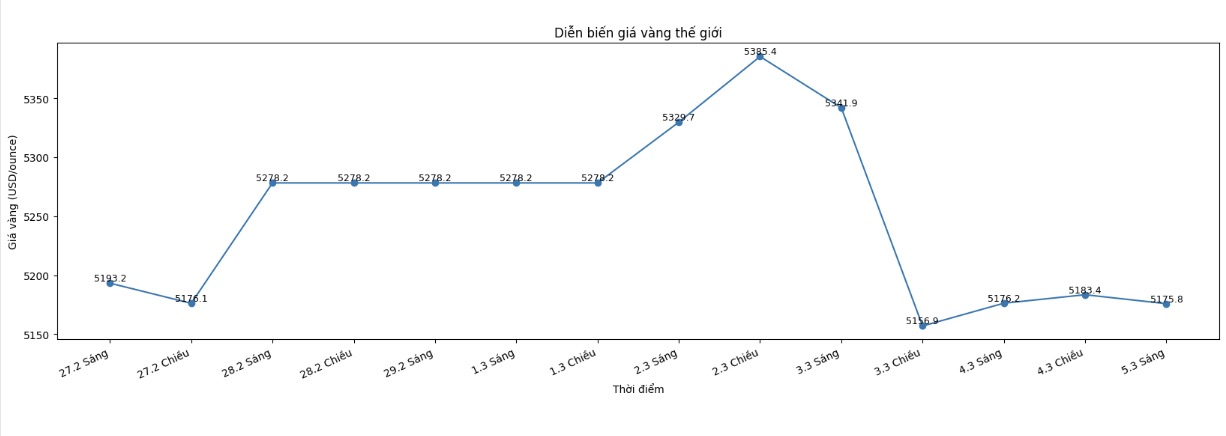
According to Kitco, gold prices edged up slightly as the USD weakened after a previous strong increase, amid mixed signals from the US labor market and escalating military conflict between the US, Israel and Iran continuing to boost safe-haven demand for this precious metal.
The USD weakened after a sharp increase on Tuesday, thereby directly supporting gold prices. Because gold is valued globally in USD, when the greenback depreciates, this metal becomes cheaper for buyers using other currencies, thereby often boosting demand.
However, the main driving force supporting the gold market is still the escalating conflict in the Middle East. The US and Israel are conducting continuous military operations against Iran. The situation became more tense this week when US Secretary of Defense Pete Hegseth announced that a US submarine sank an Iranian warship off the southern coast of Sri Lanka. This development significantly expanded Washington's campaign to pursue Iranian forces at sea and made the global market more worried.
Meanwhile, Iran threatens to restrict traffic through the Strait of Hormuz - a shipping route that transports about 1/5 of the world's daily oil supply. The risk of energy supply disruption has increased risks to the global economy, thereby further strengthening the role of gold as a systemic risk hedging channel.
This precious metal is benefiting from a rare combination of many supporting factors: prolonged geopolitical instability, expectations that the US Federal Reserve (Fed) will cut interest rates by the end of the year, strong buying activity by central banks, and a downward trend in dependence on USD-denominated assets globally.
As a non-performing asset, gold usually attracts capital during low or low interest rates, when the opportunity cost of holding gold is lower than bonds or other profitable assets. The Fed currently maintains the benchmark interest rate at 3.50% - 3.75% since its January meeting.
Although the possibility of the Fed cutting interest rates in March is almost negligible - according to CME FedWatch data, it is only below 5%, the market still expects interest rate cuts to take place in the second half of 2026.
The ADP national employment report released on Wednesday showed a rather contrasting picture. The number of jobs in the US private sector in February increased more strongly than forecast, reflecting a certain resilience of the labor market.
However, last month's data was significantly down-adjusted, causing optimism to be restrained and expectations of the Fed cutting interest rates were generally maintained.
Currently, all attention is focused on the official US non-farm payroll report to be released on Friday. Economists surveyed by Reuters forecast that the US economy will only create an additional 59,000 jobs last month, a sharp decrease compared to the 130,000 jobs in January.
If the actual results are weaker than expected, this may reinforce the argument that the Fed needs to ease monetary policy soon, thereby further supporting gold prices.
From an organizational perspective, gold demand remains strong. Many central banks around the world are continuing to increase gold reserves at record highs, partly to diversify assets and reduce dependence on the USD amid concerns about sanctions risks and the sustainability of US fiscal policy.
J.P. Morgan Bank once predicted that gold demand could push the price of this metal up to 5,000 USD/ounce by the end of 2026, but in fact the market has far exceeded this mark. Some experts now believe that gold prices could reach 6,000 USD/ounce or higher if geopolitical tensions continue to prolong.
Famous investor David Einhorn of Greenlight Capital also said that the Fed will eventually be forced to cut interest rates more sharply than currently forecast - a factor that may continue to support gold prices.
In the context of war, currency instability and weakening USD appearing at the same time, the gold market is witnessing a period of strong growth and continuously setting new record levels.
Whether the US jobs report released next Friday will force the market to re-evaluate its outlook or simply add more momentum to the story of gold's "residential asset" remains an open question.


