According to Reuters, instead of pouring money into gold, investors seem to have turned straight to holding cash in USD, selling almost all assets that had increased sharply before last weekend attacks.
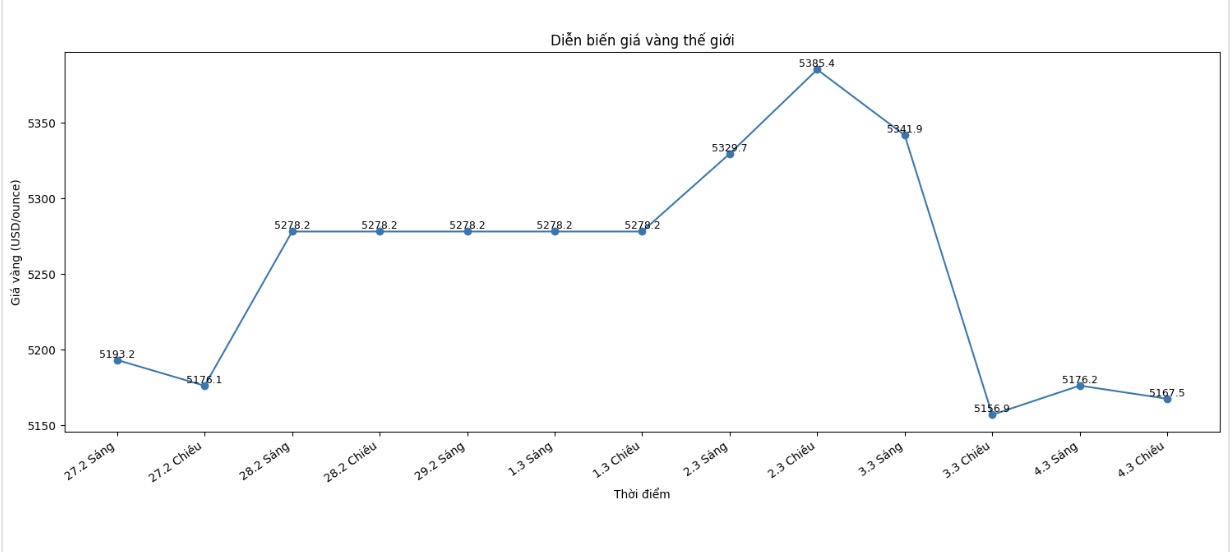
Three days after Saturday's attacks on Iran, initial buying power for the precious metal quickly weakened. By Tuesday, the market reversed sharply: gold prices suddenly fell 4%, while silver at one point plummeted by 10%.
A fundamental reason mentioned is the return of the USD's "safe haven" role. The USD index (DXY) rose this week, although the US stock and bond markets suffered heavy losses.
Public and private funds in the Middle East are currently facing the risk of Iran's retaliation - which may be prioritizing liquidity in USD. The soaring price of oil and gas valued in USD may also boost the demand for holding cash in the world's reserves.
However, the main reason for the USD price increase is likely that major economies in Europe and Asia will be more strongly affected if energy supplies are disrupted for a long time and energy prices rise, while the US economy is relatively less affected.
Whatever the reason, the strengthening USD always reduces the attractiveness of gold. There are other factors that prevent gold from playing the role of "hideout" this week.
One of them is the correlation between gold and the Swiss Franc. Both are considered the safest assets in times of instability and often increase in price together, especially when other safe haven assets such as the Japanese Yen or US bonds have somewhat lost this role in recent years.
However, the Swiss Central Bank on Monday issued an unusual warning about the possibility of intervention in selling the Franc, causing the currency to quickly reverse to decrease against the USD and Euro. Investors simultaneously closing safe-haven positions may have put more pressure on gold prices.
A simpler explanation is that investors who bought gold during the speculative fever - which nearly doubled the price of this metal and set a new record last year - are now taking profits from their best profitable investments as risks and market volatility increase.
This is also consistent with the developments of this year's strongest stock market. South Korea's Kospi index fell more than 7% on Tuesday as the Seoul market reopened after the holiday, thereby reversing part of the nearly 50% increase from the beginning of the year.
Before the attacks, gold and silver were the two and three strongest growing markets in 2026, second only to Kospi. Meanwhile, Japan's Nikkei index - which increased by about 15% before the end of the week - has fallen by more than 4% since then.
As volatility increases and the risk of a new energy shock to the global economy appears, many investment portfolios may simply increase the proportion of cash and liquidity.
The fact that gold has not shown a shelter role in this context shows many things about the nature of the buying wave and the price increase of gold over the past year, especially when it is closely linked to the reversal trend of more than a decade of strong USD price increases.
As Mr. Dan Katz, First Deputy Managing Director of the International Monetary Fund (IMF), commented on Tuesday: the diễn biến of the USD this week shows that the shelter role of this currency is still intact, and the USD is still the "heart of the international monetary system".
Gold prices may still rise for many other reasons. But if the recent increase of this precious metal is driven by pessimistic forecasts about the weakening of the USD, then fluctuations this week may force the market to rethink.