
The US Department of Labor said that the number of initial jobless claims in the week ending April 11 decreased by 11,000, to 207,000, lower than the market forecast of 230,000.
Last week's data was also adjusted down to 21.8 million applications. Meanwhile, the average 4-week unemployment benefit application number was 209,750 applications, showing that the US labor market still maintains a relatively stable state.
At the same time, the Philadelphia Federal Reserve (Philly Fed) said that the manufacturing business outlook for April increased sharply to 26.7 points, far exceeding the 18.1 point of the previous month and much higher than the forecast of 10.3 points. Component indices such as new orders and delivery volume both increased significantly, reflecting continued expansion of manufacturing activities in this region.

The above data shows that the US economy is still sending quite good resistance signals. This is a disadvantageous factor for gold, because when the labor market stabilizes and production recovers, the fear of recession will decrease, leading to a weakening demand for gold to hedge against risks.
In terms of impact, positive job data often makes investors believe that the US Federal Reserve (Fed) has more room to maintain a cautious monetary policy, instead of early strong easing. On the other hand, the price index in the Philadelphia production survey jumped to 59.3 points, also showing that inflationary pressure has not completely cooled down.
The combination of positive economic growth and high inflation risk may push back interest rate reduction expectations, thereby putting pressure on gold prices, as precious metals often benefit in a low interest rate environment.
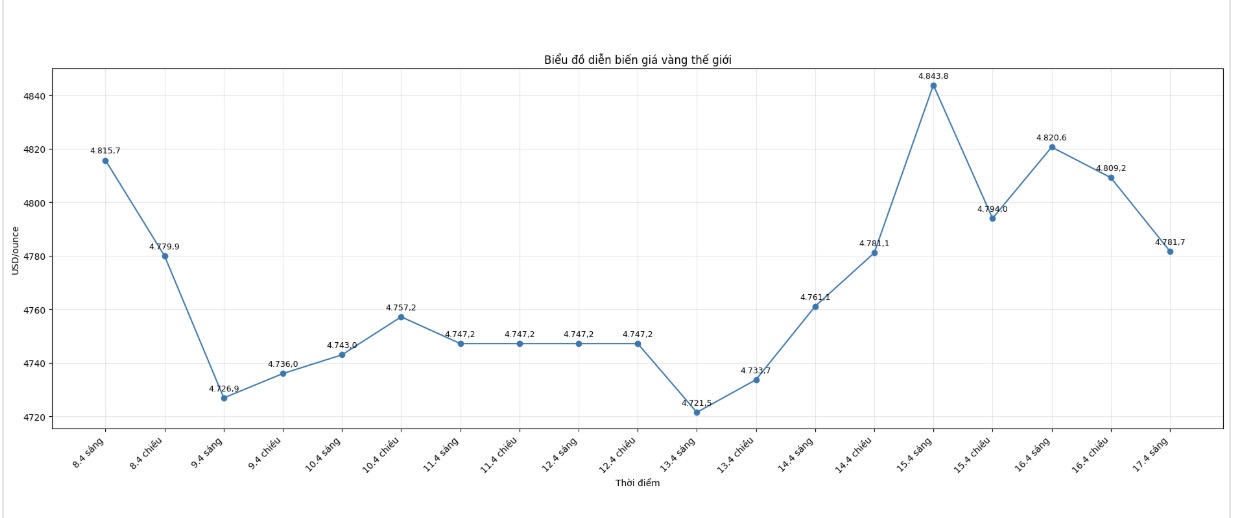
Although spot gold prices once returned above the 4,800 USD/ounce mark, the market did not record strong enough buying to maintain the upward momentum. This shows that investors are more cautious about gold after new economic information reduced the attractiveness of safe-haven assets.
However, the Philly Fed report also showed some not-so-positive points, especially the manufacturing sector employment index falling to negative 5.1 points. The number of people continuing to receive unemployment benefits also increased to 1.818 million people. This shows that the US economy has not completely escaped potential risks, which may partly limit the deep decline of gold prices.
At the time of writing, at 0:41, the world gold price was listed around the threshold of 4,781.7 USD/ounce, down 18.7 USD/ounce compared to the previous day.


