
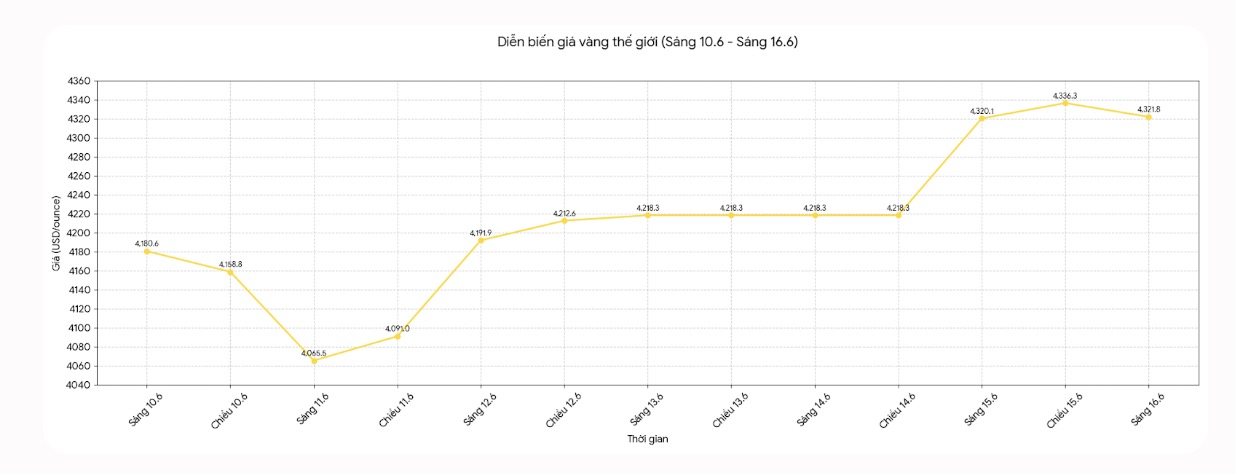
The gold market recorded a fairly strong continuous buying force at the beginning of the week, when prices increased by more than 3% in the first trading session in North America. The precious metal is having the strongest percentage increase since the beginning of February.
Analysts believe that gold is reacting to information that the US and Iran will sign a peace agreement on Friday, ending the months-long conflict in the Middle East. This information has pulled oil prices below 80 USD/barrel, thereby easing inflationary pressure.

Despite the recovery on Monday, the market remained below the 200-day moving average.
In a recent interview with Kitco News, Ms. Michele Schneider - Market Strategy Director at MarketGauge - said that gold holding the support zone above 4,000 USD/ounce is a basis for investors to try participating in the market with small positions. However, she added that she wants to see the price surpass back the 200-day moving average, currently around 4,450 USD/ounce.
Mr. David Morrison - senior market analyst at Trade Nation - said that although gold has overcome the first barrier by maintaining an important psychological support zone, there are still many developments that may occur from now until Friday, when the US and Iranian governments are expected to sign a peace agreement.
The risk this week is that something will happen that delays the signing of the treaty on Friday. If this scenario occurs, the $4,000/ounce zone could be retested," he said.
Some other analysts also noted that, despite increasing optimism, inflation is still a short-term resistance for gold. Mr. Nick Cawley - a collaborative analyst at Solomon Global - said in a note to Kitco News that the market will closely monitor the statement of the new Chairman of the US Federal Reserve (Fed) Kevin Warsh, in the context that investors continue to assess the possibility of the Fed raising interest rates at the end of the year.
If Mr. Warsh signals willingness to ignore current inflation levels, a peace agreement can be seen as a factor supporting inflation reduction, and interest-sensitive markets could receive a second significant boost," he said.

Spot gold prices need to decisively surpass the simple 50-day moving average, currently at 4,581 USD/ounce. Then, the lower peak of May 12 at 4,773 USD/ounce will be the next notable resistance level. Clearly breaking through both of these milestones will open up the possibility of a more sustainable upward momentum. As the political context is improving, attention is now completely shifting to the Fed," he said.
In a note released on Monday, commodity analysts at TD Securities said that despite being optimistic about gold and silver, investors still need to pay attention to the oil market, as high energy prices continue to fuel concerns about inflation.
With the interest rate market still assessing the possibility of interest rate hikes in early 2027 and the energy market expected to tighten, the recovery momentum of the precious metal group may be somewhat temporary" - experts said.
Commodity analysts at Société Générale warn investors that the reduction in global oil inventories, after governments used reserves to limit the impact of supply disruptions, will continue to affect oil prices and inflation even after the official conflict ends.
In the current context, the French bank said it maintains a neutral stance on gold in the short term.
The main influencing factor is still high real yields, continuing to limit gold's room to increase despite persistent inflation, thereby reducing the attractiveness of this precious metal as both an inflation hedging tool and a defensive asset" - experts said.


