
Talking to Kitco News, Mr. Thorsten Polleit - Honorary Professor of Economics at Bayreuth University, and also publisher of BOOM & BUST REPORT - said that even if gold prices continue to fall, the long-term upward trend of this precious metal has not been broken.
Although recent fluctuations have disappointed many investors, Mr. Polleit believes that the decline in gold prices from the peak should be seen as a natural correction after a period of excessive increase, rather than the beginning of a new downward price market.
“If using the exponential trend line and the polynomial trend line, it can be seen that the level of 5,500 USD/ounce has gone quite far compared to any trend line. Therefore, the correction response from this perspective is not too surprising,” he said.
According to Mr. Polleit, although gold prices may test lower zones in the short term, the fundamental outlook of the global economy continues to strongly support the precious metal.
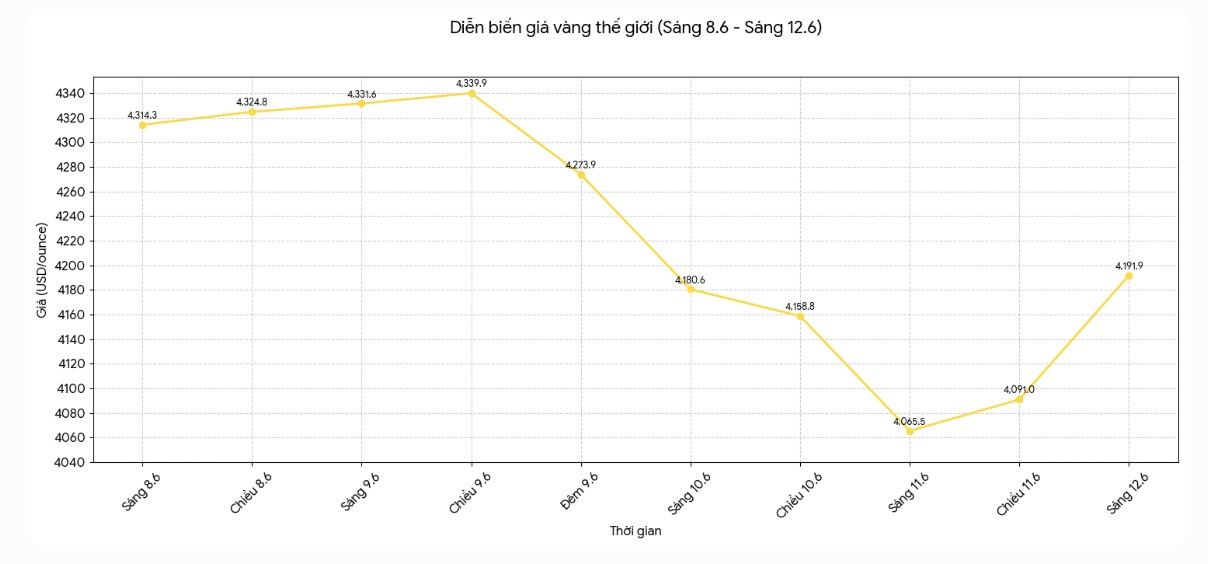
Gold prices may fall below 4,000 USD/ounce, but I think around the 3,900 USD/ounce range, the decline will stop. This is actually a fundamental trend reflecting our current regime, with a series of problems such as negative real interest rates, money printing and uncontrolled public debt growth" - he said.
This view is also affecting his investment decision. Polleit said he is considering increasing gold holdings. Although still choosing between physical gold and products trading on the exchange, he emphasized that the current price level does not make him hesitant to buy.
I am not afraid to buy gold at 4,000 USD/ounce. I will also not be surprised if the price drops a little further. But if you have a long-term vision, with an investment period of 5 years or more, this is an attractive price," he said.
According to Polleit, trying to bottom-fish may not be as important as maintaining a position with an asset that continues to benefit from structural supporting factors.
Of course, investors can bet that prices will fall slightly further, but who knows what will happen? In the next 5 years, I have little doubt that gold prices will be much higher than they are now," he said.
Polleit's optimistic outlook is mainly based on the assessment that the global monetary system is becoming increasingly fragile. The heavy public debt burden, persistent budget deficits and the limited ability of central banks to maintain tight monetary policy are all factors supporting gold prices in the long term.
Mr. Polleit believes that investors are still underestimating the impact of "fiscal dominance" - the situation where central banks are bound by government financing needs. When the debt level in developed economies remains high, he believes that policymakers have very little room to maintain high real interest rates for a long time.
The real yield of bonds will continue to be negative and this may also happen to some stocks. This is another reason why I think gold will continue its upward trend," he said.
Although rising bond yields have put pressure on gold in recent weeks due to increasing the cost of unsecured asset holdings, Polleit believes this pressure is only temporary. He predicts the market will eventually realize that central banks cannot maintain significantly higher interest rates without risking economic growth and the sustainability of public debt.
Besides concerns about government debt, Polleit argues that most of the current inflationary pressure comes from increased energy costs, rather than excessive monetary expansion. In that context, he argues that traditional monetary policy tools are not appropriate to deal with the problem.
According to Polleit, strong interest rate hikes to cope with supply-side inflation risks could slow economic growth and push high-debt economies closer to recession, while not significantly reducing energy costs. This development ultimately further strengthens the role of gold as a channel to retain long-term value.
Despite periodic adjustments and investment cash flow shifting its attention to high-growth technology topics, Polleit believes that gold has not yet been properly held and fully appreciated by many investors.
The argument in favor of gold is currently even stronger than a few years ago. In fact, I believe more than ever that holding gold is completely reasonable," he said.


