
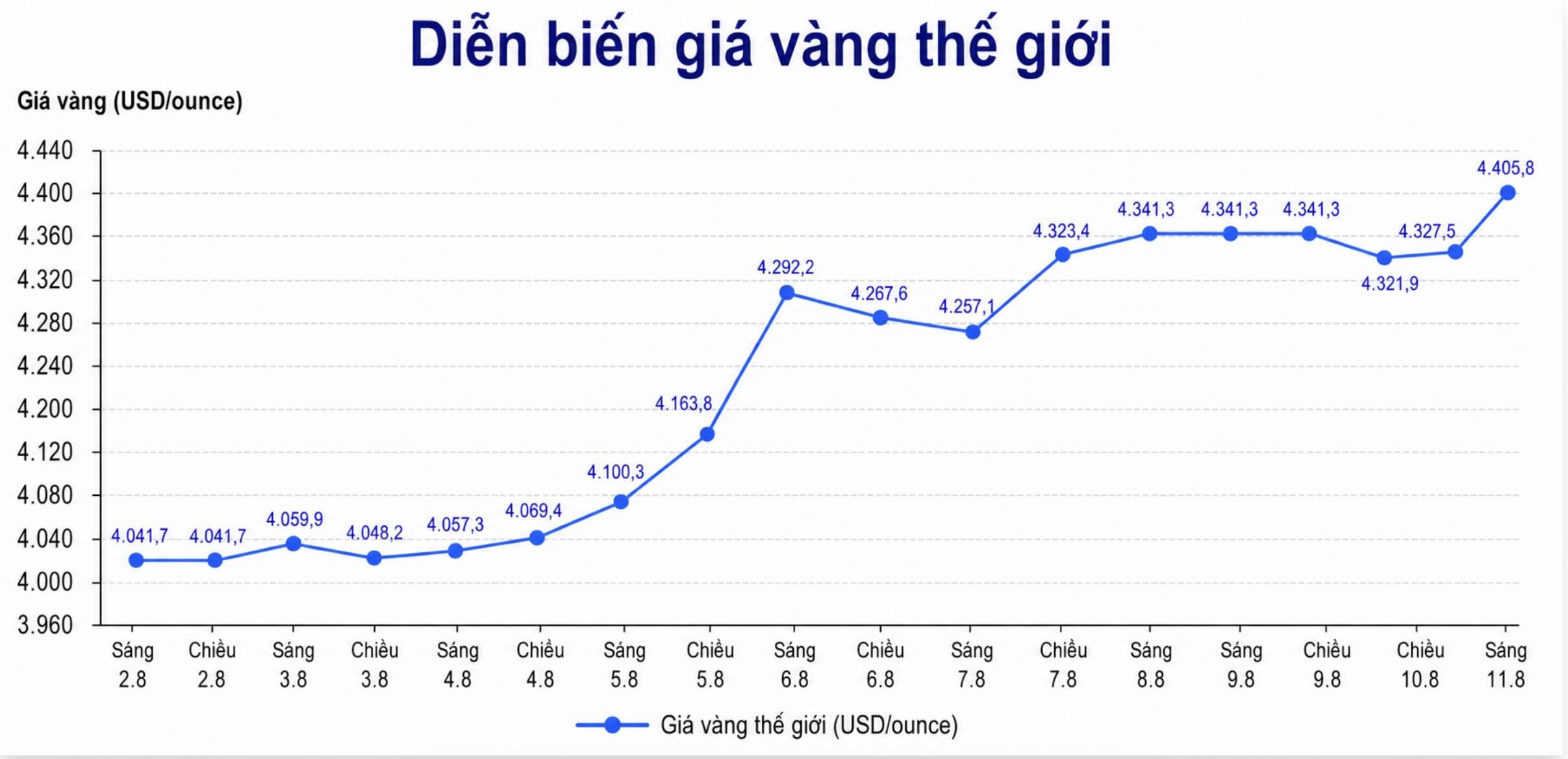
After falling in the first session of the week, world gold prices quickly reversed and increased sharply again in last night's trading session. A noteworthy development is that the precious metal still maintained its upward momentum even though the USD, US bond yields and expectations of the US Federal Reserve (Fed) raising interest rates all recovered.
Recorded at 7:15 am on August 11, world gold prices were listed around the threshold of 405.8 USD/ounce, up 0.41%. Meanwhile, silver also increased by 0.46%, to the threshold of 65.94 USD/ounce.
One of the important factors continuing to support gold is the aftertaste from the US jobs report released last weekend.
Data shows that the US non-farm payroll in July decreased by 23,000 jobs. Data from previous months also was adjusted down by a total of 103,000 jobs, while the unemployment rate was 4.1%.
These figures increase concerns that the US labor market is losing momentum, and at the same time cause investors to adjust expectations about monetary policy.
Immediately after the report, the probability of the market forecasting the Fed to raise interest rates in September fell to 44.4%, from 54.7% before the data was released.
Expectations that the Fed will be less tough often support gold, because the precious metal does not yield yields and becomes more attractive when the opportunity cost of holding decreases.
However, in the first session of the week, part of this expectation reversed. The probability of the Fed raising September interest rates recovered to about 51.7%.
Along with that, the yield of 30-year US government bonds increased by about 5 basis points to 5.244%, approaching the high closing level of 5.253% recorded at the end of July. The yield of 10-year bonds also exceeded the 4.7% range.
Usually, rising yields and higher interest rate expectations are factors that are detrimental to gold. Therefore, the fact that the precious metal still increased in the last night's session shows that shelter buying and defensive sentiment are still playing a significant role.
Another factor closely monitored by the market is the situation in the Strait of Hormuz.
New developments related to Iran are reducing expectations that transportation through this strategic maritime route will soon return to normal. This makes investors continue to be concerned about the risk of energy supply disruption and possible geopolitical instability.
US WTI oil is trading around 79 USD/barrel, while Brent oil is near 85 USD/barrel.
However, the recovery of oil prices is not a direct driving force for gold to increase. Conversely, rising oil prices may increase inflationary pressure, thereby strengthening the Fed's ability to maintain monetary policy tightening for longer and put pressure on precious metals.
A noteworthy point in last night's session was that gold still maintained buying power despite these pressures.
The market is currently shifting its attention to a series of important US economic data, especially the consumer price index CPI in July. After that, investors will continue to monitor the PPI production price index and retail sales data.
If inflation is lower than forecast, the expectation that the Fed will raise interest rates may decrease again, thereby creating more room for gold prices to rise. Conversely, higher-than-expected price data may push bond yields and the USD further up.
Technically, the 4,360-4,380 USD/ounce zone is a near resistance level. If it clearly crosses this area, gold may head towards 4,480 USD/ounce and further to the 4,500 USD/ounce mark.
In the opposite direction, the 4, 299 USD/ounce zone is considered near support, followed by 4, 223 USD and 4, 147 USD/ounce.
In the short term, the direction of gold prices is likely to continue to depend on US inflation data, Fed policy expectations and geopolitical risk developments in the Middle East region.
The information in the article is for reference, reflecting market developments at the time of recording, not an investment recommendation. Gold prices may fluctuate rapidly according to economic data, monetary policy, exchange rates, bond yields and geopolitical factors.


