
World gold prices continue to maintain strong growth momentum as cash flow turns to precious metals amid investors' concerns about fiscal risks, US monetary policy and new signals from the US Federal Reserve (Fed).
On the futures market, gold prices increased by another 48 USD/ounce, while spot gold prices increased by nearly 49 USD/ounce, extending the upward momentum starting from mid-last week.
This increase helps gold prices surpass the important technical threshold of 4,692 USD/ounce, corresponding to a 38.2% recovery of the previous decline (calculated from the peak of nearly 4,600 USD/ounce to the recent bottom of around 4,000 USD/ounce). This is the price range that many investors are monitoring to assess the possibility of gold continuing to increase or entering a correction phase.
Technically, gold prices are heading towards the next target around 4,900 USD/ounce, corresponding to a 50% recovery of the previous decline. Continuously surpassing important price zones shows that buying power is still dominant, consolidating the upward momentum of precious metals.
Last week, gold prices surpassed many important resistance levels in technical analysis, including a 23.6% recovery of the previous decline along with 100-day and 200-day price averages.
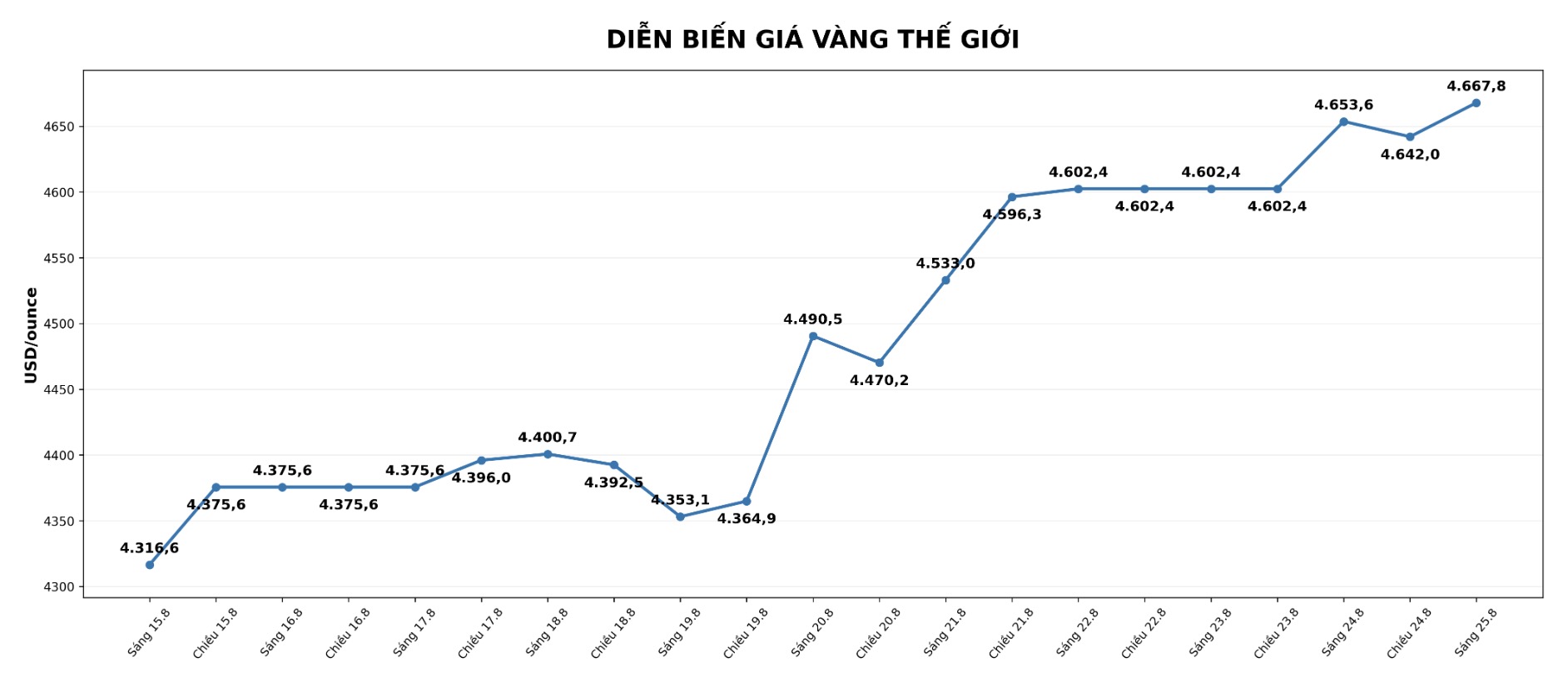
These are milestones that investors often monitor to assess market trends. The fact that gold has surpassed these resistance zones without a sell-off wave shows that buying power is still strong and the upward trend is being consolidated.
Notably, the upward momentum of gold occurred even when the USD had a slight recovery at one point. The USD index increased by about 0.14% in the session but was not enough to put pressure on gold prices. This shows that the main driving force of gold today comes not only from currency fluctuations but also from the need to defend against economic and financial risks.
While gold increased sharply, silver fluctuated in opposite directions. Spot silver prices at one point fell to about 68.75 USD/ounce, while silver futures contracts closed at 68.59 USD/ounce. The differentiation between the two precious metals reflects the differences of silver when it is both a safe haven asset and plays an important role in the industrial sector.
The gold/silver price ratio is tending to expand as gold surpasses silver in the short term. History shows that periods of large difference between these two metals can often create conditions for silver to recover, but the time of reversal is very difficult to predict.
Currently, the gold market continues to focus on US macroeconomic factors. Personal expenditure inflation (PCE) data for July, Nvidia's business results and Fed Chairman Kevin Warsh's speech at the Jackson Hole Conference are considered important factors that can orient interest rate expectations in the coming time.
A signal that the Fed may ease monetary policy or acknowledge challenges from US public debt of about $40,000 billion and prolonged inflationary pressure may create more momentum for gold prices. Conversely, a tougher stance from the Fed may cause investors to take profits after the recent strong rally.
Besides monetary policy, geopolitical factors continue to support the safe-haven role of gold. Tensions related to Iran and the situation in the Strait of Hormuz are still factors that the market is monitoring. However, the drop in oil prices in the first session of the week has somewhat eased concerns about inflationary pressure.
Technically, the 4,650 USD/ounce zone is an important resistance level for spot gold. If successfully surpassed, the next target may be 4,772 USD/ounce and further is the 4,968 USD/ounce zone. In the opposite direction, the near support zone is at 4,594 USD/ounce, followed by 4,453 USD/ounce.
Currently, the upward trend of gold still prevails as buying power remains strong and supporting factors have not disappeared. However, developments from the Fed and US economic data this week will determine whether the precious metal can continue to approach the 5,000 USD/ounce mark or enter a correction phase.
Gold prices fluctuate according to many factors such as monetary policy, economic data, exchange rates, geopolitical situation and market sentiment. The information in the article is intended to provide market developments and analysis, not investment recommendations.


