
Exciting start
World gold prices have just closed a volatile trading week. The strong increase at the beginning of the week once brought the precious metal to the highest level in three months, but all the achievements were quickly wiped out after the speech of US Federal Reserve (Fed) Chairman Kevin Warsh at the Jackson Hole conference.
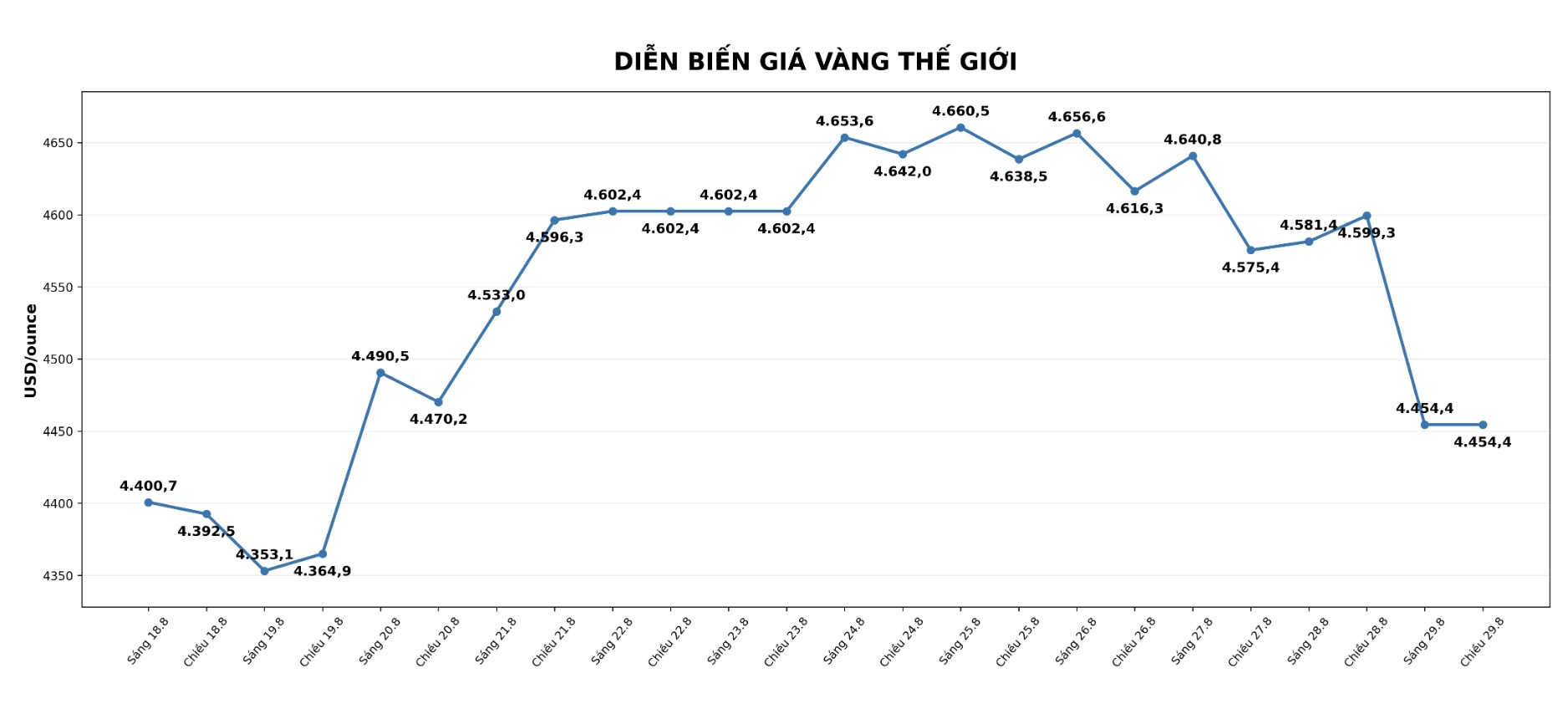
Spot gold opened the week around 4.618.79 USD/ounce on Sunday evening (US Eastern time). In Monday's session, prices continued to rise as the market assessed the impact of the US Treasury bond repurchase plan previously announced, especially on long-term yields, sustainability of public debt and demand for tangible assets.
On the futures contract market, gold prices increased by about 48 USD in the first session of the week, surpassing the Fibonacci 38.2% mark at 4,692 USD/ounce. Previously, the precious metal had successively surpassed the Fibonacci level by 23.6% along with 100-day and 200-day moving averages, helping technical prospects become more positive.
The increase lasted until Tuesday. Spot gold jumped to 4,697.66 USD/ounce, the week's highest level and also the highest price range in about three months. This is also the seventh consecutive session that gold has set a higher peak on the daily chart.
The upward momentum begins to crack
The first turning point appeared in Wednesday's session. US inflation data continues to show that price pressure has not been fully controlled. The July Personal Consumption Price Index (PCE) increased by 0.2%, higher than the forecast of 0.1%, while the annual growth rate reached 3.7%.
This data supports the USD and bond yields, thereby putting pressure on gold. Spot prices at times fell below 4,600 USD/ounce.
On the technical chart, the downward movement simultaneously completes the reversal warning candlestick pattern that appeared from the previous session. However, the price still maintained the 200-day moving average line, making the upward trend not completely broken.
Selling pressure continued to increase on Thursday as the market raised expectations that the Fed could raise interest rates. The strengthening USD along with the rise in short-term US Treasury bond yields has reduced the attractiveness of non-performing assets such as gold.
Spot gold at one point fell to 4,566.17 USD/ounce before recovering, returning to the 4,631.98 USD/ounce zone at the beginning of Friday's session.
Jackson Hole causes gold to reverse vertiginously
This positive development did not last long. The tough message from Fed Chairman Kevin Warsh at Jackson Hole quickly changed market sentiment.
The fact that the head of the Fed continues to emphasize the fight against inflation makes expectations about the possibility of interest rate hikes in September return. The USD and short-term yields immediately went up, creating strong selling pressure on the precious metals market.
Spot gold plunged to 4,445.45 USD/ounce, the week's lowest level, before slightly recovering and ending at 4,454.4 USD/ounce.
On the futures contract market, December gold fell by 150.7 USD, equivalent to 3.24%, in Friday alone, closing at 4,504.10 USD/ounce. The entire increase created from the beginning of the week was not only wiped out but the price also fell deeper.
After the sharp drop, the technical picture of gold also became less positive. Futures prices have returned below the 200-day moving average of around 4,641 USD/ounce. The 4,485-4,385 USD/ounce zone is considered a noteworthy technical area in the coming sessions.
If it continues to weaken and break through the Fibonacci 23.6% zone around 4,435 USD/ounce, downward pressure may increase. Conversely, regaining the 4,692 USD/ounce zone will be an important signal if gold prices want to restore the short-term upward trend.
The article only updates market developments, not investment recommendations. Investors need to be cautious in the face of strong market fluctuations and carefully consider risk factors before making decisions.


