
Many financial "giants" simultaneously lower expectations
After the explosive period of setting a historical peak at the beginning of this year, the world gold market is entering a period of cooling down and clear adjustment.
Notably, in strategic reports released simultaneously in early July 2026, a series of major financial institutions in the world such as HSBC, JP Morgan... have officially "turned around" to lower short-term gold price forecasts. What signals does this wave of adjustment send and how should domestic people behave with their cash flow?
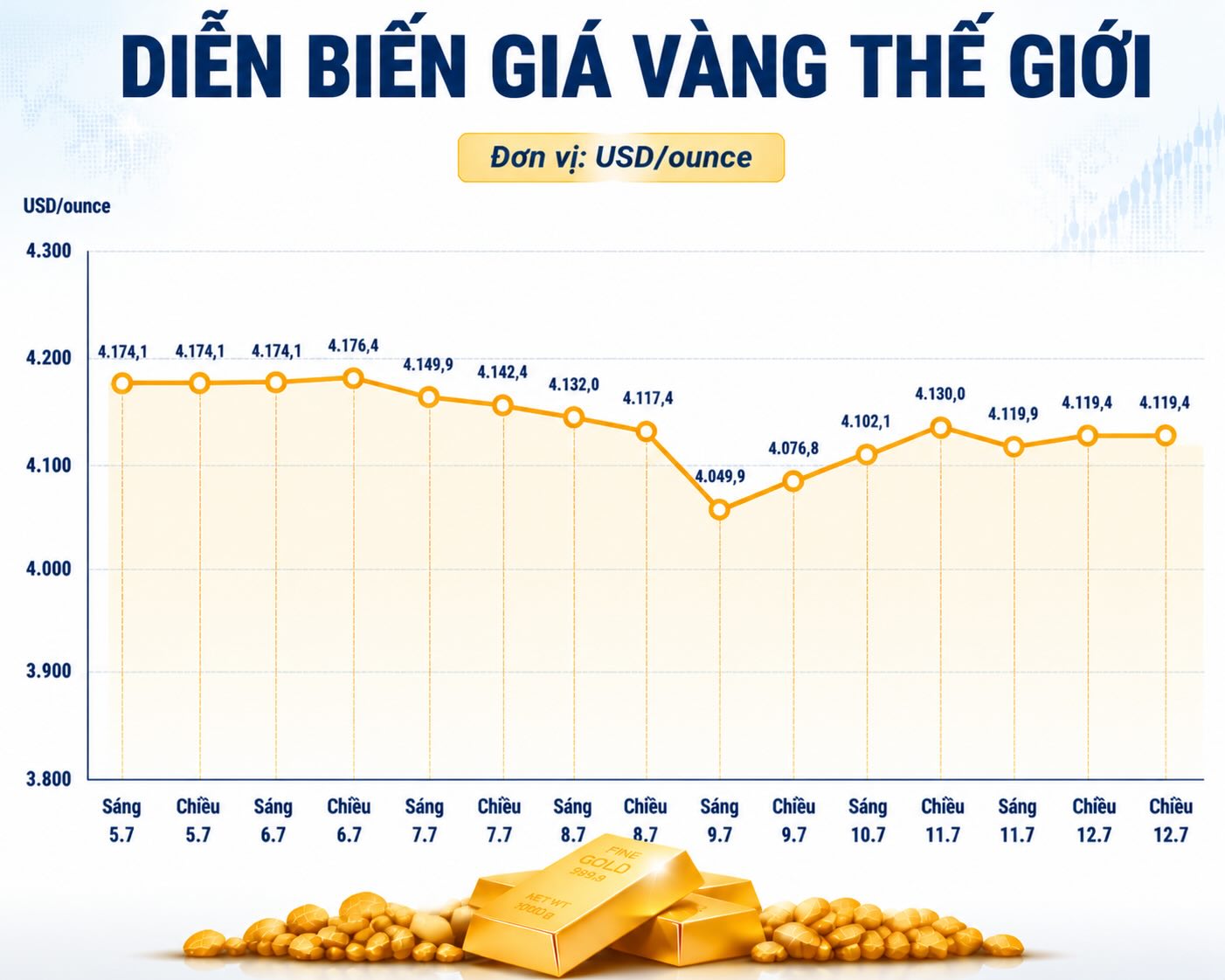
Closing the trading session last week, world gold prices are trading around the threshold of over 4,100 USD/ounce. This price level has decreased sharply compared to the record peak of nearly 5,600 USD/ounce set in January 2026.
This decline is clearly reflected in the data adjustment moves of major banks. In an updated report on July 9, 2026, HSBC Bank cut the average gold price forecast for 2026 to 4,560 USD/ounce (a sharp decrease compared to the previous forecast of 4,864 USD/ounce). HSBC experts predict that gold prices will be under pressure and fluctuate in a wide range of 3,800 to 4,700 USD/ounce from now until the end of the year.
Similarly, JP Morgan in its mid-2026 report also slightly lowered its average gold price target this year to 5,243 USD/ounce. Expert Bart Melek from TD Securities said that short-term sell-off pressure could push gold prices further down below the 3,900 USD/ounce mark before having a chance to recover in 2027.
Why is the global gold "fever" cooling down?
The core reason why banks simultaneously lowered forecasts came from changes in the policy roadmap of the US Federal Reserve (Fed). Expectations for the Fed to soon ease monetary policy were dashed when this agency maintained its "hawkish" (tightening monetary policy) stance longer than expected to control inflation. The high USD interest rate has strengthened the greenback, putting direct pressure on non-performing assets such as gold.
In addition, capital flows from large gold ETF funds are tending to net withdraw to shift to investment channels with higher yields. At the same time, some central banks - which are the main net buying force pushing gold prices to peak at the beginning of the year - have also proactively slowed down the rate of accumulation in the second quarter of 2026.
The "cooldown" of world gold prices immediately affected the Vietnamese gold market. Domestic SJC gold bars and 9999 gold rings, although still maintaining a certain difference from world prices, have recorded continuous downward adjustment sessions. The phenomenon of people queuing to jostle to buy gold at state-owned sales points has no longer appeared, instead is a cautious psychology, listening to information.
The fact that major financial institutions simultaneously lowered forecasts shows that gold prices are entering a deep correction cycle after a too hot upward cycle. People should absolutely not borrow money to invest in gold. The psychology of'bottom-fishing' hastily can lead to great risks because the current world fluctuation range is very wide. Buyers are very likely to fall into a short-term loss situation when the market fluctuates.
Although in the long term, geopolitical risk factors and global public debt are still the backbone to keep gold prices from falling deeply below the 3,800 USD/ounce threshold, but in the "transition period" of current monetary policy, diversifying asset portfolios is the safest strategy.
The content of the article is for reference, in order to provide more information and perspectives on gold price trends in the face of economic data, interest rate developments and monetary policy signals. The article does not recommend buying, selling or investing in gold.


