Average revenue becomes a new measure
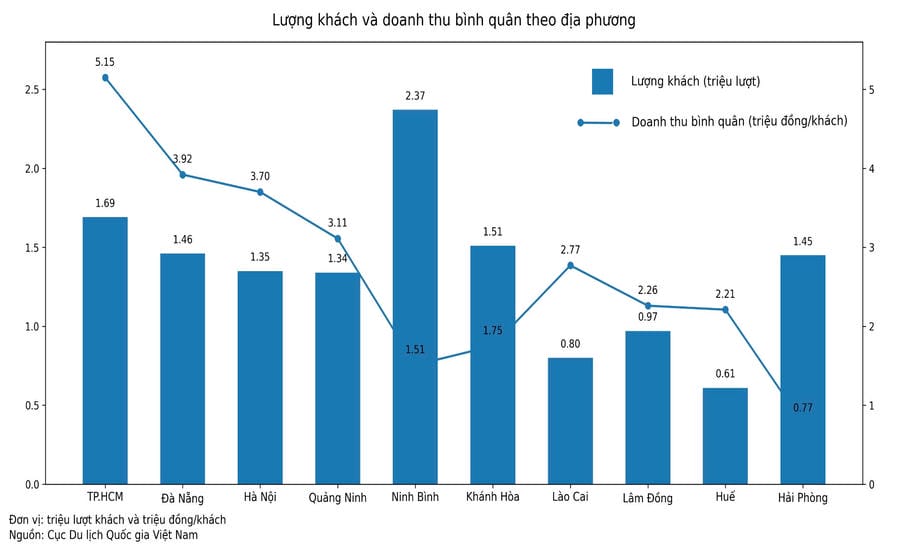
According to statistics from the Vietnam National Authority of Tourism, Ninh Binh is the locality with the most visitors in the country after 2 holidays of Hung Kings Commemoration and April 30 - May 1, 2026 with about 2.37 million visitors. Next is Ho Chi Minh City with 1.69 million visitors, Khanh Hoa about 1.507 million visitors and Da Nang about 1.46 million visitors.
However, if considering the average revenue per visitor, the ranking between localities has significant differences.
Ho Chi Minh City currently has the highest average spending in the leading group, reaching about 5.15 million VND/customer. Da Nang reached about 3.92 million VND/customer, Hanoi about 3.70 million VND/customer and Quang Ninh about 3.11 million VND/customer.
Meanwhile, Ninh Binh, although leading the country in terms of number of visitors, has an average spending level of only about 1.51 million VND/visitor. Khanh Hoa reaches about 1.75 million VND/visitor, while Hai Phong is about 0.77 million VND/visitor.
These figures show that the new competition of tourism today no longer lies in which locality welcomes more tourists, but in the ability to retain tourists longer and make them spend more.
Khanh Hoa is one of the localities that clearly shows the paradox of "many tourists but revenue is not commensurate". During the recent holidays, this locality welcomed about 1.509 million visitors but revenue was only about 2,638 billion VND, significantly lower than many other major tourist centers despite possessing strong advantages in islands and resorts.
According to Mr. Nguyen Phi Hong Nguyen - Deputy Head of Khanh Hoa Travel Association, the big reason comes from the increasingly popular trend of self-sufficient tourism.
Most tourists currently only use basic accommodation and dining services. Fun, entertainment or additional experiences are not strong enough to retain tourists and make them spend more" - Mr. Nguyen assessed.
According to Mr. Nguyen, Khanh Hoa tourism still mainly depends on hotels and traditional sea and island products, while sectors with high spending potential such as shopping, entertainment, health care and cultural experiences have not developed strongly.
The problem of retaining customers and stimulating spending
Quang Ninh is one of the localities showing a trend of shifting from "mass tourism" to increasing spending quality. After the holidays, Quang Ninh welcomed about 1.35 million visitors with revenue of more than 4,100 billion VND - significantly higher than many destinations with equivalent number of visitors.
A survey by the Quang Ninh statistics sector in 2025 showed that domestic self-sufficient accommodation costs an average of about 3.676 million VND/visit, while international self-sufficient accommodation costs about 4.443 million VND/visit. These figures are forecast to continue to grow in 2026.
According to Mr. Phan Xuan Anh - General Director of Tan Hong Tourism Company, international tourist groups, especially luxury cruise passengers, currently not only want to visit beautiful scenery but also seek cultural and local experiences.
If only exploiting natural landscapes, it is very difficult to keep visitors for long or make them return. International visitors currently have a very high demand for cultural, artistic, festival or local-inspired experiences" - Mr. Xuan Anh said.
To extend the length of stay and stimulate spending, Quang Ninh is promoting the night market tourism of Vui-Fest Ha Long, art shows, street carnivals, large-scale concerts and many cultural and ecological experiences in Ha Long, Co To, Van Don and Mong Cai.
According to experts, the night economy, cultural events and entertainment ecosystems are decisive factors in tourist spending at many destinations. This is also an advantage that helps Ho Chi Minh City lead the country in tourism revenue even though it does not own sea and island resources like many other localities.
With Hanoi, Da Nang or Quang Ninh, the current development trend is also shifting to building a complete experience chain so that tourists stay longer and spend more, instead of just promoting destinations.