King's image
In Vietnamese feudal dynasties, horses played an essential role in social life. But under the Nguyen Dynasty, that role was pushed to a higher level, when horses not only served daily life but also became part of the power structure of the dynasty. In the historical context without railways, cars or mechanical vehicles, horses were the fastest and most effective means of mobility, associated with all important activities of the court.
Horses are used to travel, transport goods, food, and military supplies in long marches. In the army, horses are strength and speed, which are factors that help create tactical advantages. In court life, horses pull horses, serving patrols, hunting, and ceremonies. From the battlefield to rituals, from state affairs to the King's personal life, the horse is always present as a loyal companion.
It is this attachment that makes the image of the horse gradually go beyond its pure use value to carry symbolic meaning. For the Nguyen Dynasty kings, the horse is a symbol of power, of the ability to control space and time, of proactiveness in the face of national destiny. A dynasty that wants to be sustainable not only needs rituals and laws, but also needs practical strength, the ability to react quickly to changes. The horse, in that sense, becomes a symbol of an effective state.
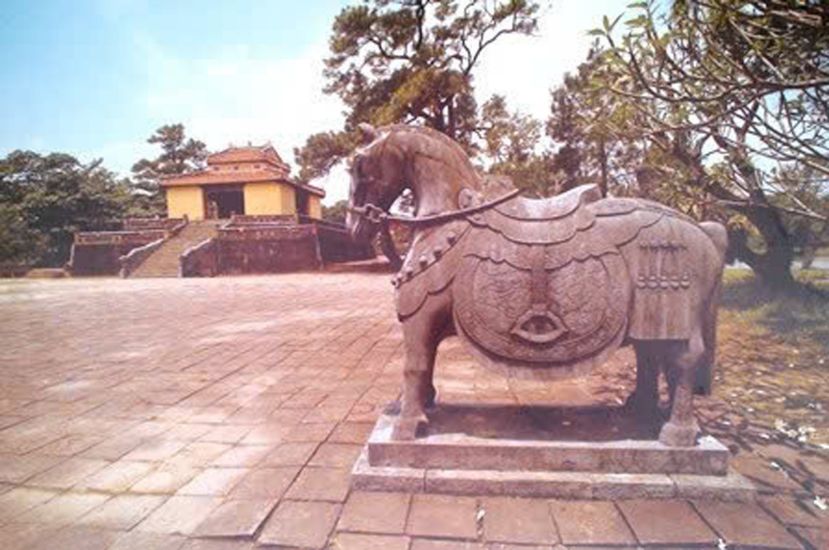
It is no coincidence that at the tombs of Nguyen emperors, from Gia Long, Minh Mang, Thieu Tri to Tu Duc, there are statues of horses standing in front of the courtyard. Each mausoleum usually places two horses on both sides, with full saddles and reins, standing solemnly. But what is noteworthy is that there are no two horse statues that are completely the same. The shape of the horse, body proportions, and facial expression in each mausoleum all have subtle differences.
Some horses exude strength and robustness, as if reminiscent of a difficult wartime. Some have a calm, leisurely appearance, evoking a sense of stability and peace. These differences make people standing in front of the tomb not only see a repeated decorative motif, but also as if facing "symbolic portraits", associated with the lives and imprints of the reign of each king.
The horse in the space of the tomb not only performs the task of protecting the emperor's soul, but is also a symbol of continuity. The horse that once roamed with the king when he was alive, now continues to stand guard in the eternal realm, as an affirmation of the close relationship between people and power, between real life and the spiritual world.
Not stopping at the mausoleum architecture, the image of the horse is also included in the Nine Peaks - the national sacred object cast under the Minh Mang Dynasty. On the Anh Dinh, associated with King Tu Duc, the image of the horse is solemnly carved. Besides, there is also a four-horse carriage - a high-class vehicle only for the king, royal family or mandarins entrusted with important duties.
Carving a horse image on the Nine Urns shows that the Nguyen Dynasty officially elevated the horse to a national symbol, on par with mountains, rivers, seas, products and core elements of the country. The horse, in this case, is no longer the personal property of the king, but becomes a part of common memory, preserved in bronze, with the aspiration to last forever with the country.
Horses in Hue folk memory
If in national architecture and spirituality, the horse carries the majesty of power, then in spiritual and cultural life, the horse appears with softer, more intimate nuances. This is clearly shown in royal poetry and literature, especially in King Thieu Tri - a famous king who loved words and had many works left behind.
In poems written about horses, King Thieu Tri not only praised the physical beauty or speed of the galloping horse, but also emphasized qualities such as endurance, endurance, loyalty and spirit of rushing into battle. The horse in royal poetry is both a real image and a moral symbol, reflecting the ideals of the monarch about people serving the court and the country.
For the Nguyen kings, horses were also associated with physical and mental training. King Minh Mang once said that every time they rode a horse, they felt their tendons and bones relaxed and considered regular movement as a way to avoid laziness, keeping people always ready for big things. That view reflects a very practical national rule mindset: The head cannot just sit still and enjoy peace, but must train himself to be able to shoulder responsibilities.
Out of the royal court space, the image of the horse continues to liven up in Hue folk memories. The familiar saying "Love what is like love the shrimp nest, love Thuong Tu horse, love Thuy Kieu nôm" has been passed down through many generations, showing that horses are not only present in material life but also deeply imprinted in the community's consciousness.
Thuong Tu horse is not an ordinary farmed horse, but a horse given by the king. "Thuong" is the King, "Tu" is given. That is a reward for mandarins, military generals or those who have made special contributions to the court. Therefore, "love of Thuong Tu horse" is not only love of a rare mandarin horse, but also love of the great honor of being recognized and bestowed by the King.
From that concept, the place name Cua Thuong Tu - Dong Nam Mon of Hue Citadel was formed. Near this area was formerly the Thuong Tu Institute, where horses were raised to serve royal carriages and the Nguyen Dynasty army. Although the stables were burned down in the capital's fall in 1885, the name Thuong Tu still exists today, as an imborrable mark of memory.
Horses are also associated with strict ritual regulations in the imperial space. Before the Horse Gate, before Phu Van Lau, there was a stone stele engraved with the four words "Khuynh cai ha ma" - tilting the palanquin, getting off the horse - reminding passersby to show respect for the supreme power space. These regulations show that the horse, despite being associated with authority, must still comply with the strict ritual order of the court.
It can be seen that the horse under the Nguyen Dynasty was not simply a means or decorative image. It is a symbol crystallizing many layers of meaning: Strength and discipline, speed and order, power and responsibility. The fact that the Nguyen Kings valued horses, put the image of horses into the national spirit, erected horse statues in tombs, carved horses in poetry and kept horses in folk memory is a conscious choice, reflecting a deep cultural vision.
It is also a vivid symbol of a dynasty that has entrusted its national rule ideals, discipline and memories into every detail, leaving for posterity a cultural space that is both solemn and imbued with humanity.