Tet rituals
Celebrating Lunar New Year is a common custom of Vietnamese people, but in Hue, Tet is first of all a story of rituals.
The Tet atmosphere does not start bustling from the 23rd day of the twelfth lunar month like in the North, but comes more slowly. The Ong Tao worshiping ceremony of Hue people is simple, focusing on cleaning and tidying up the worship space rather than arranging formally.
The real Tet is only "activated" after the 25th day of the twelfth lunar month, when the boat workers' association holds a ceremony to worship the ancestors of the profession, which is also a year-end ceremony.
For Hue people, ending a year of labor is not only to close the work book but also a ritual of gratitude and repayment to the ancestors and gods, a stream of thinking imbued with the traditional Kinh Ky tradition.
Before Tet, Hue people visit ancestors' graves. It's not just sweeping the graves but an act of "inviting" the deceased to celebrate Tet with their children and grandchildren.
That ritual makes Hue Tet not only the reunion of the living but also the sacred presence of the deceased generations.
Kitchen keeping the soul of the family
If rituals are the backbone, then the kitchen is the soul of Hue Tet. In the past, almost all dishes were prepared by women themselves. Hue Tet dining table is a miniature "food museum", where savory dishes, sweet dishes, and vegetarian dishes go hand in hand.
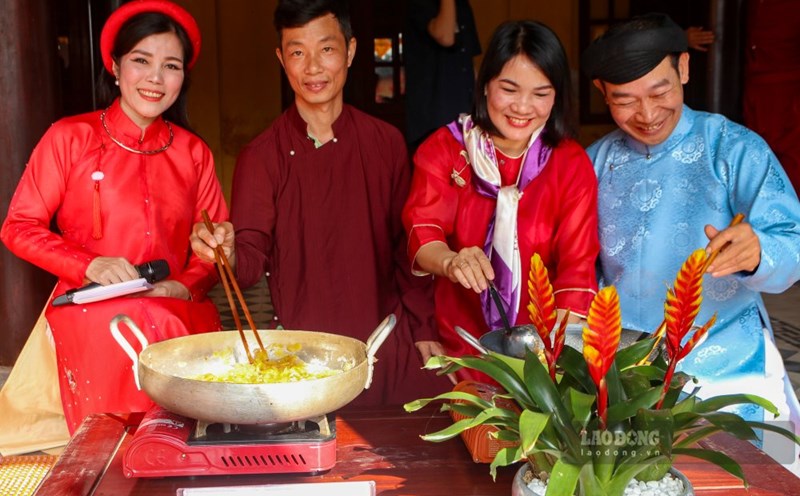
Hue Tet can be mentioned in dozens of dishes: banh tet, pickled vegetables, beef stew, nem tre, pork sausage; ginger jam, lotus jam, banh in, banh thuan, đông suong sweet soup...
In particular, the vegetarian feast on Tet in Hue reaches a level of sophistication that few places can match - a heritage from royal cuisine combined with the spirit of Buddhism deeply ingrained in life.
Today, although restaurants are available, many Hue families still maintain the habit of making their own pickled vegetables and braised meat as a way to maintain family tradition. Celebrating Tet, for them, is not only for eating but also to remember, to extend the tradition.
Playing Tet and Tet bonus
Unlike many places, New Year's Eve in Hue does not have the custom of picking lucky buds. Hue people stay indoors, keeping the tranquility for the sacred moment of transition from the old year to the new year.
However, Hue people are heavily focused on the custom of "stepping on the ground" or "first foot in the house", making all activities carefully calculated, entrusting faith in luck, light spirit and morality.
During Tet days, Hue people prioritize visiting graves, visiting clan temples, wishing Tet to calligraphy teachers and vocational teachers before visiting friends. That order clearly reflects a society that values morality and values roots more than pure social communication.
Hue Tet is also the season of festivals: Bai Choi, boat racing on the Perfume River, Sinh village wrestling, Xam Huong in every family. And indispensable are the Tet flower colors - from Thanh Tien paper flowers to Duong Xuan apricot blossoms, Bai Dau chrysanthemums, all gathered in Phu Van Lau, creating a spring space that is both luxurious and very Hue.
Hue Tet in the past, therefore, is a cultural space prepared, preserved and passed down through many generations.