
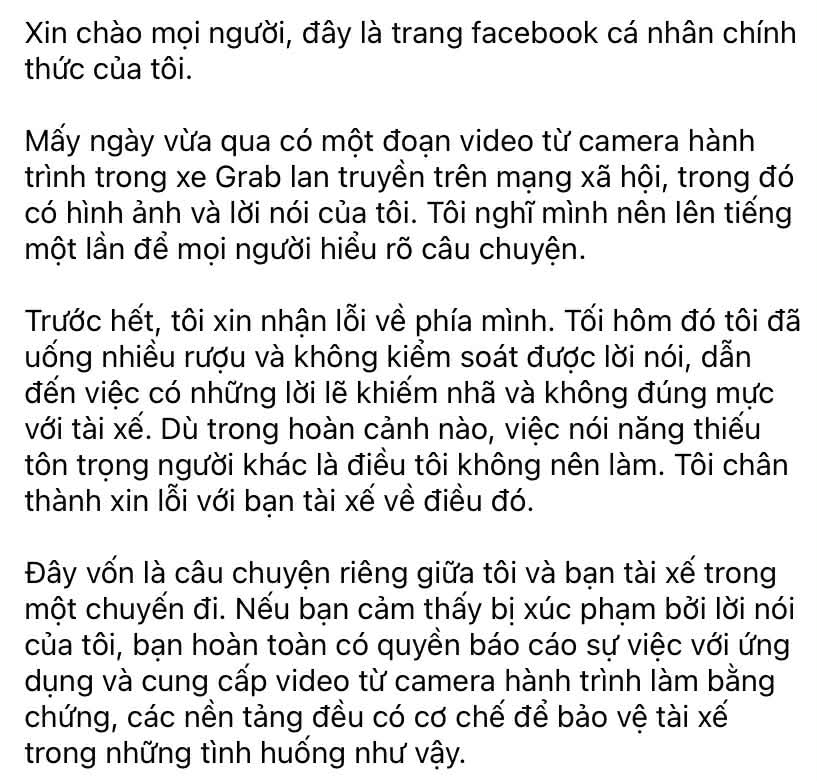
On the morning of March 18, musician Minh Khang's Facebook posted an article apologizing to the technology driver, in which the article also recounted the incident that happened on the "stormy bus". According to the article, musician Minh Khang drank a lot of alcohol and had uncontrolled words with the driver. Immediately after that, the technology driver posted a video (extracted from the dashcam) about the incident.
The video clearly revealed the image and voice of musician Minh Khang, which spread at lightning speed, causing the family and children of musician Minh Khang to also be attacked on social networks.
Currently, the incident is causing fierce controversy on social media platforms.
Driver posts video to borrow the power of the online community
The majority criticized musician Minh Khang, and at the same time said that the driver being fired by the car company was unfair.
Many articles affirm that drivers are not wrong to post videos to explain and clarify themselves. On the contrary, there are also opinions refuting that drivers posting customer videos like that is an act of violating the 2015 Civil Code and the 2025 Law on Personal Data Protection.
Talking to Lao Dong reporters about these controversies, Lawyer Hoang Ha - Ho Chi Minh City Bar Association said: "The public's controversy in this case is completely understandable because the case touches on the fragile line between legitimate grievances and personal privacy.
In my opinion, to thoroughly resolve this debate, we need to clearly separate the difference between the right to denounce and the act of disseminating data.
Current law clearly stipulates privacy and protection of personal data.

According to lawyer Hoang Ha, technology drivers are completely right to use dashcams to record trips to protect security. Drivers are also completely right to submit that video to Grab or the investigating agency to request handling of the customer who threatened.
However, the driver was wrong to arbitrarily publicly share the video (containing images and voices that are personal data of others) on cyberspace. This act violates the principle of handling data for the right purpose and exceeds the limits of self-defense.
The outrage of the majority when defending drivers is a completely natural and justified psychological reaction. No one can accept a genuine worker being insulted and threatened while working" - Lawyer Hoang Ha said.
But, considering reality, public camera extraction is often for urgent purposes, for example, to ask the community to identify and support functional agencies to arrest a criminal dangerous to society.
Contrary to the context of the technology car trip, the driver and the car company clearly knew the identity and information of the customer. The trip had ended, the threatening act had stopped, and no criminals were escaping or directly endangering the community to the point of having an online arrest warrant issued.
Therefore, I believe that drivers do not need social networks to find the culprit. Posting at this time does not mean denouncing or pursuing, but purely borrowing the power of the crowd to punish and shame others" - Lawyer Hoang Ha said.
Social media is not a court
According to Lawyer Hoang Ha, social networks are not the agency receiving denunciations and the online community does not have the authority to issue judgments.
When drivers choose to upload videos online (violating the 2025 Personal Data Protection Law), he himself has taken away his "legal weapon" and unintentionally crossed the line of the victim to become a civil law violator.
The regulation banning the dissemination of personal data is not to create an inmunity to bad behavior.
This regulation was born to protect a civilized social order, where all conflicts are resolved by law, not by mob attack.
If we advocate for "customers cursing, drivers have the right to post videos", then tomorrow there will also be cases where drivers accidentally go the wrong way, and customers have the right to publicly shame drivers online.
Lawyer Hoang Ha said, "a society of tit-for-tat with personal data will create great insecurity for everyone.
Regarding the decision to terminate the car company's cooperation with the driver, it may create a sense of injustice for public opinion, but in terms of corporate risk management and the rule of law, it is an act of mandatory compliance.
This incident also reflects a current reality that when workers choose to borrow social networks as courts instead of using legal denunciation tools, they have deprived themselves of legitimate rights and lost their jobs.
Regarding the musician's behavior towards the driver, current law stipulates very specific sanctions. Depending on the nature and severity of the threatening words and gestures recorded, this customer may face disciplinary actions such as:
Administrative sanctions. If the act stops at the level of drunkenness, cursing, insulting with vulgar words, then according to the provisions of point a, clause 3, Article 7 of Decree 144/2021/ND-CP, the act of "Having rude, provocative, teasing, insulting gestures and words of honor and dignity of others" will be fined from 2-3 million VND.
Second, criminal responsibility can be considered if the act is particularly serious and sufficient to constitute a crime. Even if it occurs in a drunken state, if the act of threat or insult exceeds the limits of administrative violation, functional agencies may consider criminal signs.
According to Article 592 of the 2015 Civil Code, the driver (victim) has the full right to sue in a competent court to request the customer to compensate for damages caused to honor and dignity. The compensation level will include reasonable costs to limit and remedy damages and a sum of money to compensate for mental damage (not exceeding 10 times the base salary if the parties cannot agree on their own).


