
The pain of Vietnamese films when released in theaters
Copyright infringement is no longer just isolated acts but has formed organized infringement ecosystems:
Those are transformed online "hooks" with names such as Phim*** (which has been prosecuted but continuously "revved" under domain names such as phimm***, phimmoi***), Phimhay***, or Ro Ph*** (a platform that attracts hundreds of millions of accesses). These pages use foreign servers and continuously change IP addresses to evade blocking commands.
Next is the problem of "theft" right at the cinema, most typical of which is Tran Thanh's 2026 Tet movie project "Thỏ ơi!!". Just a few days after screening, the film was secretly filmed and the entire ending was revealed on social networks, forcing the director to speak out to "beg" for sympathy from the audience. Previously, films such as "Mai" or "Nha ba Nu" also fell into a similar situation, causing distributor Galaxy Studio to make a written record, coordinate with functional agencies to trace the source of dissemination. This problem is not new but increasingly sophisticated.
Looking back at the past, a typical case is the movie "Co Ba Sai Gon" which was livestreamed for nearly 1 hour right in the cinema, causing producer Ngo Thanh Van to express helplessness and discouragement. These actions not only cause economic damage but are also a fatal "slash" to the creative enthusiasm of filmmakers.
Need a synchronous and drastic solution system
Closely following the Prime Minister's direction to increase the rate of handling violations by at least 20% compared to the same period last year, groups of solutions need to be deployed more widely and strongly. First of all, technology solutions.
In the digital age, only technology can cope with technological violations. Content encryption and identification are needed. The digital rights management (DRM) system combined with hidden Watermarking (Watermarking) is thoroughly applied. This technology allows manufacturers to accurately track from the seat position or account that has distributed illegal content to handle it specifically. Use AI in automatic scanning. Deploy artificial intelligence (AI) tools to continuously scan on social networking platforms (TikTok, Facebook, YouTube) to identify and automatically remove copyright-infringing videos as soon as they are uploaded.
Administrative and criminal solutions must be accompanied by technological solutions, because this is the legal "sacred sword".
Criminalizing serious violations. Instead of just imposing administrative fines "for show", it is necessary to promote criminal prosecution of large-scale illegal website owners. Handling cases like Phimmoi or Ro Phim will be the strongest warning bell.
Establish a hotline between the Ministry of Culture, Sports and Tourism and network operators (ISPs). When illegal film distribution is detected, the order to block access to violating domain names must be implemented immediately within a few hours to maximize cinema revenue protection.
Regarding economic solutions, it is necessary to cut off the "source of livelihood" for pirated films. Management agencies need to coordinate with the State Bank and intermediary payment units to prevent money flows from betting advertising from pouring into the pockets of pirated web owners. When there is no longer profit, these sites will self-dissolve. A "Liability Alliance" must be built. Vietnamese film producers need to sit down together, contribute to the common budget to hire professional copyright protection companies, instead of fighting alone as they are now.
And finally, it is necessary to elevate the culture of enjoyment and community responsibility. Instead of just shouting slogans, practical actions are needed to build a civilized cinema ecosystem. Spreading the message that watching copyrighted movies is an action to protect national cultural values. Audiences need to access information to understand that: Each pirated view is directly contributing to crime and impoverishing the country's cinema. Increase access and diversify platforms. Official movie viewing services (OTTs) need to optimize experiences and diversify flexible packages so that all classes of people can access "clean movies" at reasonable costs.
Ensuring that the number of cases suspending customs clearance procedures and being handled increases by at least 20% compared to May 2025 is not just an indicator number, but a declaration of war against the problem of IP infringement.
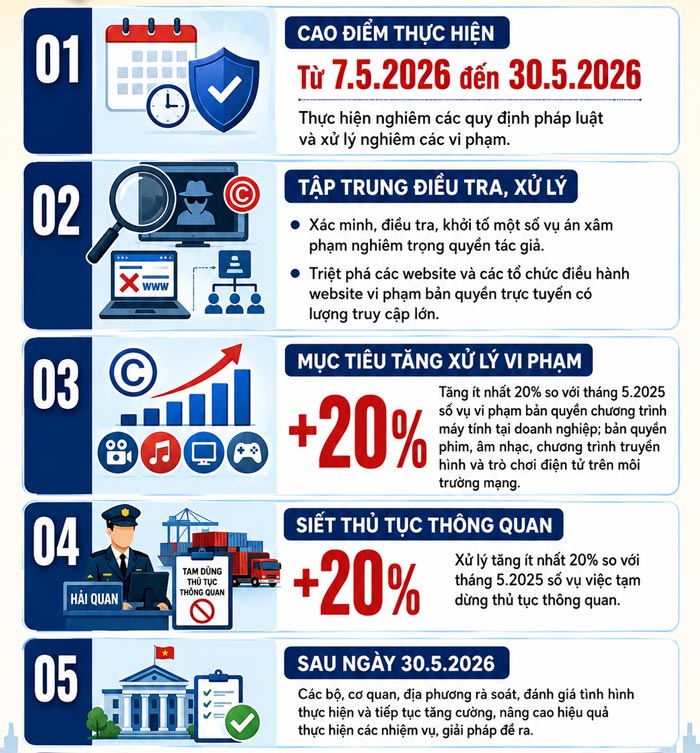
The Prime Minister has just issued Official Dispatch No. 38/CD-TTg dated May 5, 2026, focusing on directing the drastic implementation of solutions to combat, prevent, and handle acts of intellectual property rights infringement.
The Prime Minister requested to drastically direct functional forces to launch campaigns, focus resources, and immediately implement necessary measures to fight, prevent, and handle acts of intellectual property rights infringement nationwide from May 7, 2026 to May 30, 2026, strictly implement legal regulations and strictly handle violations in the spirit of no forbidden zones, no exceptions.


