
Carefully assess and consider the development of pig farm projects
Gia Lai is the second largest province in the country, the capital of a series of large-scale pig farms.
According to the Gia Lai Provincial Sub-Department of Environmental Protection, some commune-level areas currently have very high livestock density. For example, in Ia Lau and Po To communes, the livestock density can reach about 6-7 livestock units (ĐVVN) per 1ha of agricultural land.
Although in general throughout the province, the livestock density is still within the permitted limits according to regulations, not exceeding 1 VNA per 1ha of agricultural land, the concentration of too many livestock facilities in some localities may exceed the environmental load capacity.
This increases the risk of biohazard, pollution, environmental incidents and the formation of social hotspots.
Faced with the above reality, the Department of Agriculture and Environment of Gia Lai province has also reported to the Provincial People's Committee to consider stopping receiving dossiers for new pig farming projects in areas with high population density, places with large-value arable land, areas that have been planned for other economic sectors or key and sensitive areas for national defense and security...
Along with perfecting the management mechanism, functional agencies also strengthen the strict handling of violations of environmental laws in livestock activities.
Criminal handling of environmental pollution cases
In Kon Gang commune, Gia Lai province, a locality with strengths in agricultural and livestock development, many large-scale pig farms have contributed to increasing people's income. However, if waste and wastewater generation are not well controlled, this activity can seriously affect the environment and community health.
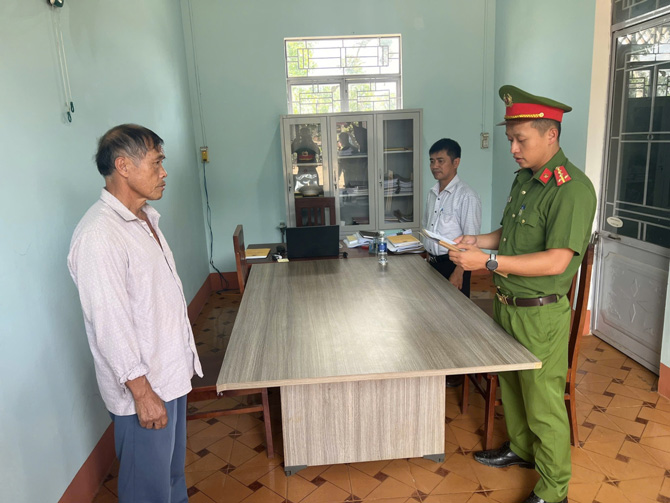
Over the past time, Kon Gang Commune Police have discovered and handled many cases of environmental protection violations. Typically, on March 28, 2026, functional forces discovered a livestock household in K'Dập village letting wastewater from pig pens flow into inter-village traffic roads, causing environmental unsanitary conditions. The household owner was administratively sanctioned and forced to remedy the consequences.
In particular, through grasping the situation, Kon Gang Commune Police discovered signs of water source pollution in the K'Dập stream area. The inspection process determined that a large-scale pig farm had discharged untreated wastewater into the environment through an underground pipeline system.
On May 20, 2026, the Economic Police Department of Gia Lai Provincial Police coordinated with relevant units to inspect Mr. To Xuan Hong's livestock farm in K'Dap village.
The inspection results showed that the facility did not have an environmental permit, did not build a waste treatment facility as prescribed, but discharged waste directly into the soil environment. The investigating agency determined that the total volume of untreated waste discharged into the environment was more than 240 tons.
From the investigation results, on June 12, 2026, the Investigation Police Agency of Gia Lai Provincial Police initiated a case and prosecuted the defendant To Xuan Hong for the act of "Causing environmental pollution" as prescribed in point d, clause 2, Article 235 of the Penal Code.
Through this incident, functional forces recommend that organizations and individuals operating in animal husbandry in the area strictly comply with regulations on environmental protection; invest and operate fully waste and wastewater treatment systems; absolutely do not discharge directly into the environment to protect water sources, land and community health.


