
People become subjects of planning
According to Assoc. Prof. Dr. Bui Thi An, former National Assembly Deputy of the XIII term, Chairwoman of the Hanoi Women Intellectuals Association, Director of the Institute of Natural Resources, Environment and Community Development, the new point of the Capital's Master Plan is not only in the planning time but also in the long-term approach, but still solving immediate problems.
Planning takes people at the center, towards harmonious development between economy, society and environment; proactively adapting to climate change, population aging, digital transformation and artificial intelligence; and is built on a basis of scientific data, ensuring publicity and transparency.
In particular, in this Capital Planning, people are no longer the subjects affected but become the subjects of the plan. People are allowed to participate in contributing opinions, criticizing, supervising and accompanying throughout the implementation process, thereby improving the feasibility of the plan, creating social consensus, contributing to ensuring the sustainable development of the country in general and the Capital in particular.
To effectively promote this role, the decisive factor is the responsibility and capacity of the grassroots cadre team, the people closest to the people, closest to the people. Along with that, the publicity and transparency of the entire process, from planning announcement, collecting people's opinions to resettlement plans, compensation prices and related policies, will create trust, consensus and ensure that planning is implemented effectively," Assoc. Prof. Dr. Bui Thi An emphasized.
Building long-term competitiveness
From an economic and urban development perspective, Economic Expert Nguyen Quang Huy, CEO of the Faculty of Finance - Banking, Nguyen Trai University (NTU) said that the Master Plan of the Capital with a 100-year vision is not only a milestone of urban planning but also reflects a major shift in Vietnam's development thinking: from term-based management to building the future according to a multi-generational vision; from expanding development space to improving growth quality; from development based on traditional resources to development based on knowledge, science and technology and innovation.
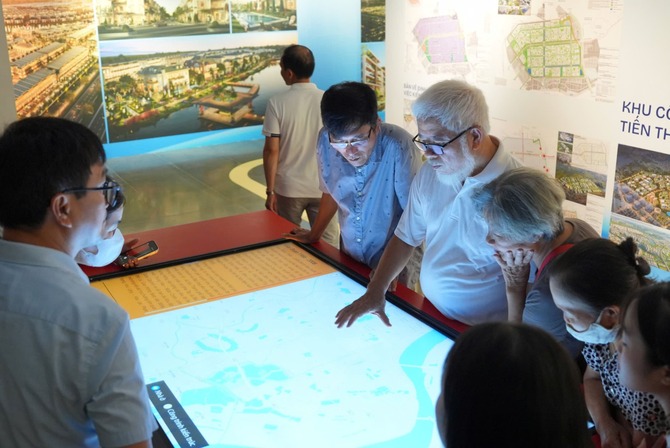
In the context of increasingly fierce competition between cities around the world, planning is no longer simply a problem of land allocation or infrastructure but has become a design for the long-term competitiveness of a city.
Hanoi's choice of the development philosophy "Culture - Civilization - Modernity - Happiness" is meaningful beyond the scope of a plan. This is an affirmation that the ultimate goal of development is not only to increase the scale of the economy, but also to improve the quality of life, develop people and build a city with global competitiveness but still retain cultural identity," Mr. Nguyen Quang Huy said.
He also highly appreciated the orientation of forming growth poles in high technology, logistics, finance and innovation; developing the Red River into an ecological and cultural landscape axis; and prioritizing attracting investment in fields such as semiconductor, artificial intelligence, microchip design, big data, biotechnology, research and development (R&D) centers, green finance, modern logistics and high-quality education. This is a shift from attracting investment in quantity to selecting projects with high added value, creating a spillover effect for the entire economy.
However, Mr. Nguyen Quang Huy said that good planning is only a necessary condition, and the decisive factor lies in implementation capacity. Hanoi needs to continue to build a transparent and stable investment environment, promote the role of public investment as "bait capital" to lead private investment, and at the same time form innovative and high-quality human resource development ecosystems to improve long-term competitiveness.
The overall planning of the Capital is not only the planning of a city, but also an opportunity to create a new growth pole for the country in the context of increasingly deep global competition.
If it is consistent with the goal of putting people at the center, putting science and technology and innovation as motivation, taking green development and sustainable development as orientations, and constantly improving the quality of urban management according to international standards while still preserving the depth of Vietnamese culture and identity, Hanoi has every basis to gradually become a competitive center of creativity, finance, culture and technology in Asia.
At that time, the 100-year vision will not just be a plan, but will become a strategic foundation for the sustainable development of the Capital and a driving force for the country's modernization process in the 21st century," Mr. Nguyen Quang Huy affirmed.


