
On September 22, the Center for Rescue, Conservation and Development of Organisms under the Phong Nha - Ke Bang National Park Management Board said that it had just received 3 wild animal individuals handed over by the authorities of communes and wards in Quang Tri province for rescue. The process of handover and receipt was coordinated and witnessed by local Forest Protection Departments.
The recipients include 2 golden mountain turtles and 1 crested ivory.
In which, the People's Committee of Hoan Lao commune handed over 1 golden mountain turtle individual discovered and reported by Ms. Tran Thi Man Ai (residing in hamlet 1, Hoan Lao commune).
Nam Ba Don Commune People's Committee handed over 1 golden mountain turtle individual discovered and reported by Ms. Truong Thi Yen (residing in Nam Ha village, Nam Ba Don commune).
The salamander individual was handed over by Quang Tri Ward People's Committee after Mr. Tran Ba Phuong, residing at No. 1 Ly Nam De, Quang Tri Ward discovered and reported it.
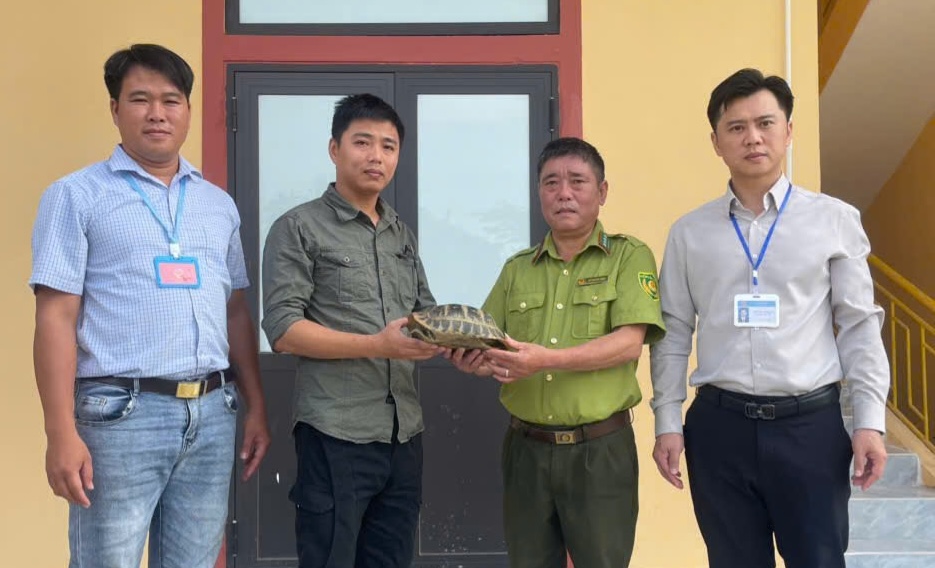
After receiving information from people, commune and ward authorities coordinate with functional forces to carry out procedures for receiving and publicly notifying to verify the owner or legal manager of individual animals.
After the notice period according to regulations expires, functional agencies cannot identify the owner or legal manager. At the same time, the individual animals are identified as not exhibits or material evidence of the law violation case.
On that basis, the People's Committees of communes and wards handed over 3 animal individuals to the Center for Rescue, Conservation and Development of Organisms to carry out rescue work according to regulations.
According to the circular of the Ministry of Agriculture and Environment, monitor monitors belong to Group IB, while golden mountain turtles belong to Group IIB in the list of endangered, precious, and rare species.
Immediately after receiving them, the Center checked their health and arranged a care area suitable to the biological characteristics of each species.
The individuals are isolated, monitored, cared for and restored to their physical condition and ecological habits according to professional procedures. When meeting all the conditions according to regulations, the individuals will be considered for re-release to a suitable natural environment.


