
On August 19, the Center for Rescue, Conservation and Development of Organisms under the Management Board of Phong Nha - Ke Bang National Park coordinated with the Forest Protection and World Heritage Center to re-release 13 wild animal individuals to their natural environment.
The activity was supervised and witnessed by Phong Nha Forest Protection Department and Phong Nha Commune People's Committee, Quang Tri province.
The 13 individuals brought back to nature include 5 macaques (Macaca arctoides), 1 turtle (Cuora mouhotii), 2 small loris (Nycticebus pygmaeus), 2 salamanders (Varanus nebulosus) and 3 Java pangolins (Manis javanica).
These are all endangered, precious, and rare species according to Circular No. 85/2025/TT-BNNMT. Among them, Java pangolins, small loris and iguanas belong to Group IB; the remaining species belong to Group II.
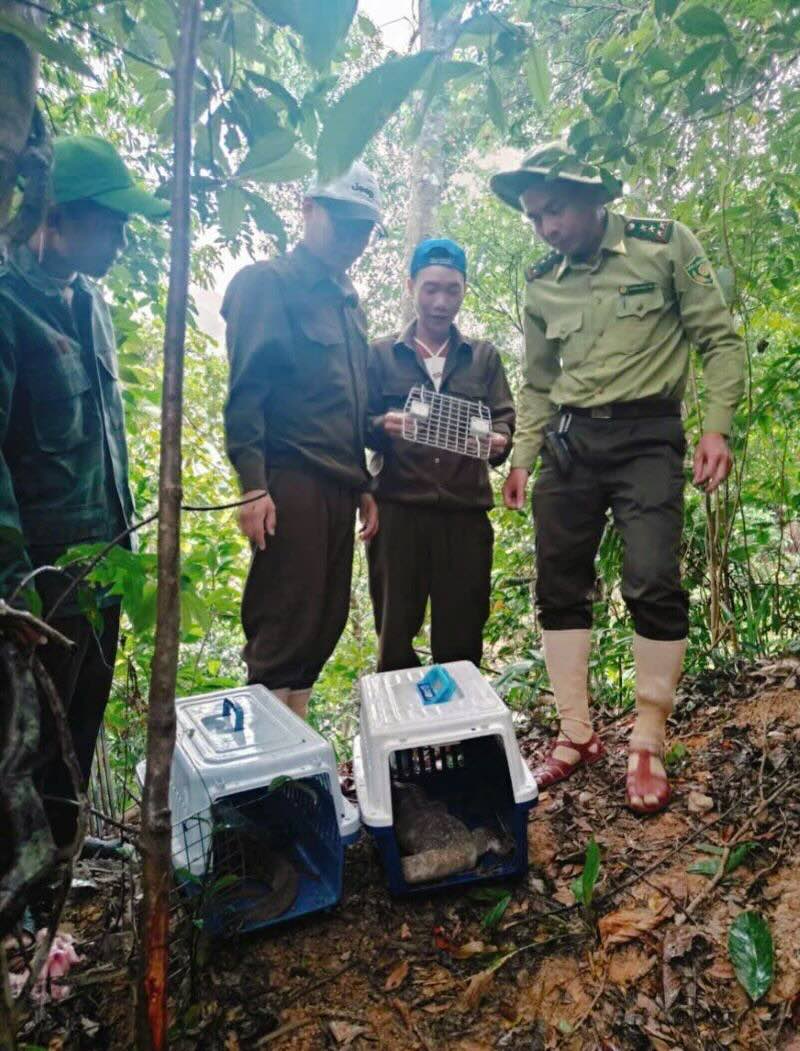
Before being released, the animals are cared for, restored to their health and wild behavior at the Center for Rescue, Conservation and Development of Organisms.
Only individuals that meet the requirements for health and adaptability to the natural environment are selected to be returned to the forest.
After meeting the conditions, the individuals are transported to the re-release area identified in Phong Nha - Ke Bang National Park. The selected location is suitable for the ecological characteristics of each species, ensuring conditions for finding food, shelter and adapting to the living environment.
According to the Management Board of Phong Nha - Ke Bang National Park, bringing animals back to the forest after rescue is the final step in the care and restoration process, and also the beginning of the process for individuals to adapt back to the natural environment.
After being re-released, individuals must find food, shelter and maintain the necessary habits to survive in nature.
Releasing activities are a step in the process of rescuing, caring for and restoring wildlife at the Center for Rescue, Conservation and Development of Organisms. The goal is to bring eligible individuals back to their habitat, contributing to maintaining the wildlife population in Phong Nha - Ke Bang National Park.
The fact that 13 individuals continue to return to the forest this time is the result of the process of receiving, caring for and restoring, and at the same time contributing to supplementing individuals for wildlife populations, preserving biodiversity and natural values of the National Park.


