
Ford Vietnam has just introduced upgraded versions of the Ranger and Everest, with notable changes in the transmission system, adding large-capacity engines and updating technology equipment. This move is aimed at maintaining competitiveness in the two pickup and 7-seater SUV segments with separate chassis.
In the pickup truck group, the Ranger Wildtrak is equipped with a V6 3.0L diesel engine, 250 PS of power and 600 Nm of maximum torque. The high-performance Ranger Raptor version uses a V6 3.0L EcoBoost gasoline engine, reaching 397 PS and 583 Nm. Meanwhile, the Everest adds the Platinum+ version using a 2.3L gasoline engine, 300 horsepower and 446 Nm of power. These configurations all combine a 10-speed automatic transmission, accompanied by a 4-wheel drive system on high-end versions.
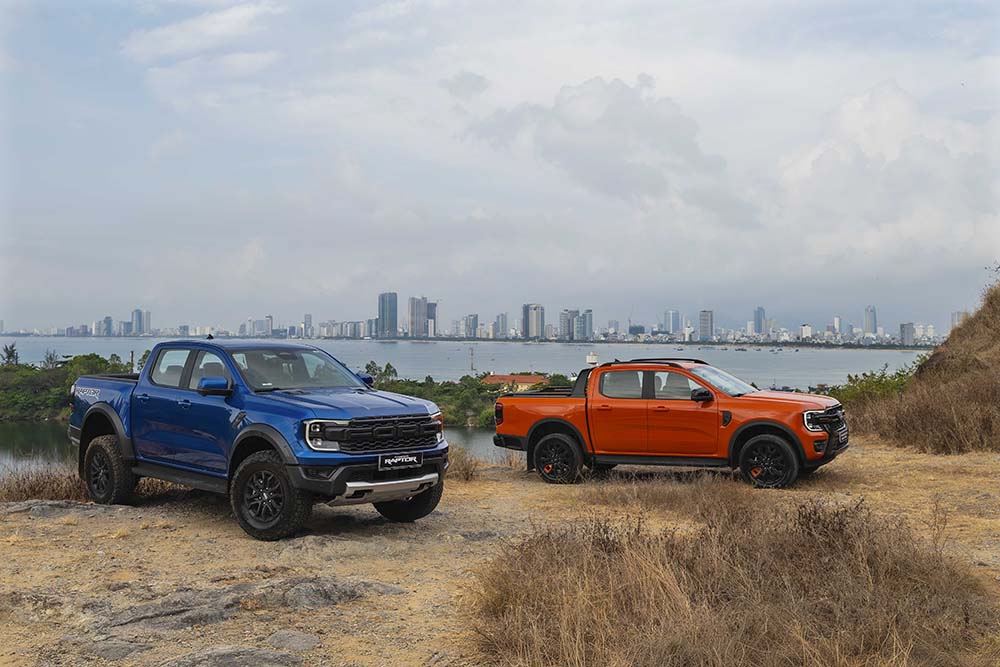
The advantages of the new product range lie in operating capacity and versatility. The V6 engine delivers a large torque, suitable for load-pulling needs, long-distance driving or complex terrain. The all-wheel drive system and 10-speed gearbox help optimize the power range in many operating conditions. The detachable chassis continues to be an advantage compared to single-frame SUV models such as Hyundai Santa Fe or Kia Sorento, thanks to its load-bearing capacity and durability when off-road. The Ranger Raptor is equipped with a 2.5-inch FOX electronically controlled suspension, which helps improve stability on difficult terrains - a rare equipment in the segment.
In addition, safety equipment and technology are upgraded evenly, including a 360-degree camera, a 12-inch central screen, advanced driver assistance system and at least 6 airbags. These features help the model approach the SUV/crossover group in terms of comfort.
However, large-capacity engine configurations, especially V6 gasoline engines, can lead to higher fuel consumption compared to competitors using small-capacity diesel engines. This is a factor directly affecting long-term usage costs. The detachable chassis also has limitations in smoothness and sound insulation when operating in urban areas, not as optimized as single-frame SUV models that favor convenience.
Ford's conversion of the 2.0L diesel engine from twin-turbo to single-turbo helps simplify the structure and can improve durability, but in return, the acceleration capability at low rpm range may no longer be as sensitive as before. Equipped with technology, although supplemented, is no longer a superior advantage as many car models in the same price range have popularized similar features.
In general, the upgraded Ranger and Everest versions are suitable for customers who prioritize power, off-road performance and versatile usage needs. Meanwhile, for users who mainly travel urbanly, value smoothness and fuel economy, frame SUVs are still a worthwhile choice in the same price range.


