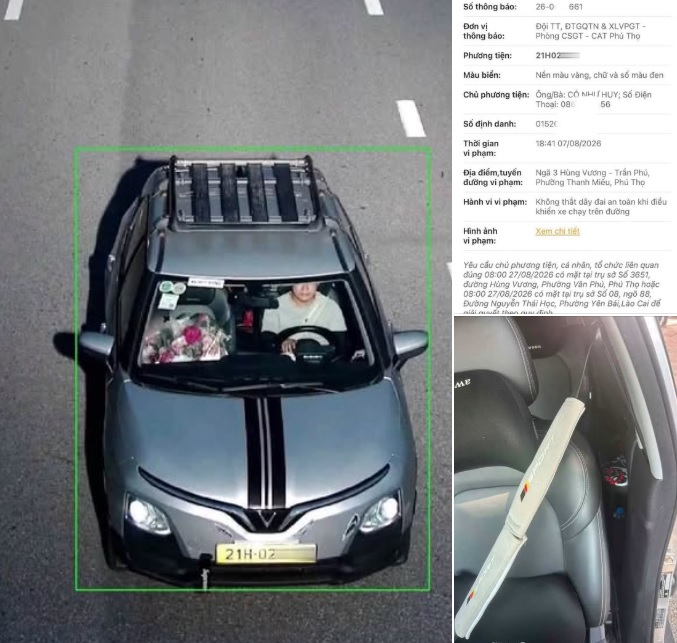
At the beginning of August, a driver in Yen Bai received a remote fine notice on VNeTraffic for the offense of not fastening the seat belt. The car was recorded to have violated at 6:41 pm on August 7 at the Hung Vuong - Tran Phu intersection, Thanh Mieu ward, Phu Tho.
The driver said that he had tied the rope, but the rope was wrapped in a cream-colored cushion, similar to the color of the shirt he was wearing, making it difficult for the camera to recognize. After verification, the police confirmed that the driver complied and did not fine.
The incident attracted attention on car and traffic groups. Many drivers believe that they should avoid wearing clothes the same color as the seatbelt or using a protective layer that makes it difficult to recognize the seatbelt through the camera.
Has the right to provide evidence to prove no violation
Talking to Lao Dong Newspaper, Lawyer Hoang Ha, Ho Chi Minh City Bar Association, said that according to point d, clause 1, Article 3 of the Law on Handling of Administrative Violations, the person with sanctioning authority is responsible for proving administrative violations; individuals and organizations being sanctioned have the right to prove that they have not violated.
Therefore, when receiving a remote fine notice, drivers need to check the information on VNeTraffic or the traffic police Department's lookup system, then contact the police agency recorded in the notice for resolution.
According to Article 24 of Circular 73/2024/TT-BCA, when the vehicle owner or person involved in resolving the case, the Police agency shall compare information and show the violator the collected results using professional technical means and equipment.
In case of suspicion that the camera or identification system is wrong, drivers should request to see images, videos or original data used to determine the violation. At the same time, people can provide dashcams, cameras in the car, images at the time of the incident, dash data or the testimony of the passenger to prove that they have complied with regulations.
Providing evidence does not mean that functional agencies must immediately accept the driver's argument. The basis for handling must be compared and verified according to the collected records and data. If the verification results show that there is no violation, there is no basis for sanctioning.
Proactively store documents to avoid affecting vehicle registration.
One issue that many drivers are concerned about is whether the rights of vehicle owners are affected if violation information is still displayed on the system while waiting for verification?
Lawyer Hoang Ha recommends that drivers should keep traffic ticket notices, petitions or explanatory contents, provided documents, receipts and minutes of working with the Police agency. These documents are the basis to prove that the vehicle owner has proactively come to resolve the case.
According to Clause 5, Article 24 of Circular 73/2024/TT-BCA, after more than 20 days from the date of sending the notice, if the vehicle owner or related person does not come to resolve, or the Police agency has not received the resolution result from the unit being transferred for handling, the competent authority will send a warning to the registration agency, vehicle registration agency and update the status on the system.
Therefore, when you have come to the Police agency to explain a misidentification error, the driver should request the file to clearly show that the case is being verified, and at the same time regularly check the violation status on VNeTraffic and the lookup system of the Traffic Police Department.
This is even more noteworthy if the vehicle is about to be inspected or perform procedures related to vehicle registration. Decree 166/2024/ND-CP stipulates that vehicles may be warned when related to administrative violations in the field of road traffic order and safety; warnings are removed when there is evidence that the warning content has been corrected.
Therefore, if the vehicle is about to be registered or transferred, drivers should bring documents proving that they have come to resolve the case for functional agencies to check and update data in a timely manner.