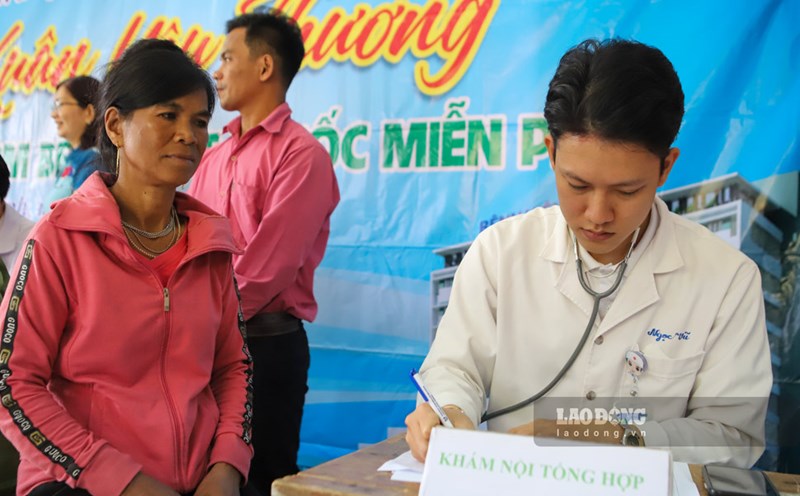
After arranging and implementing the 2-level local government model, the number of commune-level health stations in Gia Lai province decreased from 373 to 135 stations, with 369 health points.
The total human resources present at 135 commune-level health stations increased by 114 people, but human resources are still lacking and unbalanced. The actual number of people working is lower than the assigned number by nearly 494 people; there are 112/135 health stations lacking human resources.
The province has implemented policies on allowances, support, and attraction of medical personnel; maintained a team of population collaborators, village and residential health workers, and village and hamlet midwives.
However, attracting and retaining qualified personnel at health stations in remote areas, ethnic minority areas, mountainous areas and border areas still faces many difficulties, even recruiting civil servants but no candidates...
To remove these obstacles, Gia Lai Provincial People's Committee proposed to the National Assembly and the National Assembly Standing Committee to consider and improve relevant legal regulations, ensuring synchronization with the model of commune-level health stations directly under the commune-level People's Committee.
At the same time, consider having a mechanism to allocate resources and specific policies to invest in infrastructure, equipment and human resources for grassroots healthcare in mountainous, border, remote and ethnic minority areas.
Proposing to expand the investment scale of the National Target Program on People's Health Care, Population and Development for the period 2026-2035, especially the source of funding for investment in infrastructure and medical equipment for health stations in difficult areas.
The province proposes that the Government direct relevant ministries and sectors to urgently issue or amend and supplement regulations on financial mechanisms and autonomy mechanisms, suitable to the specific characteristics of commune-level health stations being public health non-business units.
At the same time, prioritize allocating medium-term public investment capital, capital from national target programs, ODA capital and preferential loans to mountainous and border provinces with large areas after the merger such as Gia Lai to synchronously upgrade infrastructure and equipment for health stations.
The province requests the Ministry of Health to soon guide and unify the conditions for establishing health stations as public non-business units directly under the commune-level People's Committee; amend and supplement Circular No. 03/2023/TT-BYT in the direction of determining human resource norms based on population, number of station points, area, geographical distance, difficulty level of the area and task volume.
In addition, it is necessary to stipulate the minimum number of personnel at the main station and station points; supplement human resources for administrative, accounting, clerical, information technology, statistics and support positions. Guide flexibly in recruiting, receiving and mobilizing health officials between communes and wards to promptly supplement human resources for areas that are still lacking.
Regarding salaries, allowances and preferential policies, the province proposes to increase the level of professional preferential allowances, regional allowances; support housing, travel and attract and retain medical personnel in mountainous areas, border areas, remote areas and ethnic minority areas.
The province also proposed to develop policies, programs, and projects to promote training according to usage addresses, assigned recruitment, articulation, and continuous training for medical staff in difficult areas, especially training doctors for grassroots healthcare, linking training support with service time commitments...