
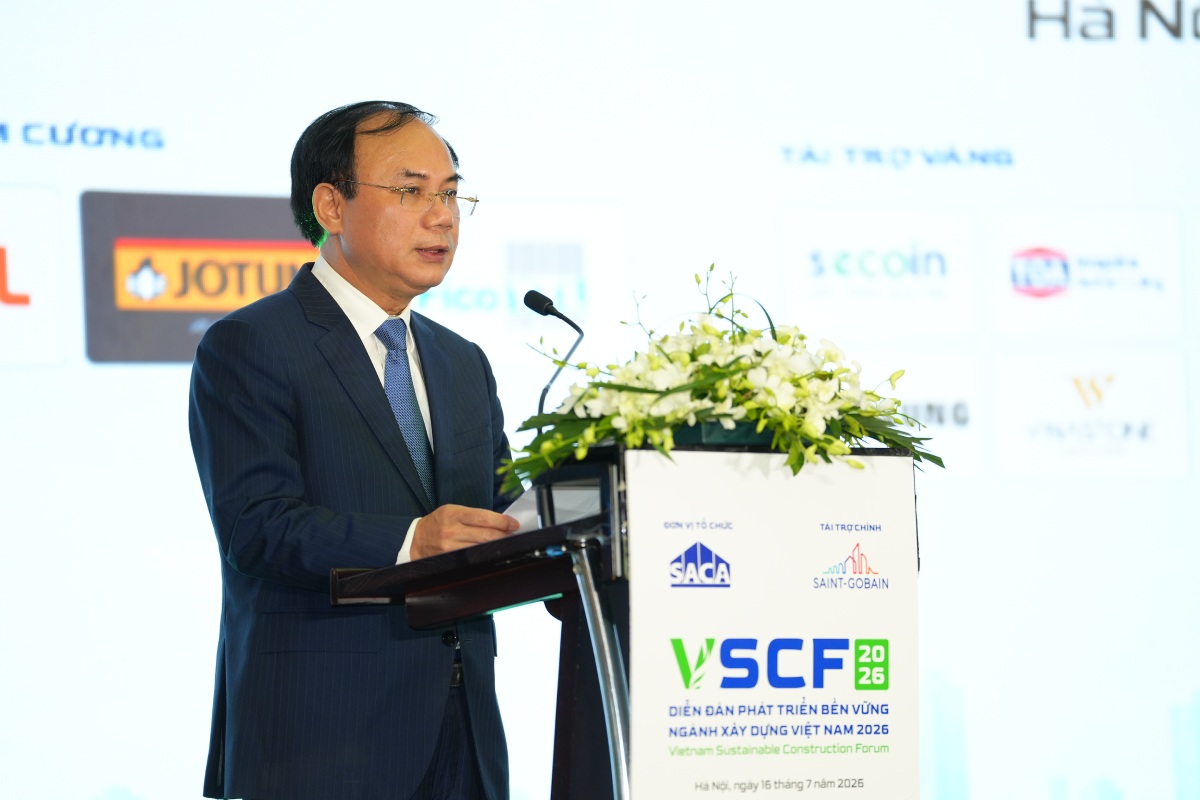
On July 16, in Hanoi, the Ho Chi Minh City Association of Construction and Building Materials (SACA) organized the Vietnam Construction Industry Sustainable Development Forum 2026.
Speaking at the forum, Mr. Nguyen Quang Vinh - Vice President of the Vietnam Chamber of Commerce and Industry (VCCI) said that the world is entering a stage where sustainable development is no longer a voluntary option, but instead - is becoming a condition of competitiveness.
Export markets, financial institutions, investors and customers are increasingly interested in carbon footprints, raw material origins, energy efficiency, labor responsibility, corporate governance and the level of transparency of the supply chain. This also means that Net Zero is not simply an environmental commitment, but is becoming an economic development strategy and a driving force to innovate the growth model of businesses in the new era.
For Vietnam, this transition process is even more significant as we are entering a new stage of development with the goal of rapid growth but must go hand in hand with quality, efficiency and sustainability. Committing to achieve "zero" net emissions by 2050, along with gradually perfecting policies on circular economy, operating the carbon market, green growth and developing clean energy, is opening up new opportunities but also posing many new requirements for the business community.
Deputy Minister of Construction Nguyen Van Sinh said that in the context of Vietnam accelerating the transformation of the green growth model, developing a low-carbon economy, the construction industry has achieved many results in many fields.
Accordingly, the transition to electric vehicles is taking place strongly. By the end of May 2026, the whole country had nearly 372,000 electric road vehicles put into circulation. These results show that the trend of green transformation is becoming increasingly clear, and at the same time poses an urgent requirement for synchronous development of infrastructure, clean energy sources and mechanisms and policies to promote the transition process in the coming time.
Many investors, consulting enterprises, contractors and building material production units have proactively applied green design solutions, advanced construction technology, using energy-saving materials, low-emission materials and strengthening project management and operation towards sustainability.
To date, Vietnam has had more than 828 green buildings certified with a total floor area of about 20.8 million m2, exceeding the set target and ranking 8th among 180 countries and territories in terms of the number of green buildings certified. This is clear evidence of positive changes in the awareness and actions of management agencies, businesses and the whole society towards green building development.
The results achieved show that the development of green transportation, green buildings, green building materials, energy saving and environmental friendliness is no longer an encouraging orientation, but has gradually entered production practice, construction investment and the market.
According to Deputy Minister of Construction Nguyen Van Sinh, the process of investing in infrastructure development needs to closely link construction projects with green transportation systems, public transport and infrastructure serving energy conversion, thereby forming a sustainable urban space and infrastructure development. At the same time, it is necessary to promote the application of green materials, advanced construction technology, energy-saving and emission-reducing solutions throughout the life cycle of infrastructure projects; strengthen the application of digital technology in management and operation to improve exploitation efficiency, reduce environmental impact and contribute to the implementation of national commitments on green growth and net "zero" emissions.


