
Mohamed Salah's continued absence from the Liverpool starting lineup for the second time in just 4 days has become the most discussed topic after the 1-1 draw with Sunderland. His declining form is clearly a concern. However, this match also exposed a much bigger problem for Arne Slot.
This is just one of countless times Slot's Liverpool have struggled against long balls this season. It has been more than a month since the Dutch coach frankly admitted that his team "has no solution" against opponents playing head-to-head and continuously playing long balls. At this point, things seem to be getting better.
According to statistics from Opta, Sunderland has made 73 long passes at Anfield - the third highest number ever created by a team in the Premier League this season. But for Liverpool, this is not a strange experience.
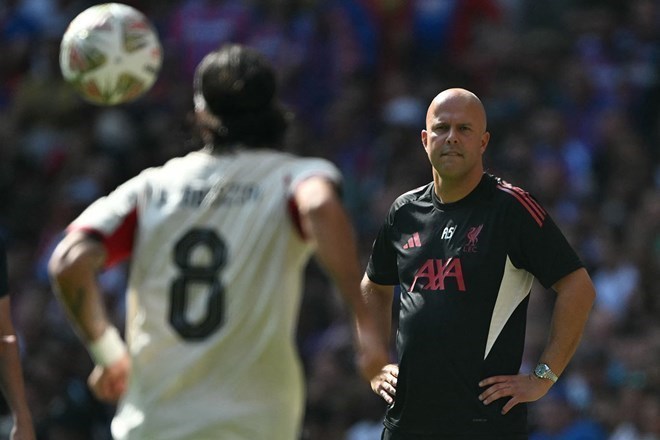
In fact, Slot's side have faced four of the five games with the most long passes this season. That shows that opponents are increasingly exploiting the weaknesses that have become too obvious for the reigning Premier League champions.
So far, The Kop have won only 1 of 4 matches in which their opponents have made 70 or more long passes. This approach helped Sunderland leave Anfield with a valuable point, while Crystal Palace and Manchester United both earned all 3 points when applying the same strategy.
This result reflects a clear trend of the "Red Brigade" under Slot. In 13 Premier League games in which Liverpool's opponents used more than 20% of long passes, the Anfield side have won just 30.8% of their games - a sharp decrease from 71.8% in the remaining matches.
It all started with Robin Roefs' feet in the match against Sunderland. The goalkeeper has made 31 of the team's 53 long passes - the highest number he has made in any game this season. And it has brought the effect Sunderland expected.
One of those passes directly led to the opening goal. Wilson Isidor's aerial dispute left Virgil van Dijk unable to control the situation, creating conditions for Chemsdine Talbi to launch a cool shot.
This season, face-to-face play is increasingly popular in the Premier League. However, Liverpool are the team facing the highest long-distance pass percentage, up to 18.22%, far surpassing Arsenal (15.67%) and much higher than the league average (11.77%).
For Liverpool, this is a significant change from last season, when their opponents only used 12.08% of long passes.
Under Jurgen Klopp, Liverpool have also often faced long-pass rates similar to this season. That number has fallen in his final two seasons in charge, although it has never been as low as it was in Slot's first year.
Looking at Liverpool at the moment, it is easy to understand why many teams choose a deep defensive style of play combined with direct passing. First of all, this approach helps them avoid pressure from Liverpool and exploit weaknesses in the defending champions' pressing system.
Liverpool pressing less effectively because they have less chance to regain the ball in the opponent's half. The Kop's statistics this season on the number of re-els and the number of pressures in the final third have all decreased compared to last season.
According to statistics, Van Dijk and Ibrahima Konate are still defending quite well against long passes from their opponents. Van Dijk's success rate in air combat has increased from 72% last season to 78% this season, while Konate has increased from 70% to 72%. However, both have to participate in about 45% of air battles, and set-piece situations are still a problem for them.


