
Slow income growth, escalating living expenses
Ms. Nguyen Thi Thuy Trang - Deputy Head of Customer Care Department of an electronics center in Phuong Liet ward (Hanoi) - said that she has worked at the company for nearly 7 years, the current salary is 11 million VND/month, nearly double compared to when she first started working.
At 28 years old, married and having a daughter in kindergarten, Ms. Trang said that her current salary must be very basic to ensure expenses and living expenses in the context that the family has to rent a house, her husband's salary is about 8 million VND/month.
If you only hear about working for 7 years, salary doubled, and a little position, everyone thinks everything is fine. But this income level makes it increasingly difficult for me to spend in the context of escalating living expenses and everything in the Capital has set a new price level," Ms. Trang complained.
According to Ms. Trang, just for rent alone, her family spends 5.5 million VND per month. Fixed tuition for her daughter is about 3.5 million VND/month. Plus food, electricity, water, living expenses, total income of about 19 million VND/month of her family is almost not accumulated. Not to mention, Ms. Trang's daughter has congenital respiratory disease, in the months she has to go to the hospital for treatment, Ms. Trang is even more stressed about money.
Not only people with families are tired of balancing income to ensure their lives in the Capital, but many young single workers also find it difficult to hold on if their income does not increase.
Mr. Nguyen Van Nam (from Nam Dinh ward, Ninh Binh province) is currently an employee of a notary office in Ha Dong ward (Hanoi). Graduating in Law from the University of Labor and Social Affairs in 2023, Mr. Nam has been attached to his current job since graduating. During his first time working, Mr. Nam's salary for studying was about 6 million VND/month, his parents agreed to provide additional support so that he could afford rent, living expenses, travel, and food. Up to now, although he has become an official employee, with a salary of about 10 million VND/month, Mr. Nam still lives very hard.
I have to calculate each fixed monthly expense, including rent, food, gasoline, and travel expenses. For expenses such as going out to eat with friends, weddings... I spend about 2 million VND, but almost every month it's not enough. My parents know I'm struggling, so they often send rice, food... even give me extra money. Working for more than 2 years, I still feel too stressed about money, salary is not enough to live on," Mr. Nam said.
Job quality is not high
Ms. Bui Thi Hoai Anh - head of analysis department of a social survey center in Hanoi said that one of the important reasons leading to the situation of young workers having jobs but struggling is the low quality of jobs. Many young workers work in service, processing, and commercial industries... with low starting salaries and slow salary increase schedules. Not to mention, many current job positions are temporary, flexible, and unstable in terms of working hours and income. Businesses tightening costs and optimizing personnel make it easy for workers to fall into the situation of working hours being reduced, bonus cuts or no stable long-term income.
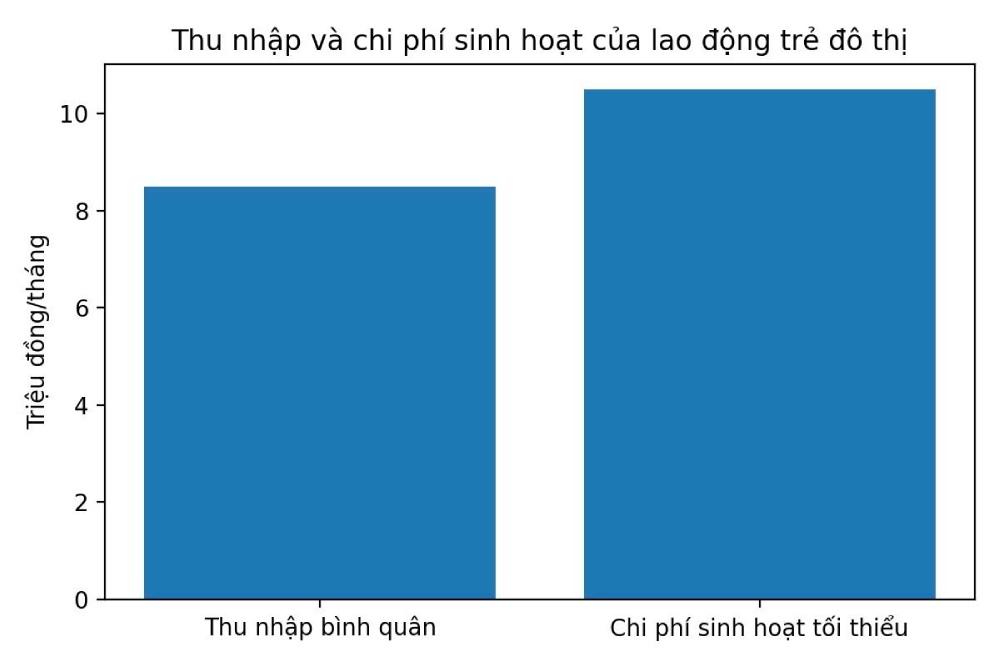
It is worrying that this group of workers is not unemployed to be supported but also does not have enough income to ensure a minimum living standard. This is the "gray area" of the labor market - where workers are vulnerable to economic shocks," Ms. Hoai Anh said.
According to Ms. Nguyen Thi Lan Huong - former Director of the Institute of Social Labor Sciences, the situation of "having a job but not enough to live on" is becoming a social issue of concern, posing many challenges for labor policies - salaries and social security. In large cities, the income of young workers is mainly concentrated at the level of 10 million VND/month, many people face increasing spending pressure over time. Prolonged financial pressure causes many young workers to fall into a state of stress, losing motivation to stick with work. Many people choose to switch jobs continuously, work extra... In the long term, this situation may affect the quality of human resources when workers do not have enough conditions to invest in studying and improving skills - key factors to improve income.
To remove the paradox of "having work but not enough to live on", Ms. Huong proposed that salary policies should continue to be adjusted towards approaching the minimum living standard, correctly reflecting living costs, especially in large cities; it is necessary to improve skills for young workers, helping them access higher value-added positions; it is necessary to expand the social security network for workers with jobs but low incomes.
It's a bit of a bit of a bit of a bit of a bit of a bit.


