
Recruiting strongly qualified workers
At the end of the year, instead of expanding mass recruitment, many businesses in Hanoi choose a streamlined strategy, focusing on positions with professional qualifications, experience and the ability to take on many jobs. This trend is clearly demonstrated through the salary structure, labor qualifications and industry groups that are "heavily" recruited by enterprises.
According to the Hanoi Employment Service Center, in November 2025, the salary segment from 10 - 20 million VND/month will account for 74.5% of total recruitment demand in the area. It is forecasted that in December, this segment will continue to play a leading role, accounting for about 2/3 of the total recruitment positions. On the contrary, jobs with a salary of less than 10 million VND/month are increasingly narrowing, clearly reflecting the trend of businesses prioritizing quality labor, instead of recruiting a large number of simple workers.
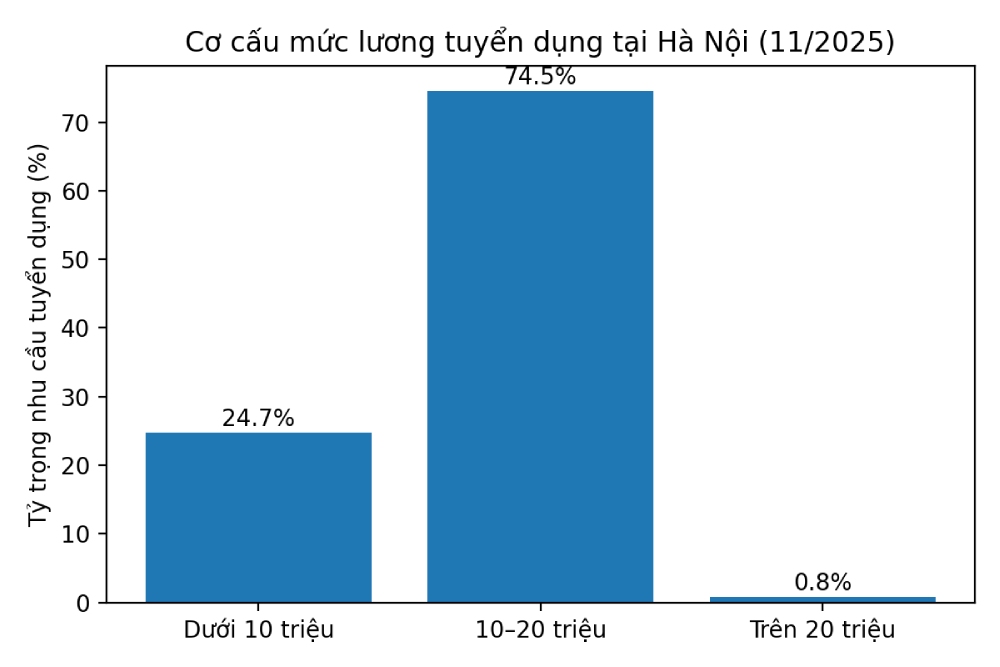
In reality, high salaries are accompanied by increasingly strict requirements on qualifications and skills. According to statistics, 67% of recruitment demand in November 2025 belongs to the group of workers with university and college degrees or higher, concentrated in the positions of technician, sales staff, electrical - electronic engineer, information technology and technical professional services. Meanwhile, the demand for unskilled labor and technical workers only accounts for about 23.8%, mainly in production, sales, protection and domestic service positions.
This shift shows that businesses are willing to pay higher salaries to attract and retain personnel with expertise, experience and the ability to adapt quickly to job requirements. According to the Hanoi Employment Service Center, this is a clear demonstration of the trend of selective recruitment, prioritizing efficiency and added value, instead of expanding recruitment in the low-payment segment.
General trend
From a business perspective, the survey results of Manpower Company show that in the fourth quarter of 2025, the demand for high-quality human resources in Vietnam increased by about 38%, focusing on the fields of information technology, finance - insurance and technical professional services. Vietnam's net employment outlook index (NEO) reached about +37% to +38%, reflecting the fact that businesses are still "heavily" recruiting people with in-depth skills, despite streamlining the apparatus.
Manpower also pointed out that businesses increase recruitment mainly to expand scale (40%), deploy projects or new markets (30%), meet technology development requirements (28%) and add new skills to improve competitiveness (28%). Notably, most of the recruitment demand is to create new job positions, instead of only recruiting replacements, showing a trend of systematic and long-term human resource investment.
Meanwhile, in the opposite direction, the demand for job searches of workers is concentrated in the untrained group, accounting for over 50% of the total number of job seekers surveyed. The group of workers with a university degree or higher only accounts for 17.2%. This "difficulty" between supply and demand has caused the stable job opportunities of unskilled and simple workers to increasingly narrow.
According to Mr. Vu Quang Thanh - Deputy Director of the Hanoi Employment Service Center, the decline in seasonal employment at the end of the year is not only a temporary phenomenon, but reflects the general difficulties of production and business activities. When businesses tighten costs, the most vulnerable group of workers is young workers and students working short-term.

This reality shows that if we do not proactively foster professional skills, digital skills, foreign languages and accumulate practical experience, simple workers will find it increasingly difficult to stay in the labor market. In the context of businesses prioritizing quality over quantity, the Hanoi labor market is sending a clear signal: only capable and adaptive workers can seize sustainable job opportunities.


