Industry lacks labor, industry "frozes" recruitment
According to Lao Dong reporters, since the beginning of the fourth quarter of 2025, in addition to industry groups and businesses that have frozen recruitment, many businesses in Hanoi have increased recruitment to meet year-end orders. The industrial production, processing - manufacturing, logistics, transportation and some essential services sectors have a stable need for additional labor, even increasing slightly over the same period.
On the contrary, many sectors that have "attracted" workers at the end of the year such as retail, fashion, food and beverage services, and event organization are no longer as vibrant as before. Many small businesses operate at a low level, even closing and returning premises due to slow recovery in purchasing power and high operating costs.
Mr. Bui Dinh Hoan - director of a fashion company based in Ba Dinh ward (Hanoi) - said that at the end of this year, his company's 12-store system almost does not recruit workers but redistries the work schedule of the existing staff. The reason, according to Mr. Hoan, is slow sales, hiring seasonal staff will make it difficult for the company due to increased costs for many input steps.
In previous years, during peak years at the end of the year, my company often recruited about 50 more staff to work as seasonal workers for the entire store system. This year, the company decided to calculate and restructure existing personnel to not recruit more people to save costs during the difficult business situation," said Mr. Hoan.
The owner of a fashion store on Nguyen Trai Street (Thanh Xuan Ward, Hanoi) said that in previous years, during Tet, he often hired 4-5 more sales staff per shift. "This year, the store only kept old staff, I don't dare to recruit more because the number of customers has decreased, the cost of premises and labor has increased," this person said.
According to the Hanoi Employment Service Center, the 3 most recruited industries at the end of 2025 are trade - services, processing - manufacturing and construction industry.
Trade - services is the industry group with the largest recruitment demand, accounting for the highest proportion in the human resource demand structure in Hanoi with 55.1% of total demand.
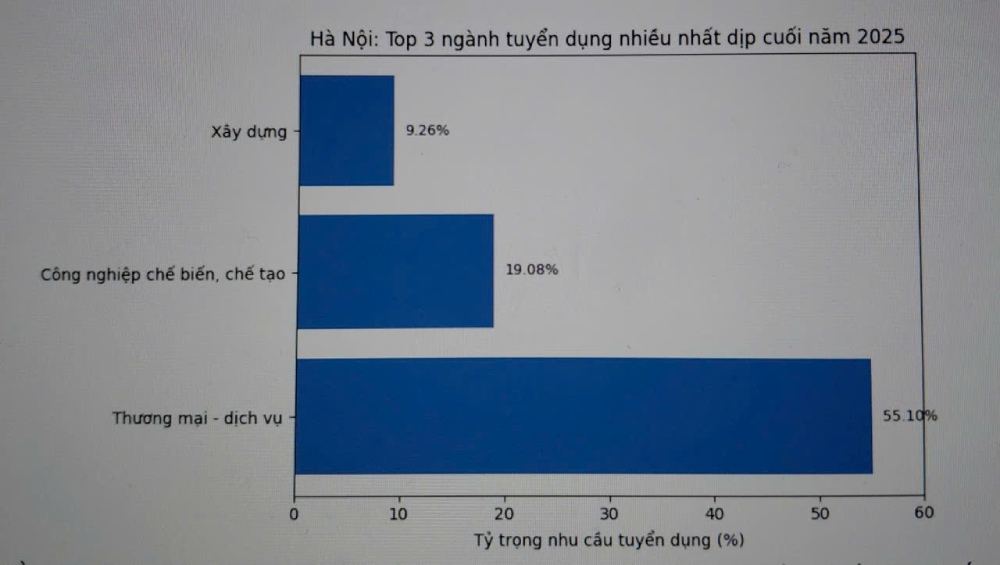
The processing and manufacturing industry with many manufacturing industries still retains a large human resource attraction, especially in fields such as textiles, electricity - electronics - refrigeration - mechanics..., because of the need to work overtime to serve year-end orders. Human resource demand is expected to grow the strongest in industries such as textiles, footwear, electricity - electronics - refrigeration and mechanics.
The demand for construction human resources has increased sharply as Hanoi has accelerated the progress of infrastructure projects, civil works and socio-economic projects in the area with recruitment needs in December 2025, accounting for 15.2%.
In addition, the 3 recruitment majors at the end of 2025 in Hanoi are administrative activities and supporting services; science - technology (specialized majors) and finance - banking - insurance.
Recruitment requirements are increasing
Nguyen Ngoc Linh - a 4th year student majoring in Investment Economics at the National Economics University - has worked at a construction company in Hanoi for 3 months. Ms. Linh said that her job is to manage expenses.

This is my extra job outside of school hours, the purpose of both earning more income and being a place to study, accumulating more experience and skills. This year, the economy is difficult, the company plans to cut staff, so I am proactively looking for extra work during Tet, in case I have to take a day off from work right now," said Ms. Linh.
Mr. Vu Quang Thanh - Deputy Director of the Hanoi Employment Service Center - said that by the end of 2025, seasonal jobs will not only increase but the level of competition will also increase: "Same position but many people register, forcing employers to screen more carefully. First-year, second-year students or young workers with no experience will have more difficulty accessing jobs. In addition, even with seasonal jobs, businesses also set higher requirements than before with accompanying soft skills.
In addition, according to a survey by the Hanoi Employment Service Center, businesses are currently prioritizing recruiting people who can " start work right away", limiting training and management costs. This trend causes many disadvantages for young workers and students if they lack practical skills.
From this reality, Mr. Thanh recommends that young students and workers should not only rely on short-term seasonal jobs. Proactively improving professional skills, digital skills, foreign languages and accumulating practical experience early on will help workers improve their competitiveness and reduce risks when the market fluctuates.