
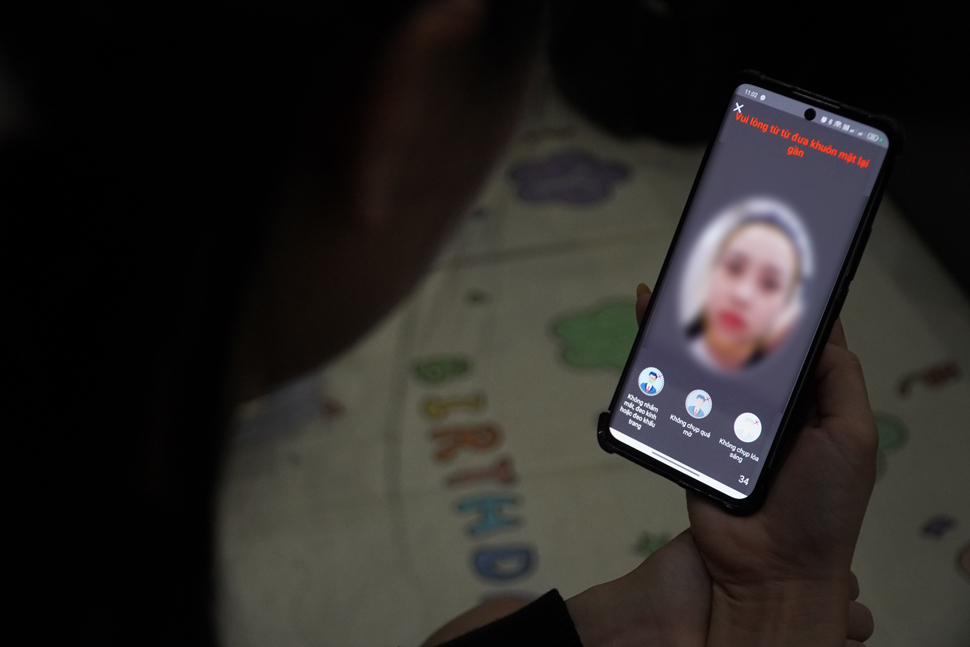
In recent days, information about mobile subscriber authentication continues to receive attention from many users. Many people expressed concern when hearing about the possibility of service restrictions if they do not have time to update information, while they themselves still do not really understand whether they are subject to authentication or not.
Talking to Lao Dong, Ms. Tran Thi Hanh (Hai Phong) said that she only grasped information about this regulation through friends sharing. As an online business person, she uses her current phone number to contact customers, receive orders and authenticate many service accounts.
I have used this number for nearly 10 years, associated with almost everything, from banking to social networks. I heard that if it is not verified, the service may be stopped, so I am quite worried, but I am not sure if I have to do it immediately or not," Ms. Hanh said.
According to her, the most worrying thing is not the authentication operation but the risk of communication being interrupted without time to react. "Just not being able to call for a day can lead to losing customers. If it is double-locked, almost everything is stalled," Ms. Hanh shared.
Similarly, Mr. Nguyen Van Tung (Hanoi) said that he had witnessed acquaintances being interrupted in contact because they had not had time to update their subscriber information.
At that time, my friend couldn't call and didn't understand the reason, later I found out that it was because the information was not accurate. This time I heard that there was more facial verification, so I proactively researched early to avoid falling into a similar situation," Mr. Tung said.
According to records, many users still do not clearly distinguish between "checking information" and "compulsory verification", leading to anxiety or delays in implementation. This may cause subscribers to fall into the area of service restrictions if they do not keep up with notifications from the system.
According to VinaPhone network operator, not all subscribers are interrupted if they are not verified immediately. For numbers that have been standardized and the information matches the national database, users only need to check when there is a notification from the system.
However, in cases where verification has not been completed or data is not synchronized, subscribers may be restricted from services according to the roadmap. Initially, it is temporarily suspended for outgoing calls, then it may be suspended in both directions if not supplemented in time.
Notably, if this situation persists, the phone number may be revoked according to regulations. At that time, users not only lose contact but also risk losing the right to use the phone number that has been attached to many personal services for a long time.
According to network operators, authentication is not only aimed at ensuring subscriber management but also helping to protect users themselves during use. When the information is fully verified, the risk of being exploited or disputes arising will be significantly reduced.
Therefore, users should proactively check their subscriber information through the network operator's application or VNeID, and at the same time carry out verification when requested to avoid service interruption.
In the context that phone numbers are increasingly associated with many important services such as banking, e-wallets or business, being interrupted or having the number revoked can lead to many consequences. Proactive early verification is considered a way to help users ensure smooth communication and limit risks.


