
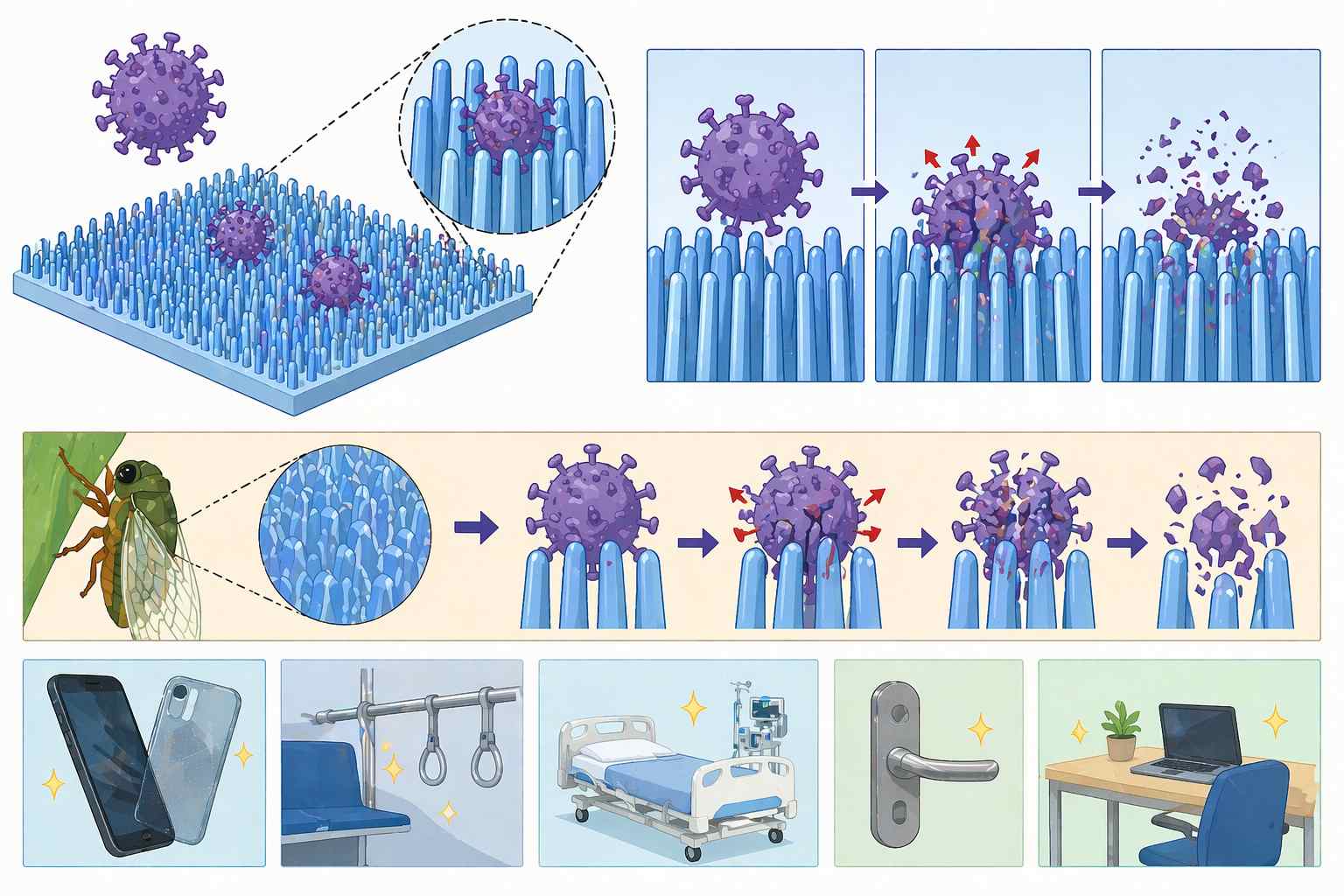
A group of scientists led by Elena Ivanova has developed a nano-structured plastic membrane capable of destroying viruses in direct contact.
Research published in Advanced Science shows that new materials can break the outer shell of viruses by physical action, instead of using traditional disinfectants.
According to the research team, surfaces such as handrails, phone screens, desks or medical devices can become places to store many dangerous pathogens. Viruses can spread when people touch contaminated surfaces and then put their hands on their eyes, nose or mouth.
Current disinfection methods mainly rely on chemicals. However, they can be harmful to the environment, damage equipment, or reduce effectiveness over time.
To solve this problem, the research team developed a thin acrylic membrane containing thousands of microscopic nanostructures simulating insect wings surfaces in nature.
These nanostructures can stick to the outer shell of viruses and stretch until the virus is broken.
In tests with the human parainfluenza virus type 3 - an agent that can cause bronchitis and pneumonia, it was found that about 94% of the virus particles were severely damaged or fragmented after an hour of contact with the material.
Scientists discovered that the distance between nanostructures plays an important role in the effectiveness of destroying viruses. A distance of about 60 nanometers yields the best results.
The research team believes that this material can be applied in many fields such as hospital equipment, public transport, food packaging or surfaces that frequently come into contact.
However, scientists say more research is still needed to assess the durability and long-term effectiveness of materials in the actual environment.


