
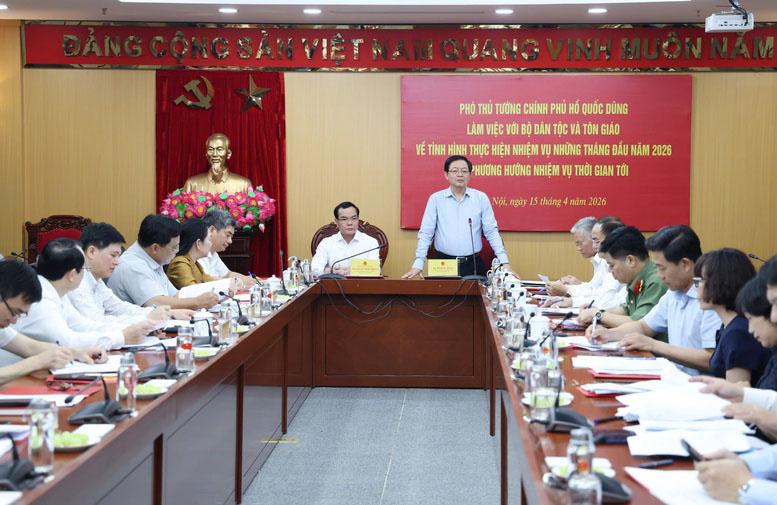
On the afternoon of April 15, Deputy Prime Minister Ho Quoc Dung chaired a meeting with the Ministry of Ethnic Minorities and Religions (DTTG) on the results of task implementation in the first months of 2026 and directions for the coming time.
Attending the meeting were Minister of DTTG Nguyen Dinh Khang; Deputy Minister of Home Affairs Vu Chien Thang; Deputy Chairman of the Government Office Don Tuan Phong; representatives of the Ministry of Public Security, Ministry of Finance, Ministry of Agriculture and Environment, Ministry of Justice...
At the meeting, Deputy Minister of EMC Y Vinh Tor said that in the first quarter of 2026, work was managed to ensure discipline, effectiveness, and efficiency; closely following the mottoes "3 more", "6 clear", "4 real", contributing to consolidating the belief of ethnic minorities and religious organizations.
Institutional building is identified as a key step to unlock resources, while shifting thinking from "tight management" to "effective management", strengthening decentralization and delegation of power to localities...
Regarding social security, the Ministry of DTTG has summarized opinions and submitted them to the Prime Minister for consideration of expanding the subjects of support for removing temporary and dilapidated houses for Agent Orange/dioxin victims of the F2 generation, ensuring the spirit of "leaving no one behind".
The Ministry of DTTG proposed that the Government allocate sufficient resources for localities to implement the National Target Program for the period 2021 - 2030, and at the same time prioritize solving 5 essential groups of issues including: residential land, housing, production land or alternative livelihoods, domestic water and essential social infrastructure.
Concluding the meeting, Deputy Prime Minister Ho Quoc Dung acknowledged the efforts of the Ministry of DTTG in the context of being a newly established agency from March 2025, quickly stabilizing its organization and implementing many important tasks.
The Deputy Prime Minister also pointed out that the progress of building and promulgating legal documents is still slow, not keeping up with practical requirements. This is a major "bottleneck", directly affecting policy implementation, especially when many national target programs are being implemented simultaneously.
The Deputy Prime Minister requested to comprehensively review the legal system related to ethnic minorities and religions; promptly amend and supplement it in a synchronous, unified, and easy-to-implement direction. The amendment of the Law on Belief and Religion needs to be carefully prepared, ensuring both respect for freedom of belief and meeting management requirements in the new situation.
Administrative procedure reform is identified as an urgent task. According to the Deputy Prime Minister, the situation of "too many circulars and guidelines" makes localities confused and difficult to implement. Therefore, it is necessary to cut down and simplify procedures, remove unnecessary regulations, and build a clear and easy-to-apply guidance system.
The Deputy Prime Minister also requested the MOET to closely follow reality, firmly grasp the lives, thoughts, and aspirations of ethnic minorities and religious organizations; proactively detect and promptly handle problems arising right from the grassroots level, contributing to maintaining social stability.
For national target programs in ethnic minority and mountainous areas, the Deputy Prime Minister emphasized that substantive effectiveness must be the highest measure. The implementation should not chase after disbursement achievements but should focus on solving essential issues such as housing, livelihoods, clean water, health, education, ensuring that people's lives are clearly improved.
Along with that, it is necessary to improve the quality of the contingent of cadres working in ethnic minority and religious affairs at the grassroots level; strengthen training and fostering, and have mechanisms to attract capable cadres to difficult areas.


