
Located at the southern gateway of the Capital, Binh Vong village (Thuong Tin commune, Hanoi) still retains the familiar shape of a Northern countryside village with village ponds, ancient communal houses and soft curved tiled bridges.
Binh Vong tiled bridge shows the crystallization of cultural life and preserves the memories of the land of studiousness and outstanding people for centuries.
According to ancient feng shui beliefs, Binh Vong is located on the land of "quần sơn la bái". Legend has it that the famous Ta Ao person once passed by and identified this as a land of convergence of vitality, inevitably producing talent.
Since the 16th century, the village has been famous for its academic tradition, many people have achieved high degrees and participated in court affairs such as: Tran Lu, Nguyen Huu Dang, Le Trong Thuong, Le Tong Quang...
In the book "Dai Nam nhat thong chi", Binh Vong is recorded as a large village with a large population, bustling markets, associated with the saying "Nam nhat cho Bang, Voi". The Nom name "Bang" also reflects the characteristics of flat terrain, convenient for trade.
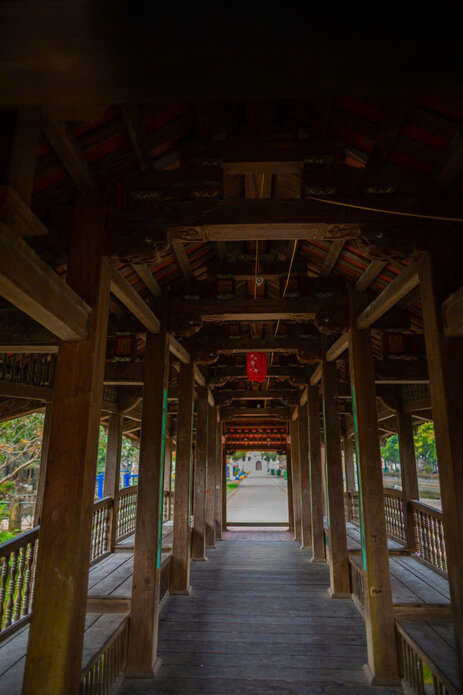
From very early on, the people here were famous for the profession of cooking lotus wine to offer to the king, mentioned by Nguyen Trai in "Du dia chi". In the ancient space of the village, the Binh Vong communal house - Bao Quoc pagoda complex is located next to a large village pond, creating a harmonious overall.
The ancient tiled bridge spanning the water surface is a special highlight, believed to have appeared from around the 17th - 18th centuries, at the same time as the village communal house. The bridge has the "thượng gia hạ kiều" architectural style, consisting of 7 compartments, of which 5 main compartments are clear, and the first 2 compartments are transitional spaces.
Solid ironwood structure, frame frame frame following the rường stacking style, chiêng rack. Roof tiled with hài nose tiles, curved heads creating a thanh thoát (elegant/elegant) look.
The carved details of dragons, chrysanthemums, peach blossoms or the words "Van" on the bars and levers are both sophisticated and reflect the religious life of the ancients. Experiencing historical upheavals, Binh Vong tiled bridge was heavily damaged in the war, almost leaving only traces. People then built a temporary concrete bridge to serve daily life.
In 1992, the bridge was repaired but not completely restored. In 2004, thanks to the joint efforts of the community and local authorities, the bridge was restored to its old shape and exists to this day.
During the resistance period, Binh Vong village carried out land clearance, many works were destroyed to avoid enemy occupation. The village communal house was no longer intact, only 3 precious stone steles remaining, recording ancient village and commune conventions such as punishing theft and preventing abuse of power.
Professor Tran Quoc Vuong once came here to research and translate the entire content, assessing it as a valuable source of information about the history of Vietnamese villages and communes.
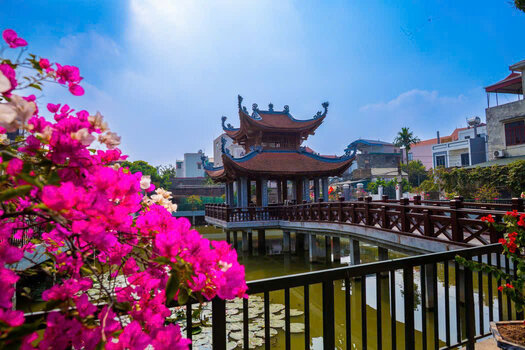
Today, although the administrative function of the village communal house is no longer the same as before, this place is still a familiar living space for the people. The new water communal house was built from the contributions of the people and continues to enrich the community cultural life.
Not only is it an architectural heritage, the bridge is also a symbol of the endurance of memories and the cultural identity of the Northern countryside over time.


