
Children are very sensitive and obedient
On Saturday evening, looking at Cu Bin holding a jar of sour pork that had begun to be heavy, going to the middle of the living room to show off his savings of more than 300,000 VND, I just smiled and praised my son for being good.
But the very next afternoon, when the two mothers and daughters stopped by the supermarket, I caught Bin standing hesitantly for a long time in front of the toy shelf. He stared intently at his favorite mini racing bike, his hand constantly caressing his shirt full of jealousy but resolutely refused to take it. When I suggested that the money in the jar was enough to buy that item, the 7-year-old child just looked up at me hesitantly and then said he had to save, spend all the money and what if his family ran out of money later, spending money makes him very scared.
Those innocent words made me stop for a long time. Looking back at the memories of the past time, I was startled to realize that I had unintentionally sown anxiety in my child's head with familiar sayings such as "don't spend money dirty", "send money to mom to keep, don't spend it all later" or "we don't have money to buy those things". The initial purpose was just to teach children to know how to save, but the rigid way of conveying it made the child develop a fearful psychology, considering spending on themselves as a mistake.
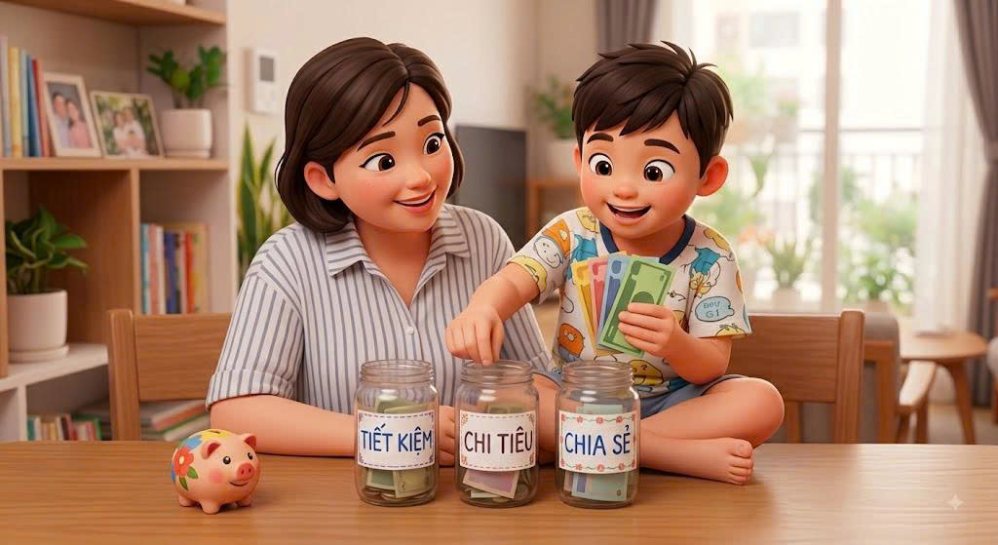
That evening, after thinking carefully, I decided to change the method. I sat down next to my child, together opened the piggy bank jar and prepared three transparent glass jars labeled: "Saving", "Spending" and "Sharing". I gently explained to my child that money is a companion, not fear, and saving is just a way to keep a part to prepare for bigger goals, not a forbidden rule. The money was divided equally into three parts: one part for long-term plans, a small part for charity or buying gifts for relatives, and the rest was entirely up to my child's decision.
Adults need to set an example
In the days that followed, the practical financial lesson began to enter the lives of the two mothers and children. Bin used the money in the spending jar to buy a plastic robot at the school gate, but after only two days of playing, the cheap toy broke its arm and was thrown around.
Seeing my child discouraged and sighing because of regretting money, I did not harshly criticize. Instead, I talked with my child to let him learn a lesson, teach him how to ask two questions before each time he takes out his wallet: is this item really "needed" or just "wants" and is it worth the money spent or not.
I myself also started to set an example right in daily activities. Standing in front of an expensive fruit juicer that I liked, instead of complaining that I didn't have money, I proactively told my child that I really like this item but this month I need to prioritize the budget for my child's studies, so I will plan to save and buy it next month. My child gradually realized that even adults must consider and make a planned choice, not because of lack or fear.
At the end of the year, after days of patient accumulation, Bin's savings jar was enough to buy the Lego assembly set that he had long dreamed of. The moment he personally held the money to pay the cashier and hugged the brand new toy box to his heart, his eyes lit up with pride.
Looking at the joy filling my child's face, I know he has understood the true value of money: saving is not giving up enjoyment, but delaying a small joy to touch something more wonderful.
I am no longer afraid every time I mention money, but have learned to proactively consider, choose and use money as a healthy tool to serve my own life.


