
On June 23, the National Economics University held a ceremony to receive the quality accreditation certificate of the International Education Quality Accreditation Organization FIBAA for 21 training programs.
Accordingly, with 21 programs just recognized, the total number of training programs of the National Economics University that have been accredited according to domestic and international standards has increased to 84 programs, accounting for nearly 49% of the total number of existing training programs of the school.
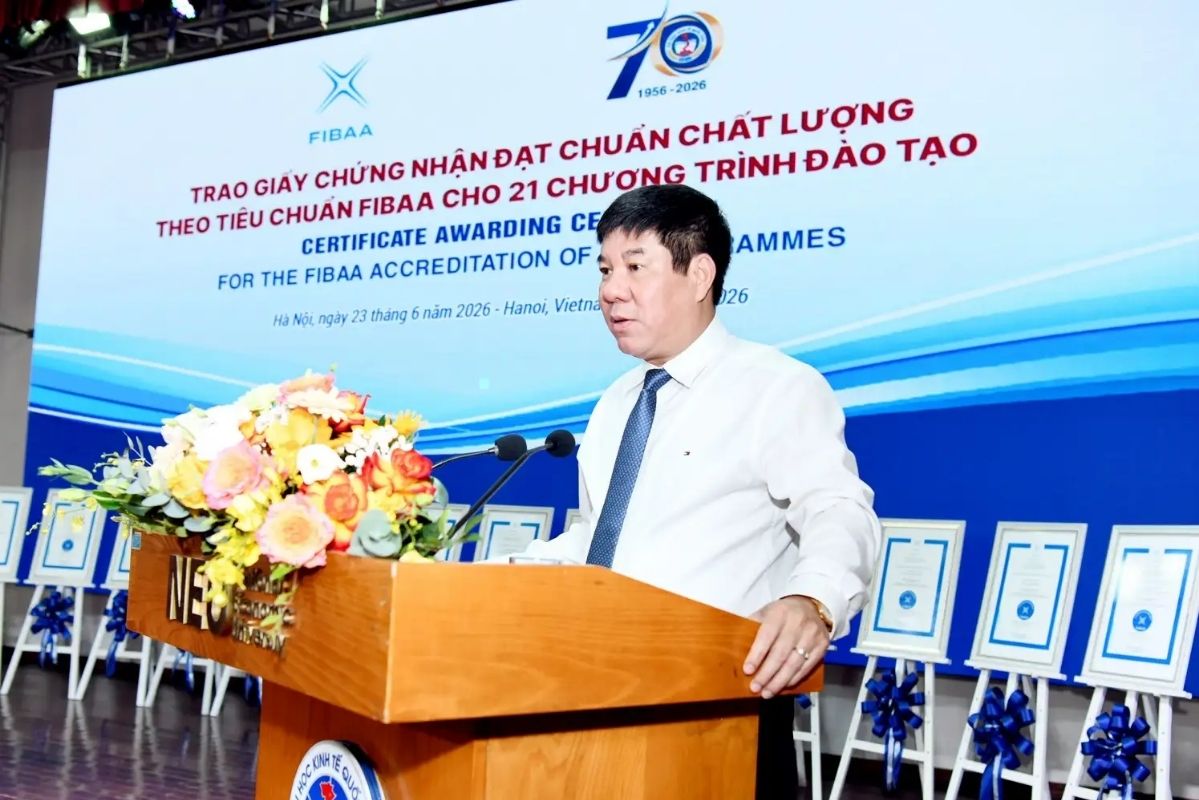
Speaking at the ceremony, Prof. Dr. Huynh Van Chuong - Director of the Department of Quality Management, Ministry of Education and Training - emphasized that the significance of this result is not only in the numbers but also reflects a strong shift in the quality management thinking of the National Economics University, from "accreditation for recognition" to "accreditation for continuous improvement".
This is also a requirement consistent with the spirit of university autonomy associated with accountability and improving the quality of substance" - Prof. Dr. Huynh Van Chuong shared.
Highly appreciating the role of higher education institutions in the context of implementing Resolution No. 71-NQ/TW on breakthrough development of education and training, Prof. Dr. Huynh Van Chuong said that universities are not only places to train human resources but also centers of knowledge, research and contribution to national development.
Prof. Dr. Huynh Van Chuong also recommended that higher education institutions continue to use quality accreditation as a strategic management tool, focusing on improving quality standards, managing according to output results and building a sustainable internal quality assurance system; and at the same time acknowledge and highly appreciate FIBAA's companionship in the process of improving quality and promoting international integration of Vietnamese higher education.
At the ceremony, Assoc. Prof. Dr. Bui Duc Tho - Secretary of the Party Committee, Director of the National Economics University - shared that in the context of global higher education having many strong changes, the National Economics University identifies ensuring and improving quality as one of the important pillars in the development strategy. To date, out of a total of 172 training programs of the University, 84 programs have met the standards according to domestic and international standards; specifically with the results awarded this time, the University has 36 programs meeting FIBAA standards and is continuing to implement the accreditation of 32 other programs, thereby becoming one of the higher education institutions with the leading number of FIBAA standard programs in Vietnam.
According to Assoc. Prof. Dr. Bui Duc Tho, the greatest value of accreditation lies not only in the achieved figures or certifications, but also in the process of reviewing and comprehensively improving training activities, completing curricula, innovating teaching methods, improving the quality of the teaching staff, strengthening cooperation with businesses and international organizations, and creating an increasingly better learning environment for learners.

Representative of the International Education Quality Accreditation Organization FIBAA, Ms. Friderike Odrowski - Project Manager - emphasized that accreditation is not only a tool to ensure quality but also a driving force to promote innovation, development and improve the competitiveness of higher education institutions in the context of digital transformation and international integration.
According to Ms. Friderike Odrowski, the accreditation results this time are proof of the strategic vision of the University's leadership, the effectiveness of the internal quality assurance system as well as the efforts and close coordination of the staff, lecturers and students.
FIBAA is a quality assurance organization of the Swiss government with headquarters simultaneously in Germany and Switzerland, performing the work of accrediting, evaluating and developing educational organizations and programs around the world in social and human sciences, law, governance and economics.


