
Vietnam before the threshold of growth model transformation
From the production and trade platform, Vietnam is strongly shifting to high value-added industries, digital innovation and services. The rapid growth momentum is leading to an increasing demand for leadership and management capacity, while the requirements of the market and the quality of human resources today are still a gap.
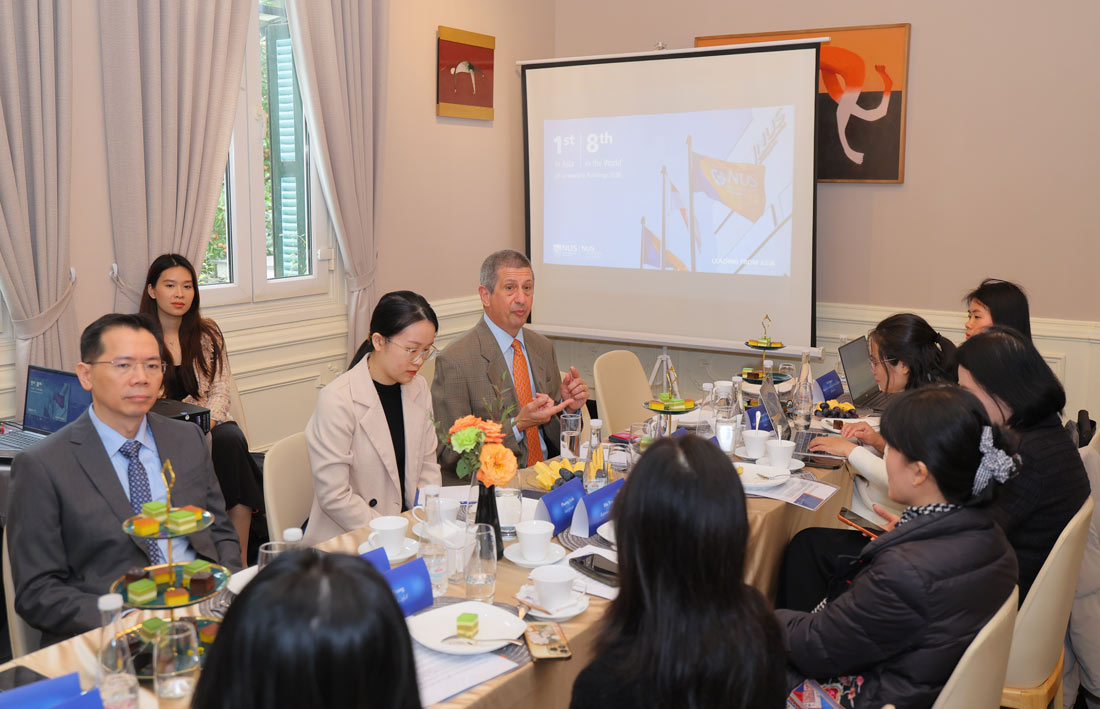
Sharing with the press, Honorary Professor Andrew K Rose - Rector of Business School - National University of Singapore (NUS Business School) - said that he has had a special connection with Vietnam for more than 20 years. Not only impressed with culture and people, Hanoi is also a place he regularly returns to study and observe the economic transformation of Vietnam.
According to Professor Andrew K Rose, the goal of making Vietnam a high-income country by 2045 is completely feasible if available advantages are utilized, including a young population, strong aspirations to rise up and the increasingly clear commitment of the Government to education, innovation and international integration.
However, he emphasized that to achieve this goal, Vietnam needs to shift its growth model towards a more sustainable direction. “To achieve long-term growth, Vietnam needs to shift from a model based on cost advantages to a model based on productivity, innovation and global competitiveness” - Professor Rose said.
People and leadership skills are key
According to the Rector of Business School - Singapore National University, Vietnam's transformation process reflects the general trend of ASEAN, as economies are shifting to a development model based more on knowledge and innovation.
To maintain the development momentum, the key factor is to form a new generation of business leaders - people who are capable of grasping regional trends, taking advantage of cross-border opportunities and effectively coordinating between public policies and innovation of the private sector.
Vietnam is having strong economic growth, foreign investment capital continues to increase, along with the rise of the brave middle class that is reshaping domestic demand. Not only is it growing rapidly, the Vietnamese economy is also becoming more mature" - Professor Andrew K Rose emphasized.
According to him, for Vietnamese organizations to succeed in the next development phase, business leaders need to have regional vision, the ability to recognize new opportunities, take advantage of international links, and maintain flexibility and deep understanding of the domestic context to adapt to an increasingly fierce global competitive environment.

From personal experience, Mr. Bui Huy - a former NUS student - believes that studying at NUS helps learners access modern management thinking in a multicultural environment. “The learning program not only provides knowledge, but also trains decision-making skills based on data and regional thinking - which is very necessary for Vietnamese businesses when expanding to international markets” - Mr. Huy shared.
Education, research and long-term cooperation prospects
Another pillar emphasized by NUS Business School is the role of higher education and research and development (R&D) in the innovation ecosystem. According to Professor Andrew K Rose, R&D does not only take place in laboratories but needs to be closely connected with businesses and the market.
He believes that basic research - usually funded by the State and applied research from businesses - will only be truly effective when linked through universities, which play a role as knowledge and coordination centers. “Without linkage, research will be difficult to transform into products and services that bring economic value” - he said.
With 60 years of development, from 21 initial students to more than 6,000 current students and a network of more than 50,000 alumni globally, NUS Business School identifies its mission as training leaders who understand Asia, capable of creating positive impacts for the region and the world. The school is currently ranked 8th globally according to QS, with outstanding strengths in research and academic staff.
In relations with Vietnam, NUS Business School wishes to become a long-term academic partner, accompanying in developing leadership, management and innovation capabilities. Cooperation forms include Master of Business, Master of Finance programs, short-term training courses for management teams, as well as research and academic exchange cooperation. The school also expands access to education through many scholarship programs.
According to Professor Andrew K Rose, summarizing these efforts shows the increasingly close link between Vietnam's development priorities and the focus of NUS Business School in developing a leadership team in Asia. As Vietnam enters the next growth phase, NUS's programs are ready to contribute to narrowing the human resource gap, supporting Vietnamese organizations to realize their ambitions to reach out to the region and globally.


