Difficult to fill
Mr. Luong Duc Minh - owner of a private hospital system in Xuan Tao ward (Hanoi) said that for nearly 10 years of operating the health sector, he has always had a headache because of shortage of personnel positions. Notably, the difficult recruitment positions for Mr. Minh's business do not come from the situation of shortage of people, few people, but also from the reality: Having personnel but "few people willing to work".
According to Mr. Minh, even with the nursing position, his hospital system at times "struggles" to recruit enough to meet demand. "There were times when we lacked and prolonged the nursing industry's human resources, pressure over pressure when branches lacked both "heads" and "shift quality". The personnel group chose public hospitals or beauty hospitals, and the group said that the income we offered was not commensurate. In the context that Vietnam currently only has about 14–15 nurses/10,000 people, lower than many countries in the region, the common consequence is increased workload/shift, greater exhaustion levels, leading to a downward spiral of resignation – shortage of people – overload – resignation," Mr. Minh analyzed.
Notably, according to Mr. Minh, the shortage of human resources for this occupational group cannot be "compensated" with general labor, nor can it be easily filled with short-term training.
Also facing difficulties like Mr. Minh, Ms. Nguyen Ngoc Anh - Director of TMT Software and Digital Transformation Services Company (Ba Dinh ward, Hanoi) said that for the past 3 years, every year her company has been "thirsty" for technology human resources.
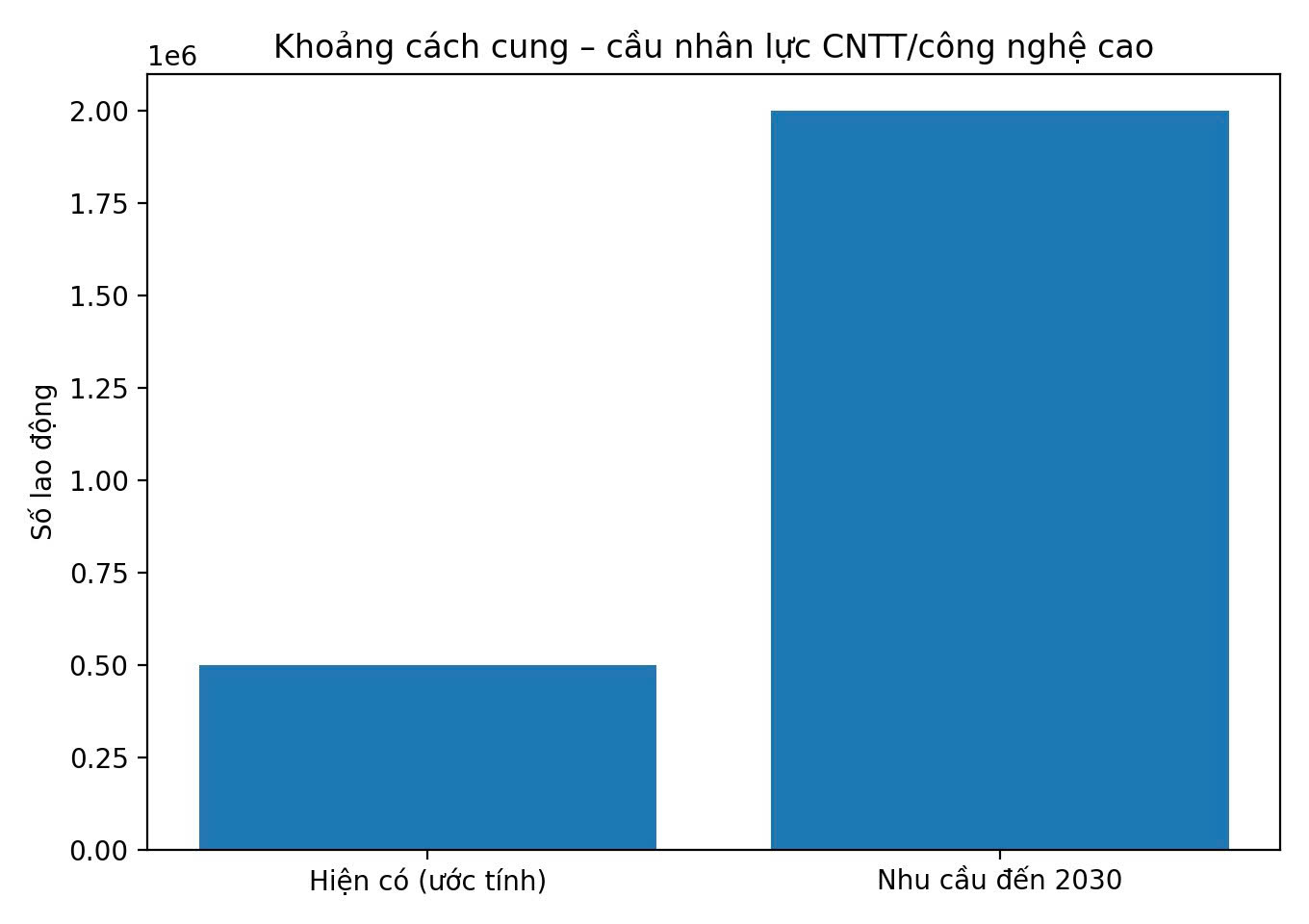
In particular, the demand for digital transformation is heating up the market in positions of software engineer, data, AI, network security, digital infrastructure operation. I imagine that we train human resources in this industry that do not meet market demand. In particular, the bottleneck is that "high-tech human resources" not only need programming skills, but also need system thinking, security, product operation and understanding of industry problems," Ms. Ngoc Anh said.
Pointing out" industries thirsty for human resources, Mr. Vu Quang Thanh - Deputy Director of Hanoi Employment Service Center said that in addition to the two prominent groups above, many localities/enterprises are still lacking human resources in the electrical engineering - automation industry with high qualifications, industrial equipment maintenance engineering, warehouse operation logistics - supply chain, welders/industrial electricians meeting standards. In which, jobs in specific conditions (toxic, shifty, far from home) are even more difficult to recruit people even though the salary can be up to tens of millions of VND/month. From there, these professions often encounter "dilemma": nominal salaries increase but the total burden (time, health, occupational risks, promotion opportunities) makes the supply unsustainable.
Businesses increase incentives to retain special personnel
Ms. Nguyen Thi Lan Huong - former Director of the Institute of Social Labor Sciences analyzed that in the current labor market context, with specialized labor groups, wage increases are necessary but not enough. Businesses often have to redesign general remuneration according to 4 classes.

Regarding salary and bonuses, it will be based on the market and the difficulty level. Businesses should build a competitive basic salary level, avoiding the situation of "recruiting and then losing due to a difference of a few million"; having shift/harmful/return allowances paid transparently according to formulas; on-demand bonuses, quality KPI bonuses; contract signing bonuses or retention bonuses according to the 6-12-24 month mark, reducing the risk of "picking jobs after training".
Regarding "successful" welfare related to housing, health, and family. There should be official residences/ rental support, especially for nurses, technicians, workers working far from the center; expanded health insurance, periodic examination packages, mental health care; family support such as childcare allowances, tuition fees for children, sickness/happy hour assistance...
Regarding the "commitment" career path and training, the competency map is linked to a clear salary frame; funding certificates (network security, cloud, data; or medical professional certificates), accompanied by a reasonable working commitment to avoid leaving after training; salary-based learning policies and cooperation with vocational schools/universities: businesses order skills, receive internships early, recruit before graduation.
Regarding working conditions to reduce "invisible costs" of the profession, businesses prioritize arranging to reduce administrative work by technology/procedures, arranging compensatory leave in accordance with the law, increasing occupational safety; creating flexible time conditions - working remotely, building a culture of evaluating according to efficiency.