
Artificial intelligence (AI) is gradually becoming a familiar tool in students' learning, research and work. From searching for materials, summarizing information to supporting reporting, planning study..., AI brings many utilities and helps learners save time. However, along with the rapid development of technology, the question is how should students use AI to avoid dependence and fall behind in the new learning and working environment.
AI is a supporting tool, not a substitute for thinking
Truong Quoc Khanh, a 3rd year student majoring in Auditing in Ho Chi Minh City, said that he regularly uses AI tools to support learning and research. However, the male student believes that AI should only be considered a supporting tool, and cannot replace the thinking ability of learners.
I also often use AI in learning, but I should not abuse it, because that will make myself less thoughtful," Quoc Khanh shared.
According to the male student, AI is currently mainly used by him to serve scientific research, search for documents and answer questions in both learning and daily life. However, to exploit it effectively, users need to clearly understand how this tool works.
First, we must understand what AI is, learn how to use it and commands to exploit it effectively. If used reasonably, AI will provide a lot of support in learning and life," Quoc Khanh said.
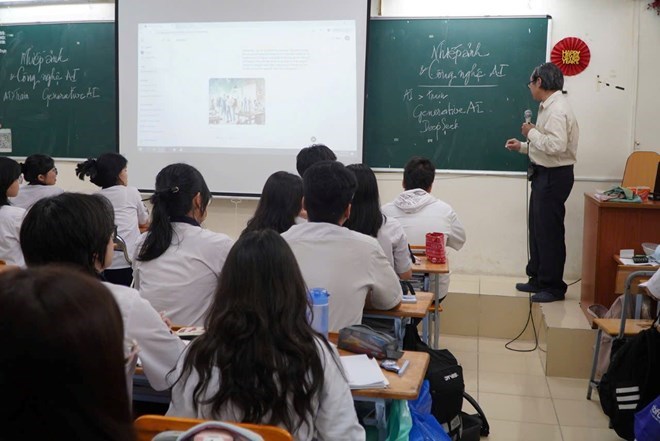
Sharing the same view, Thuy Trang, another student, said that AI brings many new sources of information and approaches, but learners must know how to select and verify instead of completely believing in the results created by AI.
I think AI will help me find a lot of information, but not all information is correct, I also have to know how to select. It gives me many directions, many approaches, and I have to think, learn more to verify for accuracy. Sometimes AI is also not correct," Thuy Trang shared.
According to the female student, she currently often uses many AI tools at the same time in learning to refer to and synthesize information.
For the same question, each tool will give a different answer. I will summarize it to create a new idea, and from there develop further," Thuy Trang said.
Thuy Trang assessed that AI helps increase creativity, expand perspective and support faster access to information. However, the most important skill is still knowing how to compare, verify and use information selectively.
Students need to learn how to test AI
Last weekend, Hong Bang International University organized a scientific conference "The impact of AI on the Vietnamese labor market", which raised the issue of how students need to be prepared to not be passive in the face of the AI wave.
At the conference, Assoc. Prof. Dr. Phuoc Minh Hiep - Head of the Faculty of Economics - Management, Hong Bang International University, said that the impact of AI is not fixed, but depends on how people adapt to technology.
The ultimate impact of AI is not fate, but depends on our response strategy," he emphasized.
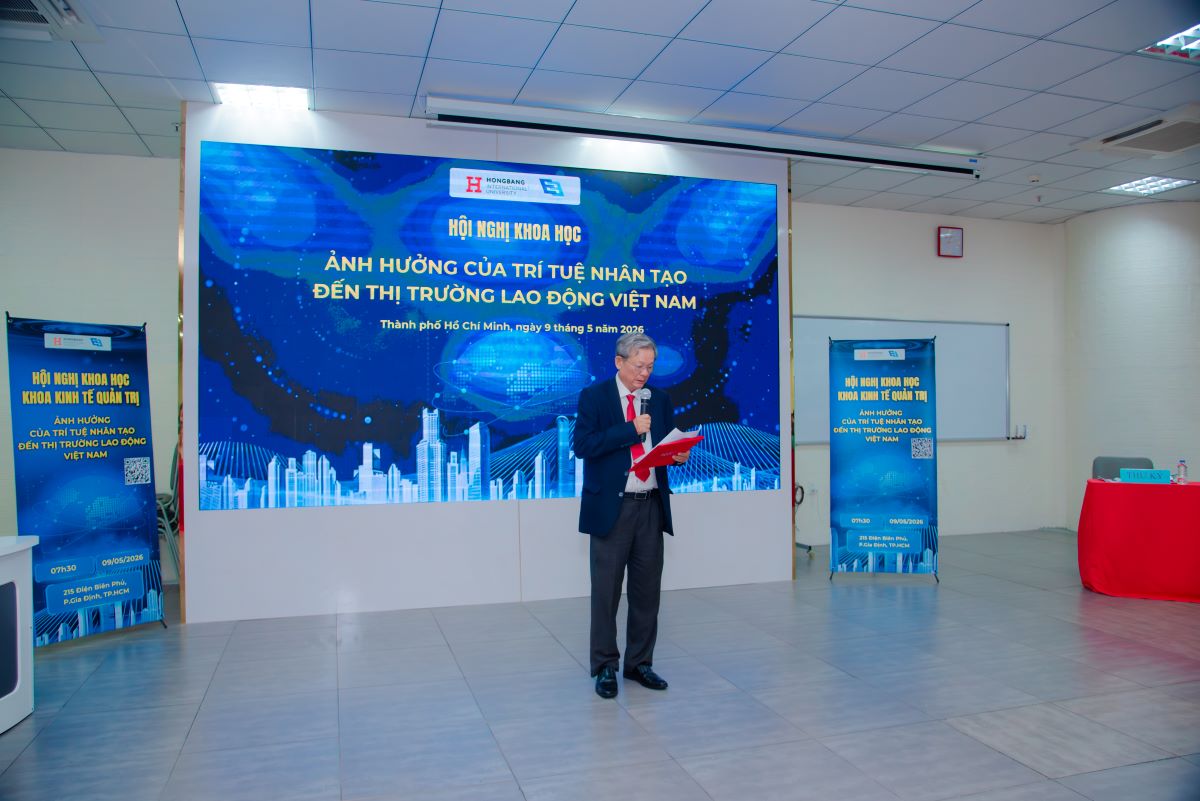
According to Mr. Hiep, higher education today cannot just stop at imparting knowledge or available professional processes. In the context that AI can write reports, analyze data or support decision-making in a short time, the value of workers lies in their ability to understand the context, raise the right issues, verify information and make responsible choices.
Therefore, the requirement for higher education is not only to add AI tools to the curriculum, but also to train students' adaptive capacity. Learners need to know how to use AI, and understand the limits of the tools, know how to evaluate the results created by AI, and coordinate human capacity with technology.


